
A back-pain trial reported mobility and disability gains with supervised core exercise. See the selective benefits and questions about lasting results.





A trial news summary dated November 19, 2026 reported better lumbar mobility and disability outcomes with two supervised core-exercise programs than with advice alone. The study involved adults with chronic mechanical low back pain. The summary identified the research as a 2026 paper in BMC Sports Science, Medicine and Rehabilitation.
The comparison tested suspension-core exercise against pressure-biofeedback-guided exercise and advice-only care. Suspension training had additional advantages on selected measures of movement and endurance. It did not outperform biofeedback across every outcome.
The development adds a comparison between two supervised approaches. Its most useful message is about the pattern of results: pain, mobility and disability did not all distinguish the programs in the same way.
The broader idea of using structured exercise for persistent back pain predates this trial. A secondary account of the World Health Organization’s 2023 guideline lists structured exercise among the options that may be offered to adults with chronic primary low back pain. It places exercise alongside other non-surgical approaches.
That context matters because the new report concerns a more specific question. Rather than asking whether exercise belongs anywhere in back-pain care, the trial compared two supervised core-exercise approaches with advice-only care.
The guideline context and the trial also use different population labels. The guideline summary refers to chronic primary low back pain. The trial report refers to chronic mechanical low back pain. Those descriptions should be kept attached to their respective evidence.
Nothing in the guideline summary establishes an endorsement of this particular suspension program. The relevant connection is broader: structured exercise was already an option in guidance before this comparison appeared. The trial adds information about the programs it tested rather than replacing that wider guidance.
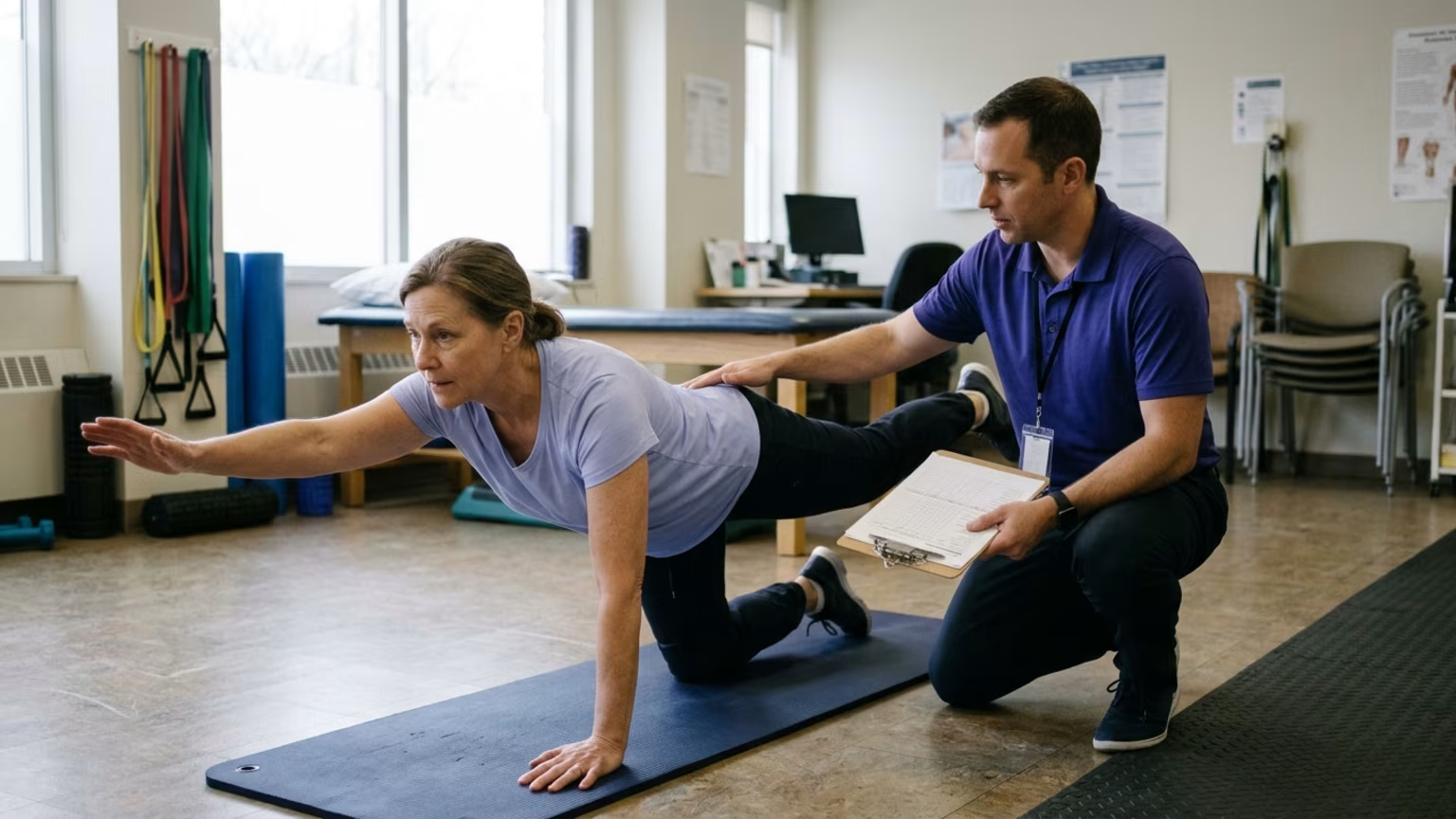
According to the trial summary, researchers randomly assigned 48 participants to three groups. Each group had 16 participants. The two exercise groups trained under supervision three times weekly for four weeks. The comparison group received advice without supervised exercise.
Researchers assessed participants before the intervention and immediately afterward. Measures included pain, lumbar movement and disability. They also assessed core activation and endurance, along with movement patterns involving the lower back and pelvis.
The summary reported adjusted lumbar-extension measurements of 2.75 cm for suspension training and 2.12 cm for pressure-biofeedback training. The advice-only measurement was 1.69 cm.
For lumbar flexion, the reported adjusted measurements were 6.28 cm for suspension training and 5.82 cm for biofeedback. The advice-only measurement was 4.68 cm.
The report described an advantage for suspension training over biofeedback in lumbar extension. It did not report a significant difference between the exercise groups in lumbar flexion.
These figures are reported adjusted measurements. They should not be read as the number of centimeters each participant gained during treatment. Keeping that distinction clear avoids turning an end-of-study result into an unsupported claim about the amount of improvement.
The summary reported adjusted pain scores of 1.34 for suspension training, 1.87 for biofeedback and 4.54 for advice-only care. It described clinically meaningful pain improvement in both exercise groups but not in the control group.
However, the two exercise approaches did not significantly differ on pain. The lower reported score in the suspension group did not establish a clear pain advantage over biofeedback in this trial.
For disability, the pattern was different. Reported adjusted Oswestry Disability Index scores were 11.47 for suspension training and 16.83 for biofeedback. The advice-only score was 28.24. The summary reported a disability advantage for suspension training over biofeedback.
The report also said suspension training outperformed biofeedback on all evaluated trunk-endurance tests. It reported no significant difference between the exercise approaches for core activation or lumbopelvic movement patterns.
Taken together, the findings support a selective result rather than an overall winner. Suspension training had reported advantages in disability, lumbar extension and trunk endurance. Several other measures did not separate the two exercise approaches.
That distinction preserves the actual comparison. A headline about better extension should not become a claim that suspension exercise was better for every part of recovery.
The studied population was adults with chronic mechanical low back pain. That is the group to which the reported results are most directly relevant.
The findings do not establish the same results for people recovering from back surgery or another orthopedic condition. Nor do they establish that suspension training is the best choice for every person who has back pain. A shared symptom does not make every recovery situation the same as the trial population.
The form of care matters too. Participants in both exercise groups received supervised sessions. The comparison therefore concerns supervised programs as delivered in this study, not an independently chosen home routine or equipment used without that support.
For readers in midlife or later life, the useful starting point is whether their condition and care setting resemble those studied. Applying that comparison to an individual situation belongs with a qualified healthcare professional.
For someone considering exercise during recovery, the practical relevance is a conversation about an appropriate supervised plan. The report offers a reason to discuss the goals of that plan rather than choosing an approach from its name alone.
The trial tracked several different outcomes. That provides a useful framework for discussing what care is intended to address. A plan aimed at a mobility problem may be evaluated differently from one focused on pain or activity-related disability.
Questions grounded in this report include:
These are discussion points rather than a request for a particular exercise method. They keep attention on the purpose of care and how progress will be judged.
The trial also illustrates why a pain result is not the whole story. The exercise groups did not significantly differ on pain, yet they differed on some other measures. ReboundBody’s discussion of looking beyond pain when considering a return to exercise addresses that broader recovery question.
For readers approaching the end of formal rehabilitation, the remaining issue is how supervised progress connects with everyday demands. Questions about how exercise progresses after a setback fit into that conversation. This trial assessed the end of a supervised intervention rather than the full path back to recreation or sport.
The reported session schedule describes what participants received. It is not an individual prescription. The summary does not provide enough exercise detail to reproduce the program independently, so it should not be used as a self-treatment guide or a reason to replace an existing care plan.
The central evidence limits are the modest sample, the four-week intervention and the absence of post-intervention follow-up. According to the summary, the researchers called for larger trials with longer observation. The available results do not show whether improvements persisted after supervised sessions ended.
The report also leaves important details unresolved. It does not provide the participants’ age range or information about adverse events. It does not report trial registration, blinding or allocation-concealment details. Those gaps restrict judgments about safety and how firmly to rely on the trial methods.
The findings are available here through a news summary rather than the full study paper. The reported figures and conclusions therefore need to remain attributed to that account. In particular, the absence of reported adverse events is not evidence that no adverse events occurred.
A longer study could help establish whether the selected advantages remain after supervised treatment. More complete reporting would also help clarify which adults were represented and how the programs were delivered.
For now, the report offers an encouraging comparison within a defined period of supervised care. The quieter unanswered question is what remains when those sessions are over and ordinary life becomes the setting for recovery.
A favorable core-exercise result can be mistaken for a complete route back to ordinary activity. ReboundBody addresses uncertainty after formal rehabilitation with evidence-aware explanations of movement and strength rebuilding for active adults in midlife and later life. Its independent articles put recovery findings in context without medical promises.

Follow ReboundBody for practical articles on injury recovery, rehabilitation, mobility and rebuilding strength. New posts turn research into clear ideas for the road back to activity after injury or surgery.






Read practical guidance on injury recovery, rehabilitation, mobility and rebuilding strength as you work your way back to activity.
Explore Resources