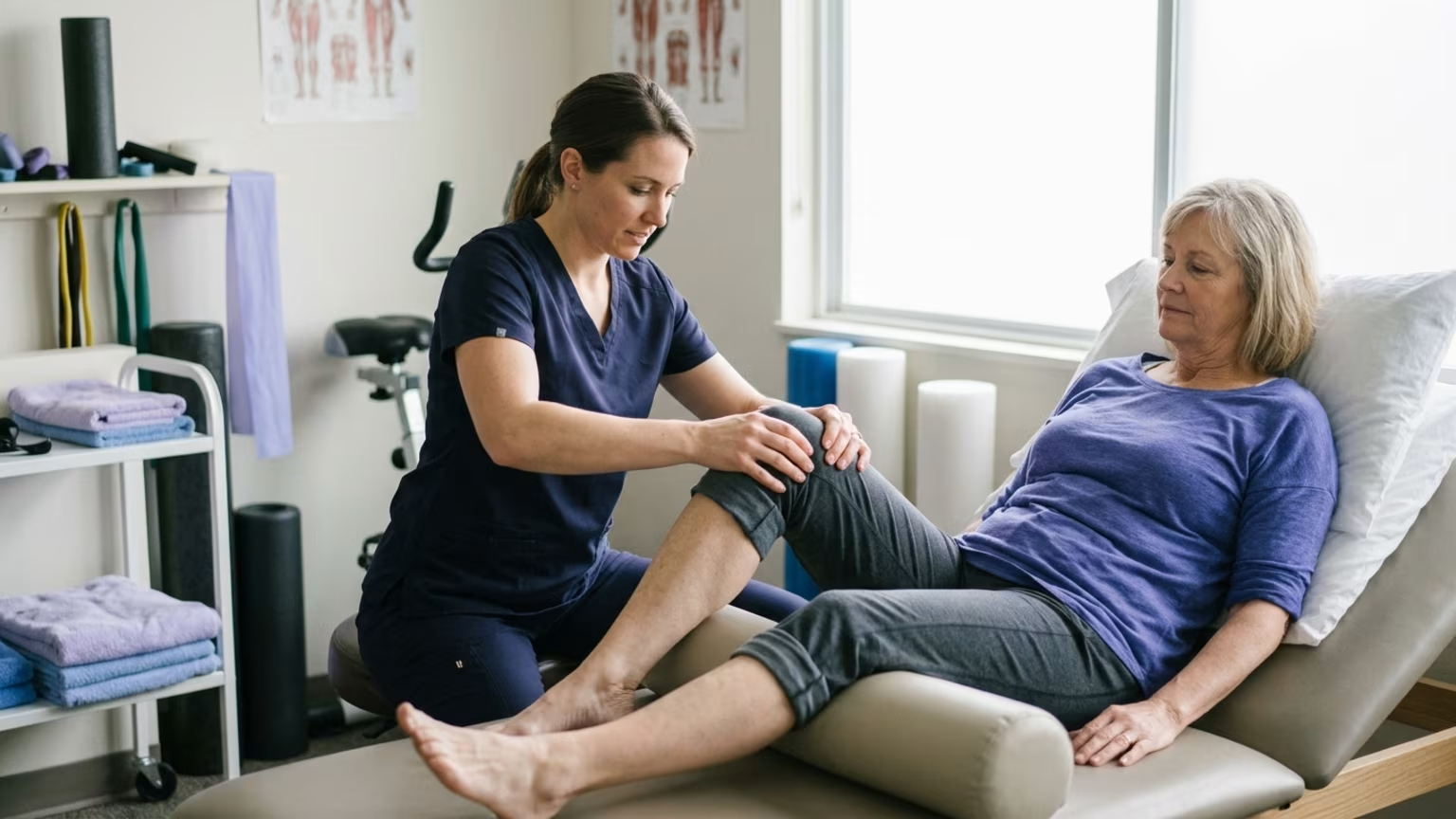

A small trial reported faster early gains with mobilization plus exercise for knee arthritis. Lasting benefit and wider use remain uncertain.





On November 14, 2026, a report of a randomized trial described faster early improvement when therapist-applied mobilization was added to supervised exercise for knee osteoarthritis. The study was published in Chiropractic & Manual Therapies in 2026 and compared isometric exercise alone with the same exercise preceded by Mulligan mobilization with movement.
The reported advantage involved pain, quadriceps strength and physical function. It was most apparent during the first three weeks of the six-week program.
The important distinction is what changed: one group received an added hands-on treatment while both groups continued exercising. The finding concerns the early pace of rehabilitation, not a reason to replace active exercise with manual care.
The evidence context is an add-on question: does manual treatment offer something extra when exercise is already part of care? Related research on manual therapy added to exercise addresses additional effects on pain and function. That is a different question from whether hands-on care should take the place of strengthening.
In this trial, the starting point for both groups was supervised isometric training. The exercise targeted knee and hip muscles. The combined group received therapist-applied mobilization before the same exercise program.
This design matters because it keeps the main comparison focused. It does not compare a full rehabilitation program with doing nothing. It compares exercise with exercise plus one additional approach.
For readers following the broader evidence on exercise for knee arthritis, this is a useful distinction. A finding about an added treatment does not tell us that the underlying exercise has become less important. It asks whether the beginning of that exercise-based program could look different with extra therapist input.
According to the trial report, the combined group improved faster in pain, quadriceps strength and functional disability. The clearest separation appeared early in treatment. The researchers reported statistically significant group-by-time effects for all three outcomes.
In plain language, the groups' results changed along different paths during the study. The finding was about the pattern of improvement over time rather than just a single final score. That makes the timing of assessment important when interpreting the result.
Pain, quadriceps strength and functional disability were separate outcomes. Improvement in one does not by itself describe the other two. Keeping those labels separate makes the finding clearer: the report described a faster early trajectory across all three. That detail is more useful than a sweeping statement about recovery speed.
The report gave the following interaction effect sizes, expressed as partial eta-squared:
Those values describe statistical effects in this study. They are not percentages of pain relief or strength gain. Reading 0.532 as a percentage improvement in pain would misrepresent the result.
The intervention also needs a clear description. In the combined group, the therapist applied mobilization while participants actively bent and straightened the knee. This was Mulligan mobilization with movement delivered within supervised rehabilitation.
The study therefore tested a paired approach, not hands-on care in isolation. The active knee movement during mobilization was part of the treatment being studied, and the exercise program remained in place afterward. It would be a different claim to say that any hands-on technique offers the same benefit.
The trial randomized 50 women with symptomatic knee osteoarthritis confirmed by imaging. They were 40 to 65 years old and had moderate disease, described as Kellgren-Lawrence grades 2 or 3.
Treatment took place at an outpatient rehabilitation center at Majmaah University in Saudi Arabia. Both groups received six weeks of supervised isometric training, five days per week. This schedule describes the research program rather than a recommended routine for readers.
The participants had knee osteoarthritis, not a general mix of injuries or surgical conditions. Recent lower-limb surgery was an exclusion in the reported eligibility criteria.
The symptoms and imaging confirmation were both part of how the study group was described. The report was not simply about anyone who reported a stiff knee. It concerned a defined osteoarthritis population entering the same type of supervised rehabilitation.
These details locate the finding in a specific setting: a supervised program for women with moderate knee osteoarthritis. Age, diagnosis and care setting are part of understanding a study. They are not details to set aside when a headline sounds broadly relevant to knee pain.
The practical relevance is a focused discussion with a physical therapist about whether hands-on mobilization has a useful role alongside strengthening. The aim of that conversation is to clarify what an added treatment is meant to contribute. It is not a reason to stop an existing program on the strength of a headline.
Useful questions stay close to what the researchers actually measured:
These are questions about the role of an added treatment, not requests to copy the trial schedule. The therapist's explanation should connect the proposed hands-on work with the goals of the active program. The personal decision still belongs within qualified care.
It also helps to separate feeling better during an early phase from completing rehabilitation. Pain, strength and function were distinct outcomes in the report. A discussion that names the intended outcome is more precise than simply asking whether manual therapy works.
Describing mobilization as a possible aid during early exercise is narrower than describing it as a way to shorten the whole recovery process. The first description matches the question tested here. The second reaches beyond the reported finding. Keeping the wording precise helps keep the conversation tied to the study's actual results.
For a broader view, ReboundBody's discussion of knee movement alongside strength and balance places this topic within rehabilitation education. This trial adds a narrower question: whether one supervised manual approach changes the early course of an exercise-based program.
The first uncertainty is the size of the change a person might actually notice. The available report does not provide time-specific raw outcome scores. Without those values, the statistical effects cannot be translated into a typical expected change in pain or strength.
The timing also changes the interpretation. The report notes that outcome scores converged by the end of six weeks. An early lead is therefore different from a clear advantage at the end of treatment.
Long-term follow-up was not established. The study does not show whether an early difference persists after supervised care ends or affects later activity. It also does not establish how well the findings carry over to men, other ages or different stages of knee osteoarthritis.
The sample was small and limited to one treatment setting. For someone recovering from surgery or another orthopedic injury, this is not direct evidence for that recovery path.
The report recorded no adverse clinical events during the 30 supervised sessions. That is useful information from this trial, not proof that the technique is suitable for every person. The findings also do not establish a universally appropriate technique or dose for self-treatment.
The most measured reading is that mobilization may have helped this group progress sooner during supervised rehabilitation. Whether that earlier progress changes what comes later remains an open question.
A more comfortable beginning can matter without settling the whole course of recovery.
Considering mobilization alongside knee arthritis exercise raises a clinical choice; ReboundBody adds context for understanding the research behind that choice. Its independent articles explain mobility and strength rebuilding for active adults living through an orthopedic setback, with attention to the limits of recovery evidence.

Follow ReboundBody for practical articles on injury recovery, rehabilitation, mobility and rebuilding strength. New posts turn research into clear ideas for the road back to activity after injury or surgery.






Read practical guidance on injury recovery, rehabilitation, mobility and rebuilding strength as you work your way back to activity.
Explore Resources