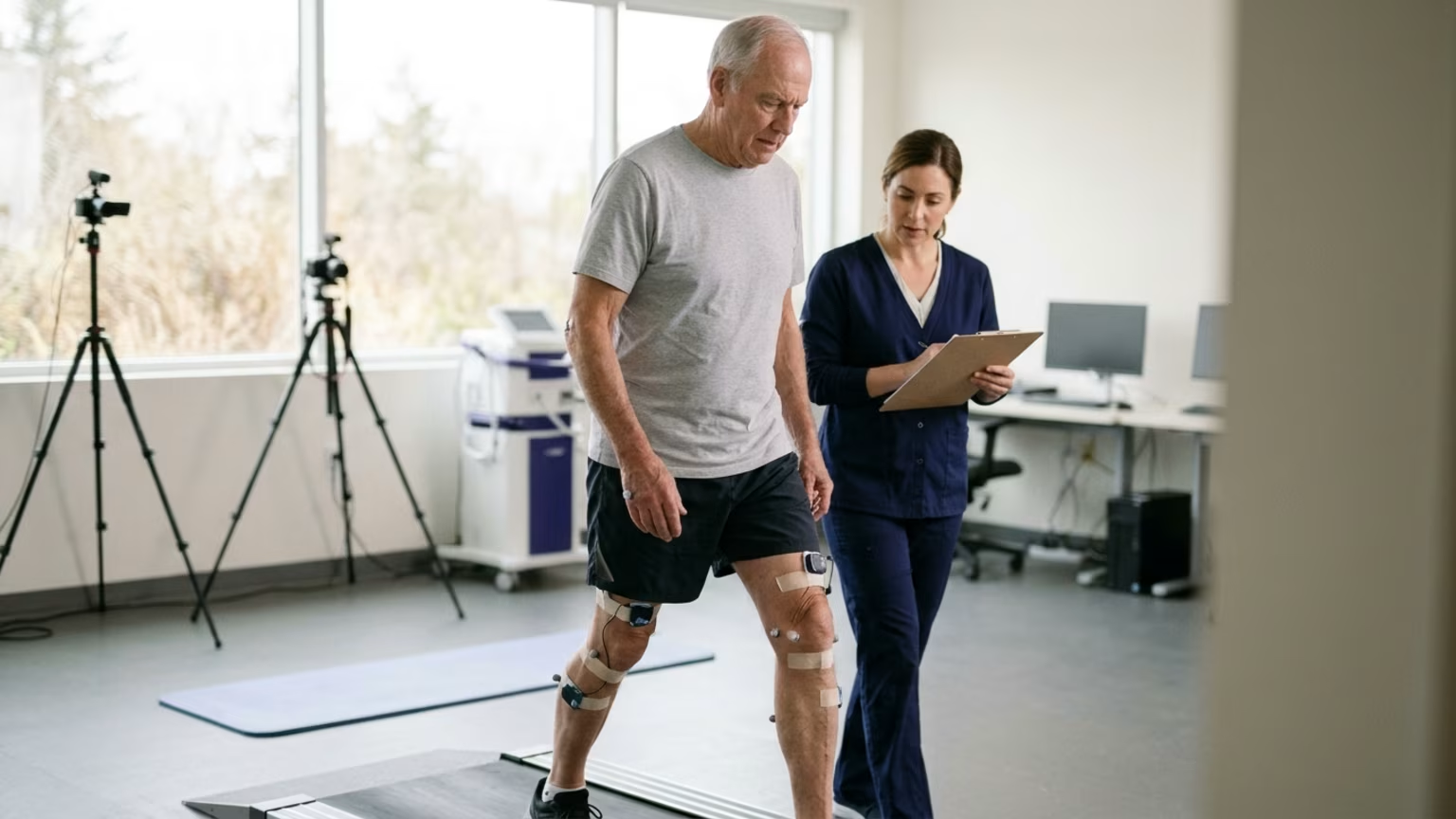

A knee osteoarthritis study links muscle coactivation with walking changes. Learn who was studied and what the findings may mean for care conversations.





A November 19, 2026 report on research in Knee Surgery & Related Research linked greater overlap in opposing knee-muscle activity with slower walking and shorter steps in people with knee osteoarthritis. The reported pattern also included less joint motion and greater difficulty with function.
That overlapping muscle activity is called coactivation. The finding adds a coordination question to the discussion of pain, stiffness and strength: how are muscles working together while someone walks?
For readers following knee arthritis research, the useful shift is toward a fuller picture of movement. Symptoms remain part of that picture, but walking mechanics may offer another topic for a healthcare conversation.
An earlier November study provides useful context. A randomized trial published November 6, 2026 in Scientific Reports examined core activation exercises added to conventional knee rehabilitation.
That trial reported improvements in some pain and self-reported function outcomes. It also described improvements in some transitional-function and core-endurance measures. Knee strength improvements were comparable between groups.
Those findings concern the results of a rehabilitation approach. The coactivation study addresses a different question: how muscle activation patterns relate to walking mechanics, strength and symptoms across knee osteoarthritis stages.
The distinction matters when reading exercise headlines. A study about rehabilitation outcomes and a study about muscle coordination can both add information without answering the same question. Improvements in reported function should also be kept separate from findings about strength or walking mechanics.
This is the evidence context behind the update, rather than a reason to replace one rehabilitation approach with another. For related reading, ReboundBody also covers how to interpret knee arthritis exercise evidence.
According to the study report, investigators assessed several parts of knee function together:
This combination let the researchers examine how different measurements related to each other. Rather than looking only at symptoms or only at strength, the report placed muscle activity alongside walking and knee mechanics.
The reported muscle pattern involved greater coactivation between the hamstrings and the vastus lateralis. The lateral hamstrings were especially prominent in the findings. These are specific muscle measurements, not a general description of every muscle around the knee.
Compared with healthy controls, the knee osteoarthritis group had lower walking speed and cadence, meaning a lower stepping rate. They also had shorter steps and strides, along with reduced joint range of motion.
The report described lower knee flexion moments and higher knee adduction moments in the osteoarthritis group. These are laboratory measures of knee mechanics. Differences were more pronounced in more advanced disease.
The lateral hamstring-to-vastus-lateralis activation ratio was higher across walking phases and increased with greater radiographic severity. The authors also reported associations among coactivation measures, walking mechanics and WOMAC scores for pain, stiffness and function.
Another reported relationship connected early-stance lateral coactivation with knee adduction moment measures. Functional scores were also associated with walking speed and knee range of motion.
Taken together, the findings connect several parts of the assessment. The central addition is the relationship between muscle coordination and the broader pattern of walking and symptoms, rather than any single measurement standing above the others.
The study report describes 197 participants. Of these, 165 had unilateral symptomatic, radiographic knee osteoarthritis and 32 were healthy controls.
Unilateral means the identified condition affected one knee. The osteoarthritis group had symptoms as well as radiographic evidence of the condition. Researchers divided that group across Kellgren-Lawrence grades I through IV.
Including different grades allowed the investigators to compare patterns across radiographic disease severity. The findings therefore concern a defined knee osteoarthritis sample, with a healthy comparison group, rather than orthopedic recovery in general.
That focus matters for ReboundBody readers. Someone managing knee osteoarthritis may find the research relevant to questions about walking and daily function. Someone recovering from a different injury or an operation is dealing with a different clinical context.
The study population should remain attached to the headline. “Muscle coordination and walking in knee osteoarthritis” is a more accurate reading than a broad claim about why anyone develops a limp or loses walking speed.
The practical relevance is not a new walking technique. It is a reason to discuss observable movement and everyday function alongside pain and stiffness with a qualified clinician.
A change in walking speed or step length can provide useful context for that discussion. The aim is to describe what has changed, not to decide what caused it. A simple account of an everyday difficulty may be more useful for the conversation than trying to apply a laboratory muscle-activation label.
For example, a reader might describe that their steps seem shorter or that walking feels different than before. Those observations give the healthcare team something concrete to consider with symptoms and the rest of an assessment. They do not require the reader to interpret an EMG result.
Useful questions include:
These are discussion prompts, not a rehabilitation protocol. The purpose is to make room for the full picture rather than assuming that a pain score captures every concern about movement.
The distinction also works in the other direction. If walking feels different, that observation belongs beside the symptom history rather than replacing it. This study considered multiple measurements together, which supports asking how those parts of an assessment fit together.
Readers seeking broader context can also read about considering knee motion alongside strength and balance. Personal decisions about assessment and rehabilitation still belong with the treating team.
The first uncertainty is direction. This was a cross-sectional study, meaning people at different disease stages were assessed at one point in time. It cannot establish whether coactivation came before the walking changes, developed in response to them or reflected other factors. It also cannot show that coactivation caused osteoarthritis to progress.
The authors describe increased coactivation as a possible way to stabilize the knee. At the same time, they associate it with less efficient walking and worse symptoms. This is a proposed explanation, not proof of the mechanism. It leaves open whether a particular pattern is helpful, costly or both in a given situation.
That possible stabilizing role is why coactivation should not be treated as something to eliminate. Readers should not try to consciously suppress muscle activity or make substantial walking changes based on this report. The practical response is to bring movement concerns to a qualified clinician.
The testing methods also set limits on interpretation:
Treatment remains a separate question. The coactivation study did not test a rehabilitation plan, and the separate core activation trial does not prove that core exercises reverse the reported muscle pattern. Evidence about an intervention must be judged by the outcomes that intervention study actually measured.
Future research would need to clarify how these patterns change over time and whether changing them improves outcomes that matter to patients. For now, the study supports a broader conversation about knee function rather than a new self-treatment strategy.
Today, add this question to your next appointment notes: “How are my walking pattern and everyday function being considered alongside my knee symptoms?”
Knee muscle coordination is a research finding to weigh alongside symptoms and function, not a ready-made recovery plan, which fits ReboundBody's emphasis on realistic limits. ReboundBody explains mobility and rehabilitation for active adults seeking clearer context after an orthopedic injury or recurring physical problem.

Follow ReboundBody for practical articles on injury recovery, rehabilitation, mobility and rebuilding strength. New posts turn research into clear ideas for the road back to activity after injury or surgery.






Read practical guidance on injury recovery, rehabilitation, mobility and rebuilding strength as you work your way back to activity.
Explore Resources