
A cadence report revisits knee and hip loading research. Learn what the findings mean for older runners and why recovery outcomes remain uncertain.





On November 16, 2026, Running Cardio published a report describing how a modest increase in running cadence may change selected lower-limb loading measures. The report says raising a runner’s preferred step rate by roughly 5% to 10% may reduce some of those measures while running speed stays the same.
Cadence means step rate, usually expressed as steps per minute. The report focuses on a change relative to an individual runner’s normal rhythm. It does not require a faster pace to produce the measured differences.
The update brings older experiments and later research reviews into a discussion aimed at aging runners. Its most useful message is about how to read a running-mechanics claim: identify the measure that changed before deciding what the finding means for recovery.
A recent publication date does not mean the central experiment is new. The treadmill study highlighted in the coverage dates to 2011. The November article brings that earlier experiment back into view alongside later reviews.
Other evidence came later. A clinical explainer summarizing a 2022 review reports moderate-certainty evidence that step-rate retraining increased cadence and reduced average vertical loading rate. Both findings describe changes in running mechanics.
Step-rate retraining refers to efforts to change a runner’s usual cadence. The review summary helps distinguish a change in step rate itself from a change in a loading measure. Those are separate outcomes, even when they appear in the same review.
That is the background for the current coverage. Earlier research had already examined cadence as a movement variable. The November report connects that work for readers trying to make sense of loading at the knee and hip.
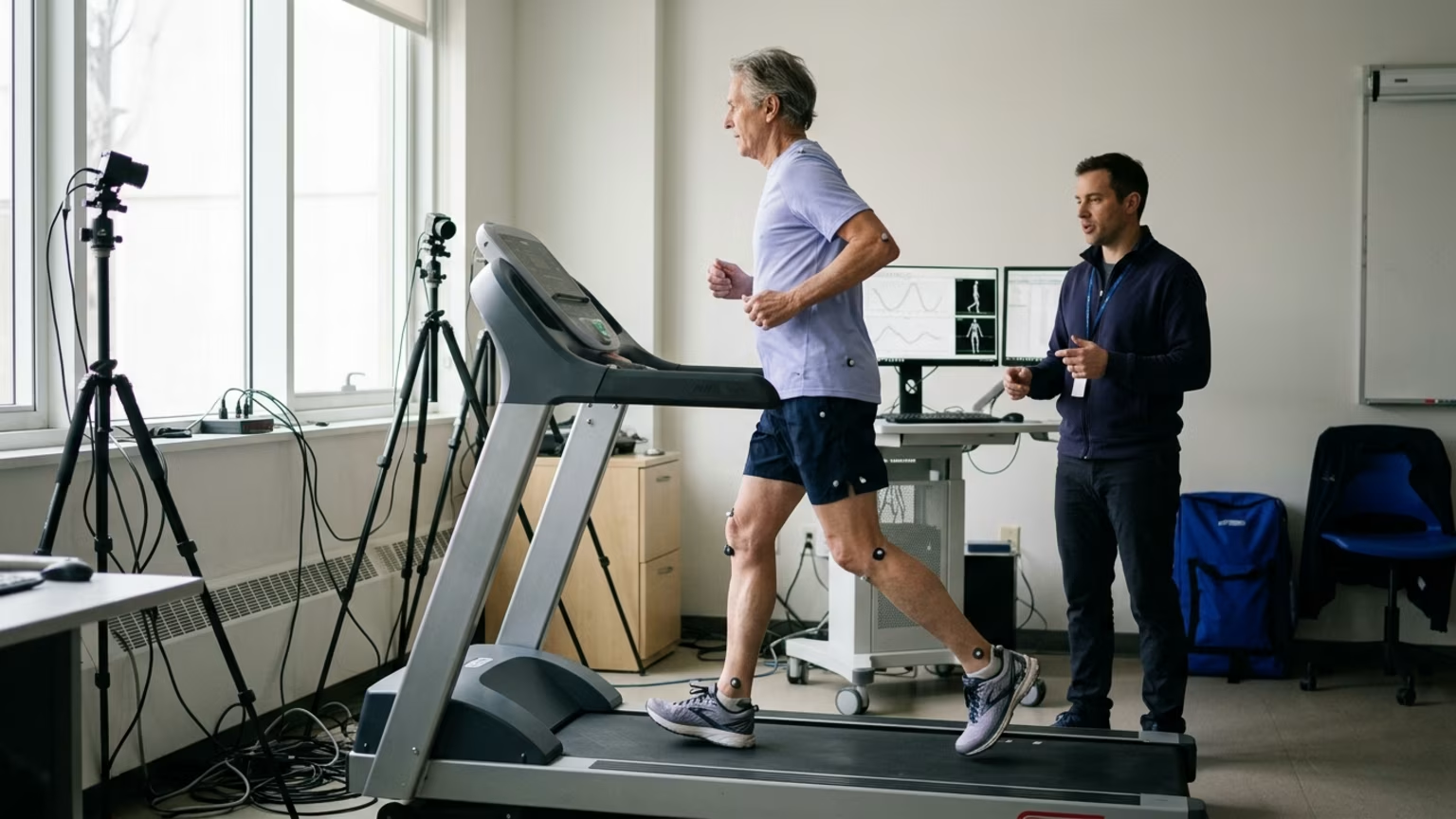
The clearest example in a secondary research summary was a treadmill experiment involving 45 runners. Researchers held running speed constant and compared different step-rate conditions. That design separates the cadence comparison from a change in speed.
The reported findings were specific:
These are joint-specific measurements. The knee and hip results were not identical at every tested increase. Describing them as selected loading changes preserves that detail.
The wording also makes the result easier to track. “Energy absorption” names the measure used in the experiment. When reading a running claim, keeping the original outcome name helps preserve the difference between the measured result and a broader interpretation.
A useful summary keeps three items together: the cadence change, the running speed and the outcome measured. Leaving out any of those makes it easier to misunderstand the claim. In this case, constant speed is part of why the treadmill comparison is informative.
The November report also described a 2025 systematic review that included 18 studies. According to the coverage, it found biomechanical changes associated with moderate cadence increases. This widens the evidence discussion beyond the treadmill experiment while keeping the main finding focused on running mechanics.
The most precise reading is therefore about particular measurements under particular conditions. The percentages describe the change in step rate. They do not describe the size of the reduction in joint loading.
The treadmill experiment involved healthy recreational runners. It was not a study of people rebuilding running after orthopedic surgery or an injury. Its results therefore do not directly establish an approach for that recovery setting.
An article framed around aging hips also needs a population check. A discussion aimed at older adults is not the same as a trial that establishes a distinct benefit for older runners. The research described here does not establish a cadence recommendation specific to older adults in rehabilitation.
For someone with a recurring musculoskeletal problem, the relevant question is more personal than whether a laboratory variable changed. It is whether a proposed gait change fits the condition being managed and the current stage of recovery. That judgment belongs with a qualified healthcare professional who knows the individual situation.
Our explanation of the difference between tissue repair and rebuilding movement provides related recovery context. It keeps the wider recovery question separate from any single running measurement.
The clearest practical detail is how the percentages are defined. They are relative to a runner’s own preferred cadence, not a universal goal such as 180 steps per minute. The report uses 160 to 168 steps per minute as an example of a 5% increase.
That example explains the arithmetic. It is not a target for every runner reading the article. A relative change and an absolute step count answer different questions: one describes a shift from a baseline, while the other names a particular rhythm.
The report suggests introducing any increase gradually and monitoring symptoms. It advises stopping or scaling back if symptoms worsen. Those points are the article’s practical recommendations, not the outcomes measured in the treadmill experiment.
For readers returning from injury or surgery, this coverage is best used to frame a conversation rather than to rewrite a running plan. A cadence discussion should not be treated as permission to change running load. The individual recovery context still matters.
Useful questions for that conversation include:
These questions make the purpose of a possible change explicit. They also help separate the appeal of a precise percentage from the reasons a clinician might consider a gait adjustment.
For a broader way to think about the discussion, our article on how activity demands increase during recovery offers related context. Cadence is the topic of this report, but the reader’s larger concern is returning to activity with realistic expectations.
The main uncertainty is whether the measured mechanical changes translate into outcomes that matter over time. Lower knee or hip energy absorption is not proof of less pain, faster recovery or fewer injuries. The treadmill findings were short-term laboratory results.
The review evidence also has limits. The November report describes small studies and samples made up mainly of male runners. That leaves questions about how broadly the findings apply.
The secondary summary of the 2022 review identifies another gap: too few trials reported pain outcomes for firm conclusions. Evidence about changing cadence or average vertical loading rate therefore needs to stay separate from claims about pain relief.
The available evidence also does not establish a tested cadence target or progression schedule for people with orthopedic conditions. More research would be needed to turn a mechanics finding into condition-specific rehabilitation guidance.
Important questions remain: How long do the measured changes last? Which runners benefit outside a treadmill session? Do changes in mechanics track with changes in comfort or ability?
Today, write down one question for your treating professional: “Would a cadence discussion be relevant to my current recovery goals?”
Cadence percentages can look like ready-made recovery targets, so ReboundBody explains the research without turning it into a personal plan. For active adults facing an orthopedic setback, its independent recovery articles clarify clinical terms and study findings to help readers prepare questions for their healthcare team.

Follow ReboundBody for practical articles on injury recovery, rehabilitation, mobility and rebuilding strength. New posts turn research into clear ideas for the road back to activity after injury or surgery.






Read practical guidance on injury recovery, rehabilitation, mobility and rebuilding strength as you work your way back to activity.
Explore Resources