
A small rotator-cuff study linked VR-measured shoulder smoothness with function. Read the movement-specific findings and the limits of the evidence.





On November 11, 2026, a study published online in BMC Musculoskeletal Disorders reported a link between shoulder-motion smoothness and clinical function three months after rotator-cuff repair. The finding was clearest for flexion and abduction, two of the movement directions assessed.
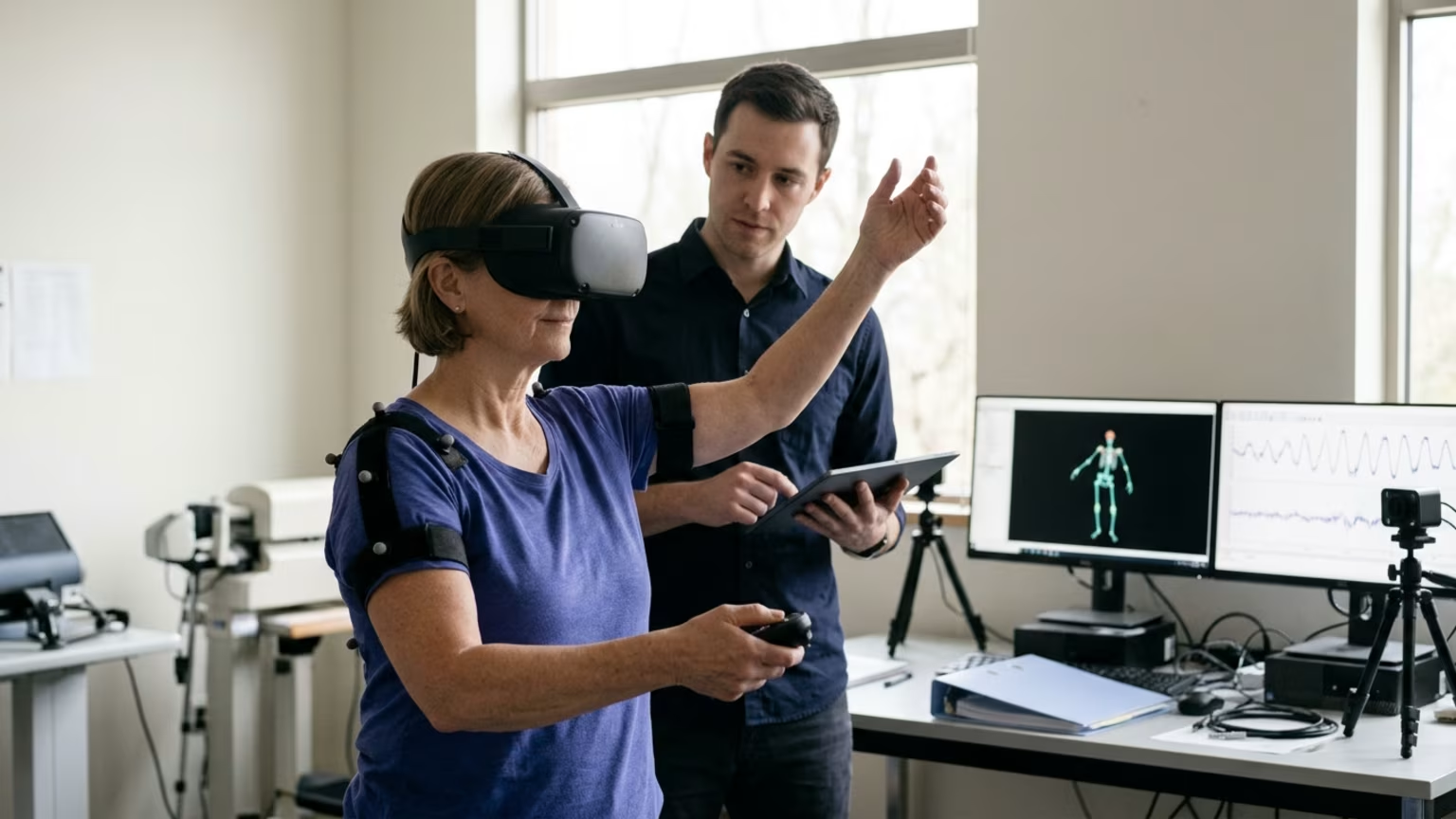
Researchers used an HTC VIVE tracking system to turn shoulder movement into numerical measurements. They then compared those measurements with clinical function scores. The central question was whether movement quality could add useful information to an assessment of recovery.
The report puts a specific measurement idea under study: how smoothly a shoulder moves. Its findings also show why identifying the movement being measured matters when interpreting a recovery score.
Before this motion-tracking report, other rotator-cuff research had examined the relationship between repair integrity and patient outcomes. A separate 2026 multicenter study in the Journal of Orthopaedics and Traumatology enrolled 543 patients at nine orthopedic centers. It assessed outcomes at baseline and at six, 12 and 24 months.
In that study, patients with symptomatic recurrent defects had worse outcomes than those with intact repairs. Patients with asymptomatic recurrent defects had comparable outcomes on several measures. Those findings concerned repair integrity rather than movement smoothness.
The November study used American Shoulder and Elbow Surgeons (ASES) scores as its clinical comparison. It asked whether an instrument-based measure of movement quality lined up with those scores.
This is the evidence context for the update. Research can examine the state of a repair or a patient's clinical function. The new report brought another measure into that picture: smoothness during particular shoulder movements.
The team assessed five directions using HTC VIVE tracking: flexion, abduction, extension, internal rotation and external rotation. Smoothness was quantified using log dimensionless jerk, shortened to LDLJ. This gave the researchers a numerical measure to compare with clinical function scores.
According to the study, flexion and abduction smoothness were significantly positively correlated with ASES scores. In plain language, smoother movement in those directions tended to accompany better clinical function scores among the people assessed.
Flexion produced the strongest reported separation between the study's high- and low-function groups. Its area under the curve, or AUC, was 0.96. That figure describes how the measure distinguished those groups within the study.
The other movement directions did not follow the same pattern:
These differences are important to the interpretation. The researchers did not find one uniform pattern across every direction of shoulder motion. A result closer to the healthy reference in extension could sit alongside a different pattern in rotation.
That makes the movement being measured part of the finding itself. Saying that someone had a smooth shoulder movement leaves out information unless the direction is also clear.
The postoperative group consisted of 10 people assessed three months after rotator-cuff repair. The comparison group included 30 healthy adults. Those healthy participants supplied a reference for the movement measurements.
That places the study at a defined point after a defined operation. It was not a sample of people at every stage of recovery or people recovering from every type of shoulder problem.
For readers recovering from rotator-cuff repair, the timing helps explain the scope of the result. The study describes how movement quality and clinical function related at that assessment point.
For readers recovering from a different procedure, the findings remain background research rather than evidence about their own recovery path. The shared body region does not make different operations or patient groups interchangeable.
For someone in rehabilitation, the most useful takeaway is about interpreting a measurement. A smoothness score describes a feature of motion. Its meaning depends on the movement assessed and how it relates to clinical function.
The everyday distinction is between an observation and a decision. Recording that a movement was smoother is an observation. Deciding what that observation means for a person's next stage of rehabilitation is a broader clinical question.
Questions that keep a discussion focused include:
These are questions about the role of a measurement rather than steps for testing a shoulder at home. They help separate what a study actually measured from what a headline seems to promise.
The same distinction matters when reading about recovery technology online. A device's ability to produce a number and the usefulness of that number for a care decision are separate questions. This study's contribution sits mainly with the relationship between a movement measurement and a clinical score.
ReboundBody's discussion of putting recovery measurements in context addresses the broader assessment question. Its article on training changes within clinical recovery limits covers the separate planning side of recovery.
Keeping those topics distinct matters. A finding about how movement is recorded belongs in the assessment conversation. Decisions about exercises and activity remain part of individualized care with qualified healthcare professionals.
The authors described their findings as preliminary and called for validation in larger multicenter studies. The small postoperative sample is the main reason to keep the result in proportion. Performance in this group does not establish that the same measure will work as well in other patients or clinical settings.
The AUC result also needs a narrow reading. It reflects separation of groups within the study rather than a demonstrated level of accuracy for predicting an individual patient's future recovery. Whether smoothness measurements forecast later outcomes remains an open question.
The relationship with ASES scores was a correlation. It does not show that making a movement smoother causes better function. The team evaluated movement rather than testing a rehabilitation intervention, so the findings do not show that VR-guided treatment improves recovery.
For the same reason, this report supplies no new exercise plan or return-to-sport timeline. It provides no reason on its own to change a clinician-prescribed rehabilitation program. Its proposed role is as a possible addition to clinical assessment rather than an established routine-care tool.
The available abstract-level information also leaves gaps in how closely the result can be assessed. It does not provide the correlation coefficients or p-values. A detailed measurement protocol is also absent from that information, limiting assessment of the reported relationships and how consistently the measurements could be repeated.
The journal identifies the online text as accepted early-access research that may receive further edits before the final version of record.
The next research questions are practical as well as statistical. They include whether the measure produces consistent results across centers and whether adding it changes the information available for care decisions. The larger repair-integrity study provides broader postoperative context but does not answer those questions about VR tracking.
A recovery score is a summary. The movement behind it still has more than one direction.
Turning a shoulder-tracking result into proof of better treatment is a leap that ReboundBody's research-led recovery articles are designed to avoid. When competing claims about rehabilitation tools blur the distinction between measurement and treatment, the site gives adults rebuilding physical capacity clear explanations of study findings and their limits.

Follow ReboundBody for practical articles on injury recovery, rehabilitation, mobility and rebuilding strength. New posts turn research into clear ideas for the road back to activity after injury or surgery.






Read practical guidance on injury recovery, rehabilitation, mobility and rebuilding strength as you work your way back to activity.
Explore Resources