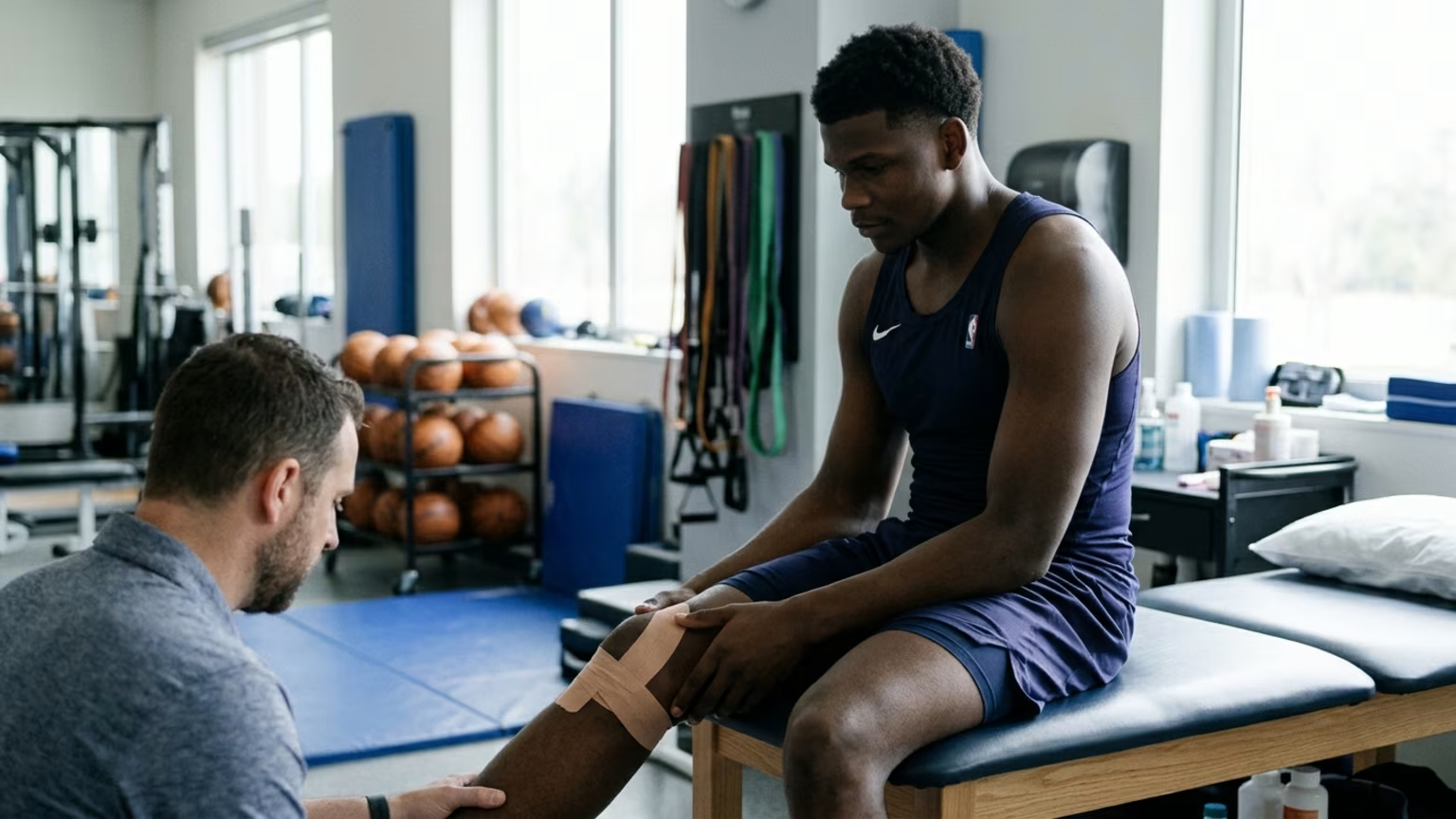

Anthony Edwards is rebuilding leg strength after knee surgery. His rehab update separates an absence estimate from a confirmed return date.





On November 19, 2026, the Associated Press reported that Anthony Edwards was continuing rehabilitation after right-knee surgery and had no set return date. His stated priority was rebuilding strength in his leg.
According to the Associated Press report, Edwards underwent arthroscopic cleanup surgery on October 29. He was doing daily rehabilitation, including two sessions on game days. The report described a general expectation of returning during the regular season rather than a specific date.
The update offered a clearer account of his current work, not an announcement that he was ready for basketball. For adults following sports coverage during their own recovery, that distinction matters. A description of rehabilitation answers a different question from a date on a schedule.
Before this update, the public context included an estimated absence. Reuters reported that Minnesota had initially expected Edwards to miss at least eight weeks. That was a team expectation, not a confirmed return date.
Coach Chris Finch also discussed the outlook with the Pioneer Press. He said he did not expect Edwards back for the team’s Christmas game. He also said he was unsure when the return would happen.
The AP placed the surgery within a longer history of knee trouble. It reported that the right knee had bothered Edwards during the previous season. He played 61 games that season, a career low.
Those details provide the background for the latest report: an earlier estimate and a knee problem that had persisted. Edwards’ own account then shifted attention toward the work he was doing rather than a game he expected to play.
In the AP report, Edwards said he was “just trying to get my strength back in my leg.” The story described him as still working to restore his leg muscles to full strength.
The report also described his priorities. He wanted to return as soon as possible while putting recurring pain behind him. At the same time, he did not want to come back too quickly and disrupt the team’s rhythm.
This adds a first-person account of his rehabilitation focus. It does not establish that one rehabilitation method works better than another. The development is a public status update rather than a new clinical finding.
Broader context comes from an educational physical-therapy explainer. It describes rehabilitation as progressing in stages, with activity demands increasing as tolerance improves. It also cautions that feeling better alone does not necessarily mean someone is ready for unrestricted sport.
The useful connection is the distinction between symptom improvement and preparation for an activity. Edwards described strength rebuilding as his immediate focus. The explainer provides a general framework for understanding why a rehabilitation discussion may address activity demands as well as how someone feels.
This case concerns a professional basketball player recovering from a specific right-knee procedure. It cannot establish a typical recovery timeline for other knee surgeries or for adults returning to everyday activity.
The reported rehabilitation schedule also belongs to Edwards’ case. The story does not establish that daily sessions or extra sessions on game days are suitable for another patient. Frequency is a detail of this report, not a plan for readers to follow.
For ReboundBody’s audience, the relevant connection is narrower than matching an athlete’s recovery. It is the question of how rehabilitation work relates to the activity a person hopes to resume. That might mean normal movement, exercise or recreational sport rather than professional basketball.
The most useful comparison is therefore a question, not a calendar: what does the intended activity require? Applying that question to an individual recovery belongs in a discussion with the treating healthcare team.
The practical value of this story is a clearer way to discuss the transition from formal rehabilitation to normal activity. Readers can use it to ask about the purpose of their current rehabilitation and how progress will be reviewed. It is not a reason to change an existing plan.
“Back to normal” can refer to different goals in a recovery conversation. Everyday movement is one possible goal. Returning to exercise or recreational sport is another.
A useful question for the healthcare team is: “Which demands of the activity I want to resume matter for my recovery?” This makes the intended goal clear without assuming that every form of activity requires the same preparation.
ReboundBody’s discussion of different goals within a return to activity offers related reading. The purpose is to give the conversation a more specific focus than the word “recovered” alone.
The physical-therapy explainer emphasizes individualized progression and monitoring the response as activity demand rises. Readers can ask their clinician: “What functional goals are relevant to the activity I hope to return to?”
The aim is to understand the reasoning behind the personal plan. It is not to select a strength target from a sports headline or create a test without clinical guidance.
Background on how gradual loading fits into rehabilitation may help readers understand that language. The treating professional remains the person who connects general concepts with the reader’s situation.
A time estimate and a discussion of function serve different purposes. One describes an expected period away. The other concerns the activities and goals being considered.
Readers can ask: “Is this date an estimate or a point for reviewing progress?” Another useful question is: “What will we discuss at that review?” Neither question assumes that the answer must be an immediate return to unrestricted activity.
ReboundBody’s article on interpreting review dates during recovery provides further context. These questions are meant to clarify an existing plan, not replace it.
The AP report does not provide objective strength results, loading tests, swelling thresholds or a formal return-to-play protocol. It also does not identify his clinicians’ specific clearance criteria. Naming a particular test he must pass would go beyond the reporting.
The physical-therapy explainer supplies broad education rather than a clinical guideline. It is not evidence that Edwards’ care team is following that exact progression.
A more complete update could explain how his reported strength work connects with the basketball demands his clinicians consider important. Details about activity tolerance and the team’s assessment would help distinguish a report of improvement from a specific clearance decision. Those details are not part of this account.
For readers, the useful next conversation is about their own activity goals and the reasoning behind their care plan. A professional athlete’s status report can prompt that conversation without answering it.
Keep the questions specific. Leave personal return decisions with the care team.
Returning to activity after knee surgery involves decisions for the healthcare team; ReboundBody translates the surrounding recovery information into plain English. For people unsure how formal rehabilitation connects with normal activity, its independent articles explain strength rebuilding and recovery expectations with realistic limits and no medical promises.

Follow ReboundBody for practical articles on injury recovery, rehabilitation, mobility and rebuilding strength. New posts turn research into clear ideas for the road back to activity after injury or surgery.






Read practical guidance on injury recovery, rehabilitation, mobility and rebuilding strength as you work your way back to activity.
Explore Resources