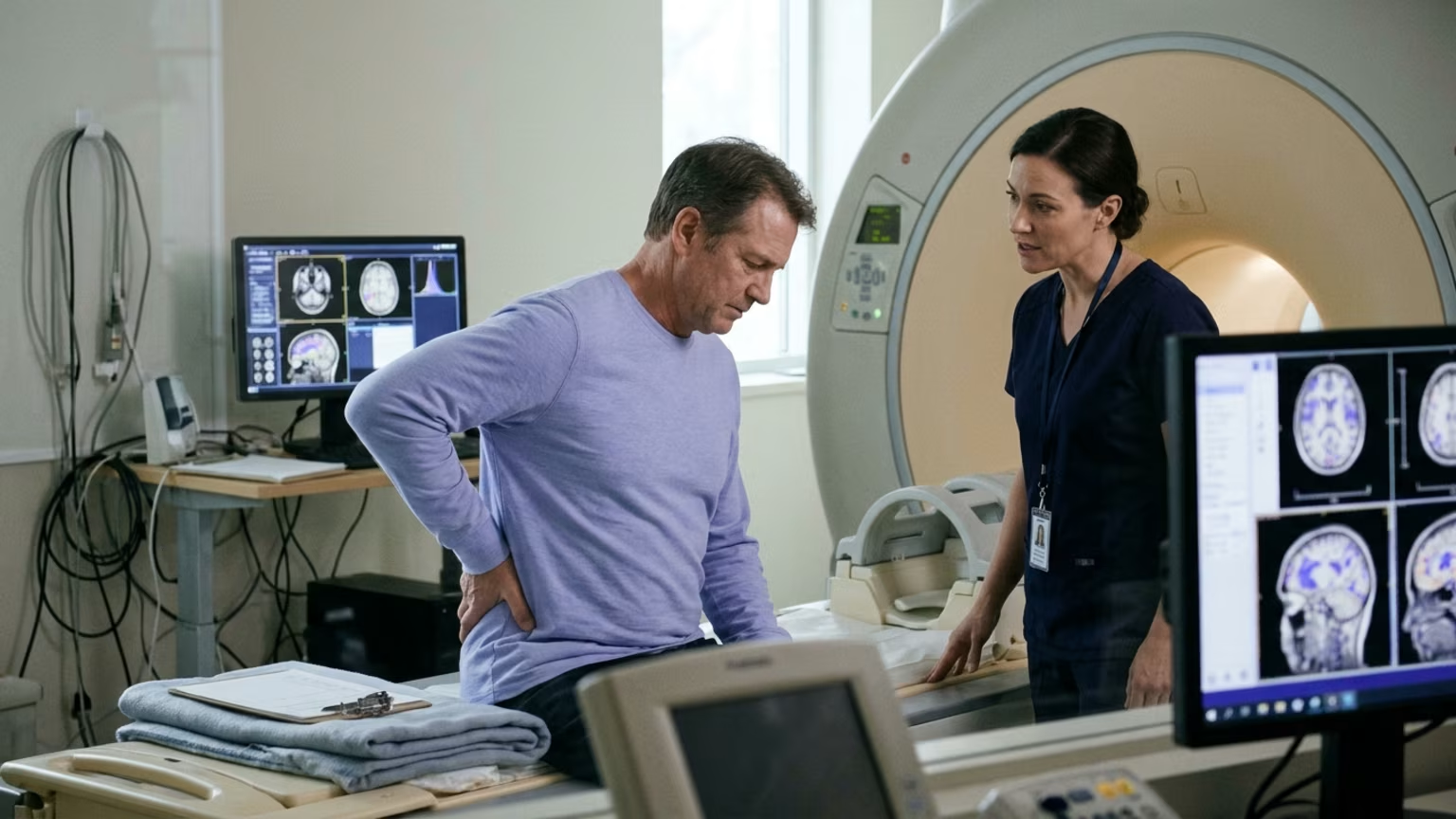

A study of 114 adults links movement-triggered back pain to self-related brain processing. Learn what it found and why it does not change care.





On October 5, 2026, the British Journal of Anaesthesia published a brain-imaging study of 114 adults with chronic low-back pain. As summarized by Pain Research Forum, a leg-raise test that provoked familiar back pain was linked to increased activity in the default mode network. This network is associated with self-reflection and thoughts about personal experience.
The researchers examined a familiar recovery concern in a laboratory setting: pain that increases with movement. Participants completed a leg-raise test intended to bring on their usual back pain. Brain imaging showed a response involving both the default mode network and several pain- and movement-related regions.
UC San Diego's account of the study presents this as a possible clue to why a flare can feel personally significant. The central development is a finding about pain processing, rather than a new treatment recommendation.
The earlier evidence context helps explain why this result drew attention. According to UC San Diego's report, acute pain typically produces a decrease in default mode network activity. Corresponding author Fadel Zeidan highlighted the contrast between that pattern and the increase seen with movement-provoked back pain.
The default mode network is associated with self-reflection, autobiographical thought and mind-wandering. In plain language, these are processes involving thoughts about ourselves and our experiences. That background gives researchers a reason to ask whether familiar back pain involves something different from a separate experimental pain stimulus.
The study included such a comparison. Researchers applied a painful heat stimulus to participants' calves and compared that response with the leg-raise response. UC San Diego reported that the heat stimulus was associated with decreased default mode network activity, while movement-provoked back pain was associated with increased activity.
This contrast is the important starting point. The study adds evidence about how different pain experiences may be processed. It does not represent an update to a back-pain guideline.
According to the Pain Research Forum summary, researchers used arterial-spin-labeling functional MRI to measure changes in cerebral blood flow. Blood flow served as an indirect indicator of brain activity.
The leg-raise test produced changes in participants' pain reports:
These were average changes within this study. The researchers recorded how strong the pain felt and how unpleasant it was, keeping those aspects of the experience separate.
The imaging results added another layer. Blood flow increased in core default mode network regions, including the medial prefrontal and posterior cingulate cortices. Several pain- and movement-related regions also showed increases. The response therefore involved more than the network associated with self-related thought.
The study also examined patterns at rest. Greater chronic-pain severity was associated with stronger resting-state connectivity between the default mode network and the somatosensory cortex area representing the back. Higher pain ratings during the leg raise were associated with greater activity in several sensory and motor regions.
Zeidan interpreted the default mode network finding as a possible connection between pain and a person's sense of self. In UC San Diego's account, he suggested that anticipation of pain and concerns about recovery may contribute to a flare's personal meaning. Fear of movement and worries about missing normal activities were also part of his interpretation.
That interpretation offers a research hypothesis: a familiar flare may involve thoughts about what pain means for a person's life. The measured findings were changes in pain ratings and brain blood flow, along with patterns of connectivity.
The evidence comes from adults with chronic low-back pain. It should be read with that population in view, rather than applied to everyone who experiences back discomfort.
The task was designed to provoke participants' familiar pain. That detail matters because the researchers were examining an existing chronic-pain experience, not simply creating an unfamiliar painful sensation. The separate heat stimulus allowed them to compare those experiences within the study.
For ReboundBody readers, the closest match is an adult living with persistent low-back pain who experiences movement-related flares. The findings should not automatically be extended to a new back injury, recovery after surgery or pain in another body area.
The sample also should not be treated as a description of every individual with chronic low-back pain. The reported group averages describe the study's overall response. They do not provide a personal forecast of how much pain a reader will feel with a particular movement.
For someone moving from formal rehabilitation toward normal activity, the useful contribution is a broader way to understand the research question. A flare can raise questions about the sensation itself and about what it means for returning to valued activities. Zeidan's interpretation brings that second part into view.
This is a helpful distinction when reading information about mobility and movement. A study may examine a biological process without answering the practical question a reader most wants settled. Understanding the process and making an individual care decision are different tasks.
One way to organize a conversation with a qualified healthcare professional is to separate three topics:
These are discussion topics, not a movement protocol. They keep a brain-imaging headline from taking over a conversation that also needs the person's clinical context.
Questions for that conversation might include: “How does this research relate to my situation?” or “What information are we using to assess my progress toward everyday activity?” Another useful question is whether a news story is reporting a measured finding or an author's proposed explanation.
The same reading habit applies to other recovery research explained in plain language. First identify what researchers measured. Then separate their result from the meaning proposed for it. Finally, look for evidence that connects the finding to a clinical decision.
The practical value here is clearer understanding. Readers can recognize why researchers are interested in the personal context of pain while keeping their own return-to-activity questions with the professionals responsible for their care.
Several questions limit how far this finding can be taken. Each concerns a different step between a brain image and a useful clinical answer.
The study was observational. It cannot establish whether the brain-activity pattern contributes to chronic pain, develops in response to it or reflects a combination of factors.
In Yahoo News coverage, Duke University neuroscientist Katherine Martucci raised another possibility. Martucci was not involved in the study and said the scan after the leg raise could capture lingering pain or anxiety as well as the response to movement. That makes the timing and meaning of the observed activity important questions for further research.
The imaging did not directly measure identity, self-concept or the meaning participants assigned to pain. Activity in a network associated with self-related thought is not proof that pain has become part of someone's identity. Martucci said the imaging may help validate participants' pain experience, while cautioning against stronger conclusions.
A laboratory leg raise is also different from everyday activity or a rehabilitation session. The study did not assess tissue injury or establish whether a particular movement was safe, harmful or beneficial for an individual. Its results therefore do not justify either avoiding movement or treating a painful movement as cleared for use.
The study did not compare rehabilitation strategies or test treatment outcomes. Martucci said it was too early to determine how the findings should be used in clinical practice.
UC San Diego's release also discusses mindfulness and psilocybin as areas of related investigation. It describes those findings as preliminary and says more research is needed. Neither approach was tested as a treatment in this imaging study.
The next clinical question is whether understanding these brain patterns can help improve care. Answering that requires evidence beyond an association seen on a scan. For now, this finding is best used to understand the complexity of chronic pain rather than to revise an individual recovery plan.
The leg raise that opened the study was a way to investigate a familiar flare. The resulting image adds detail to that moment. It does not turn that moment into a verdict about a person's back or their path from rehabilitation to everyday movement.
The healthcare professional overseeing recovery addresses day-to-day questions about returning to activity, while ReboundBody helps put research findings in perspective. For adults in midlife and later life, its independent articles explain recovery with realistic limits and help readers understand questions about the transition beyond formal rehabilitation toward normal movement.

Follow ReboundBody for practical articles on injury recovery, rehabilitation, mobility and rebuilding strength. New posts turn research into clear ideas for the road back to activity after injury or surgery.





Read practical guidance on injury recovery, rehabilitation, mobility and rebuilding strength as you work your way back to activity.
Explore Resources