

Understand flexibility, mobility, and range of motion, including active versus passive movement and why everyday function adds context to recovery.





More range of motion does not automatically mean better mobility.
Range of motion describes how far a joint moves. In this article, flexibility means how readily tissues allow a stretch, while mobility means moving through a usable range with active control.
These are plain-language working definitions, not a universal clinical classification. They help separate available movement from movement someone produces and uses.
For someone in rehabilitation, that distinction turns a broad statement such as “your movement has improved” into a more useful conversation. Did the joint move farther with help? Could you move it farther yourself? Or did an everyday task become easier to perform?
Those questions concern related parts of recovery. They do not ask exactly the same thing.
The meaning of a movement result depends on what was assessed and what question the assessment was meant to answer. A joint measurement and a practical task provide different information.
Consider these ways of describing progress:
These are useful categories for discussion rather than a ranking from least to most important. A measurement can answer a narrow question well without answering every question about recovery.
The goal also changes the conversation. Asking about a joint's movement is different from asking about standing from a chair or climbing a step. The hip-fracture trial discussed below offers an example of research that included those practical activities.
Personal restrictions belong in this context too. The supplied evidence does not establish a universal target for range of motion, flexibility or mobility. General movement definitions are not a reason to go beyond restrictions set by the clinician overseeing an injury or surgical recovery.
A useful way to interpret any result is to connect it to the question being asked. “More” becomes more meaningful when the type of movement and the intended activity are clear.
No. In the working definitions used here, flexibility concerns how readily tissues allow a stretch. Mobility concerns movement through a range that a person can actively use.
Range of motion describes the extent of movement. It does not specify whether that movement happened with outside help or through the person's own effort. That is why the words active and passive matter when discussing a range-of-motion result.
These terms overlap, but they direct attention toward different questions:
This distinction is not a recommendation to add or remove stretching from a rehabilitation plan. It is a way to understand what a claim about stretching actually addresses.
For example, a statement about passive movement should not silently become a statement about performance during exercise. The outcome being described needs to stay attached to the assessment that produced it.
When reading an article or discussing a rehabilitation note, look beyond the word “mobility.” Ask what movement was measured and whether the discussion concerns a stretch, an active movement or a practical task. A clear description is more useful than a broad label alone.
Active and passive range of motion describe different ways of producing movement. A plain-language explanation of the distinction describes active movement as movement produced by the person's own muscles. Passive movement occurs when an outside force moves the joint.
That difference changes what the observation establishes.
During passive movement, an outside force produces the motion. Reaching a position this way shows that the joint was moved there under those assessment conditions.
It does not directly test whether the person can independently reach that position, hold it or use it during an activity. Those are separate questions.
During active movement, the person produces the motion. This addresses movement under their own muscle action rather than movement supplied from outside.
An active assessment still needs context. A movement performed on its own is not the same assessment as using that movement during a practical task.
If active and passive results differ, the difference is something to discuss with the rehabilitation clinician. The distinction alone does not identify the cause or establish a diagnosis.
Useful questions include whether assistance was used and what the result means for the current rehabilitation goal. ReboundBody's explanation of movement performed independently or with assistance provides further context for that vocabulary.
The purpose is not to turn these categories into a home test. It is to understand why a clinician may describe more than one kind of movement when discussing the same joint.
Progress is best discussed in terms of the outcome being assessed. For a question about everyday activity, research that measures function offers a different perspective from an isolated joint measurement.
According to ScienceDaily's report of a randomized trial in JAMA, researchers enrolled 232 functionally limited older adults who had completed rehabilitation after hip fracture.
Participants were assigned either a six-month home exercise program or an education comparison program. The exercise program included functional activities such as standing from a chair and climbing a step. The six-month primary analysis included 195 participants.
The report found better functional mobility and balance outcomes at six months in the exercise group than in the comparison group. This was a finding about a program that included practical activities and assessed function. It was not simply a report that a joint could move farther.
The trial concerned older adults after hip-fracture rehabilitation. Its findings should not be treated as evidence that the same program benefits every injury or age group. The activities described are features of the study rather than a personal exercise prescription.
The trial authors also noted that independent exercise can be challenging without feedback on accurate, safe performance and guidance on progression. That observation supports discussing exercise decisions with the professionals overseeing recovery rather than building a program from a research summary.
When interpreting a rehabilitation finding, keep several details together:
In this trial, functional mobility and balance were reported outcomes. Keeping those labels intact avoids turning a specific finding into a broader claim about all movement.
For personal progress discussions, the same habit is useful: name the outcome before judging the result. ReboundBody's guide to connecting movement measurements with everyday function develops that distinction further.
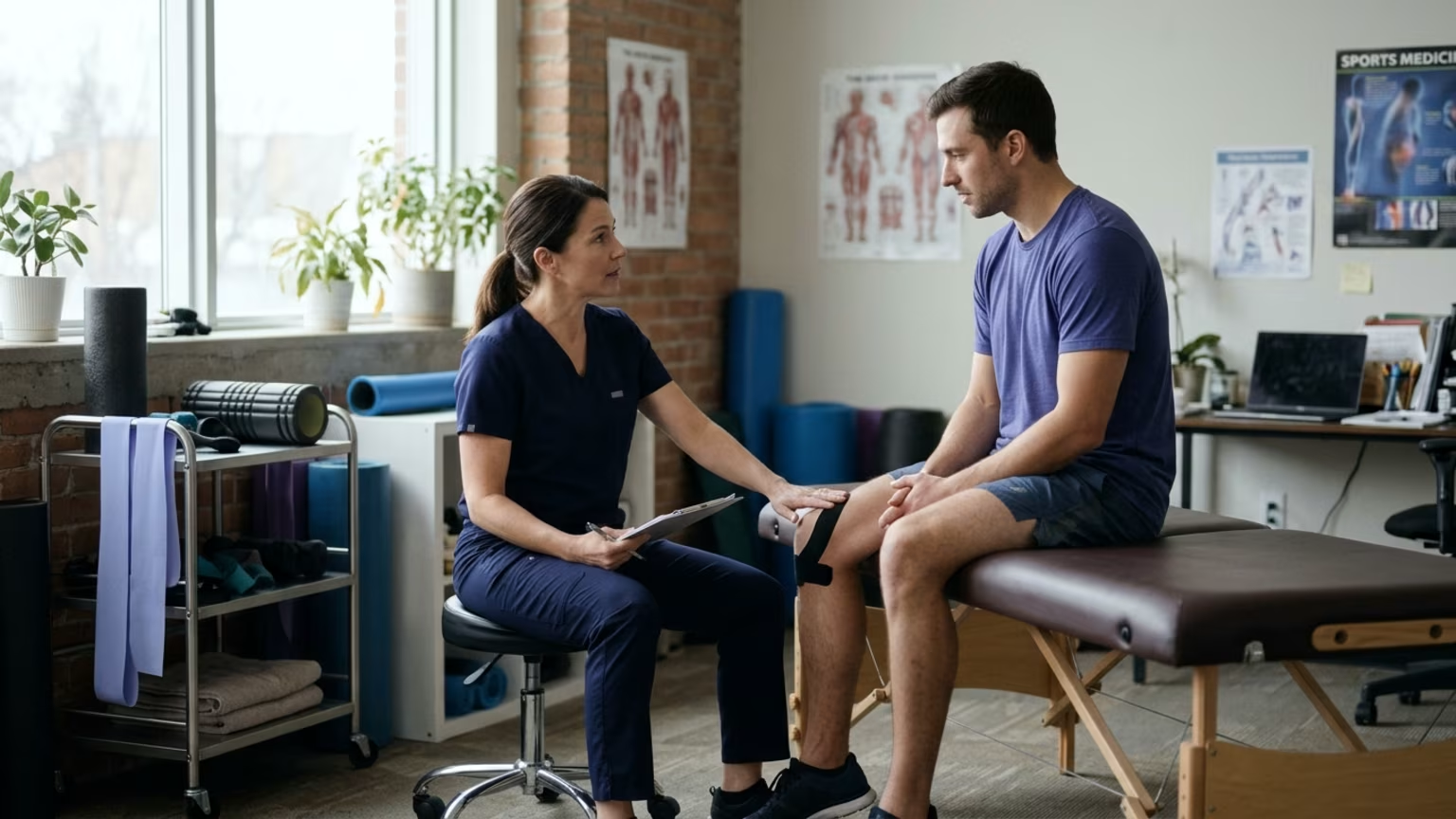
A clinician can explain how a movement finding fits your recovery stage and goals. The aim is not to arrive with your own diagnosis. It is to leave with a clearer understanding of what was assessed and why it matters.
Questions that can make the discussion more specific include:
It may also help to ask what a term means in that particular conversation. If “mobility” appears in a note, ask whether it refers to joint movement or performance during an activity. Clarifying the language helps keep expectations tied to the clinician's actual assessment.
Range of motion describes how far a joint moves. Flexibility and mobility offer useful ways to discuss stretch and actively usable movement, provided their meaning is clear.
The most helpful recovery conversation connects the assessment to the goal. Passive movement, active movement and task performance each answer a different part of the question.
The hip-fracture trial illustrates why practical function belongs in that conversation alongside movement measurements. A position reached with help and an activity performed independently are different observations.
Sometimes the meaningful change is not a farther endpoint. It is a clearer understanding of what the movement allows.
Once movement terms have meaning, interpreting a rehabilitation study is the next step, and ReboundBody supports that step through clear editorial explanations of physical recovery. For adults sidelined by injury or surgery, its articles put clinical language and research findings into context to support more informed conversations with healthcare professionals.

Follow ReboundBody for practical articles on injury recovery, rehabilitation, mobility and rebuilding strength. New posts turn research into clear ideas for the road back to activity after injury or surgery.





Read practical guidance on injury recovery, rehabilitation, mobility and rebuilding strength as you work your way back to activity.
Explore Resources