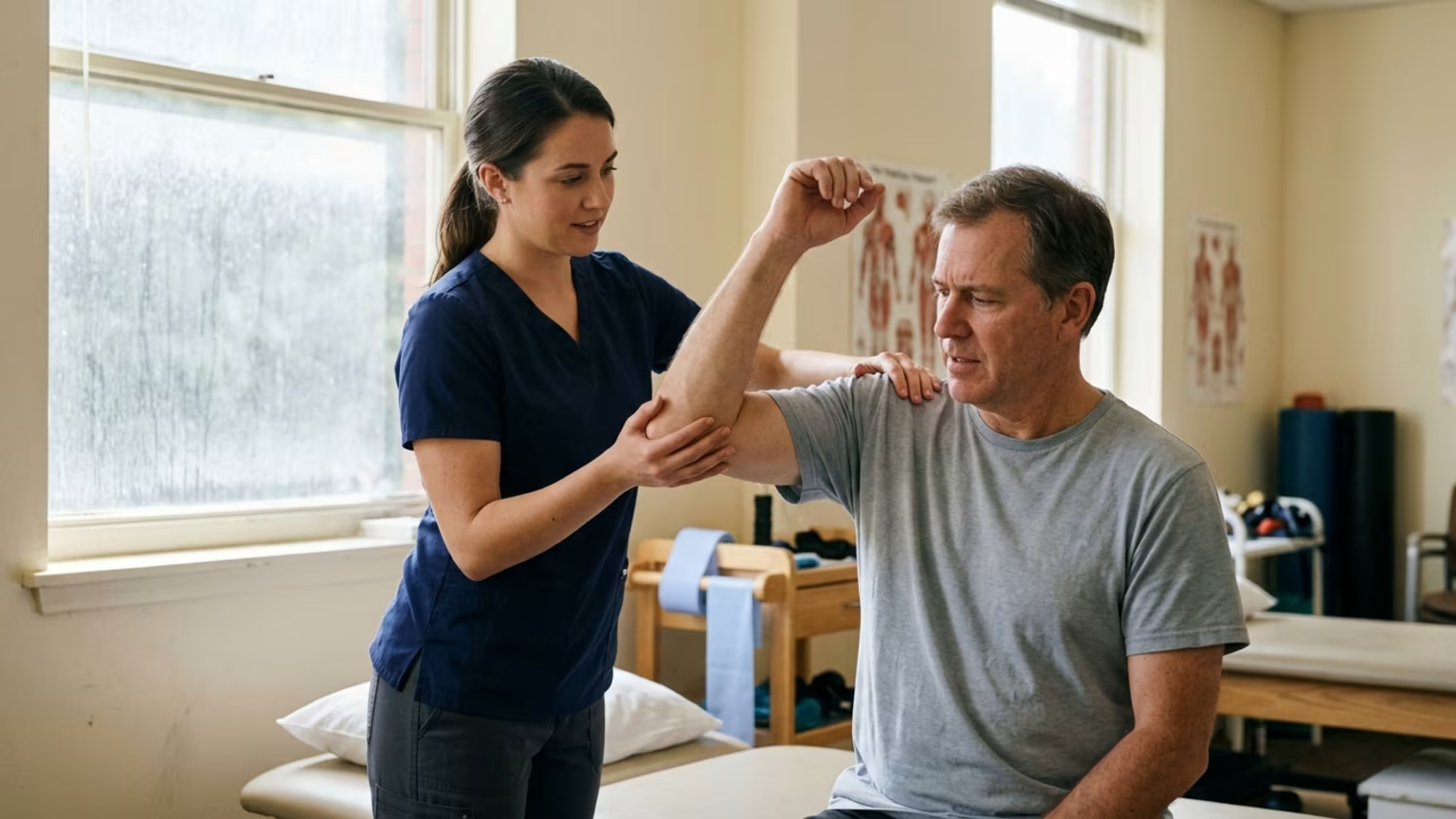

A recent review clarifies active, passive, and assisted range of motion, showing why continuous passive motion adds little benefit after knee replacement.





On September 30, 2026, Science Insights published a review clarifying how different movement strategies support physical rehabilitation. The article is titled "Active ROM vs Passive ROM: When to Use Each in Rehab." It explains the specific roles of active, passive, and active-assisted range of motion in clinical settings. These distinctions help clinicians and patients build realistic expectations for recovering joint function after an injury or surgery.
The review defines active range of motion as movement generated entirely by the patient's own muscles. This type of exercise requires the individual to initiate and complete the motion independently. Active movement demands neuromuscular control, meaning the brain and muscles must work together to move the limb safely. Clinicians often introduce this approach when the healing tissue is strong enough to handle normal muscular force.
In contrast, the article explains passive range of motion as movement produced by an outside force. During passive exercises, a therapist or a mechanical device moves the joint while the patient relaxes their muscles completely. This approach provides motion when a patient cannot yet move independently due to pain or surgical precautions. It helps maintain joint flexibility without placing stress on newly repaired tissues.
The review also highlights a critical middle ground known as active-assisted range of motion. In this approach, the patient contributes muscular effort, while a helper supplies enough assistance to complete the movement. This shared effort allows individuals to engage their own neuromuscular control even when they lack full strength. Active-assisted movement serves as a practical bridge between total reliance on a therapist and complete independent motion.
Understanding these terms can reduce the confusion that often accompanies the first few weeks of physical therapy. When a clinician uses specific clinical terminology, patients can sometimes feel overwhelmed by the instructions. Breaking down the difference between active and passive work makes the entire rehabilitation process much more transparent. This clarity allows individuals to focus on their daily exercises without constantly worrying if they are moving incorrectly.
For decades, physical rehabilitation has utilized various tools to prevent joint stiffness after major surgeries. Therapists have long balanced the need for early joint movement against the necessity of protecting delicate surgical repairs. One common historical approach has been the extensive use of continuous passive motion devices. Often referred to as CPM machines, these mechanical devices repeatedly move a joint through a set range of motion.
A CPM machine typically operates while the patient rests in a bed or on a clinic table. The device gently bends and straightens the affected limb continuously, without the patient actively generating any of the motion. Historically, these machines were a standard part of early recovery protocols following procedures like total knee replacement. The clinical intention was to reduce post-surgical stiffness, decrease joint swelling, and promote better fluid circulation around the healing tissue.
Over time, medical researchers began to evaluate whether these machines actually improved long-term recovery outcomes. A prominent piece of this historical evidence is a 2014 Cochrane review of continuous passive motion after total knee arthroplasty. According to the search results, a secondary clinical summary of this review provides detailed numbers on the practice. The summary notes that the comprehensive analysis examined data across 24 separate scientific studies.
The scope of this research provides important context for current rehabilitation guidelines. The clinical summary reports that the analyzed studies included a total of 1,445 participants. When evaluating the results across this large group, the researchers found that the additional average knee-flexion gain was small. Specifically, the continuous passive motion machine provided an average increase of about 2.4 degrees in knee flexion compared to standard care.
The recent Science Insights publication builds upon this historical evidence to refine current rehabilitation recommendations. The September 30 article presents the different range of motion categories as distinct tools for specific rehabilitation needs. It explicitly avoids framing them as competing methods where one choice is universally best for every situation. Instead, the review emphasizes that the appropriate tool depends on the immediate physical capacity of the healing joint.
Regarding the specific use of mechanical assistance after knee replacement, the review provides a clear update. The article states that continuous passive motion adds little benefit beyond standard physical therapy for this procedure. The small historical gains in knee flexion do not translate into significant functional advantages for most recovering individuals. As a result, the evidence favors therapist-guided active exercise, when safe, over relying on passive machine movement.
Despite this conclusion about CPM machines, the review cautions against treating passive movement as inherently useless. Passive range of motion remains a highly valuable option when independent movement is not currently possible. It is also necessary when a specific surgical rehabilitation plan requires externally assisted motion to protect fragile repairs. The careful application of passive movement can prevent severe stiffness during the earliest phases of tissue healing.
Ultimately, the review emphasizes the practical utility of active-assisted movement in modern rehabilitation settings. This intermediate approach lets a recovering person contribute effort while receiving the help required to complete a motion. Engaging the patient's own neuromuscular control helps rebuild the brain-muscle connection that often weakens after surgery. Active-assisted work allows patients to safely challenge their muscles without risking injury from sudden overexertion.
The conclusions drawn in the recent review are heavily dependent on the specific type of surgery involved. The finding that continuous passive motion adds little value is specific to the common total knee replacement scenario. The article does not suggest that passive movement is unnecessary for every orthopedic procedure or patient population. Applying the knee replacement findings to an entirely different surgery could lead to inappropriate recovery expectations.
In fact, the September 30 article summarizes evidence extending well beyond standard knee joint replacements. It discusses the roles of different movement types in neurological rehabilitation and complex shoulder procedures. For these varied populations, the appropriate movement approach depends heavily on the specific procedure and the tissue-healing status. It also relies on the individual patient's ability to contribute physical effort safely without compromising their surgical repair.
The complexity of these choices is particularly evident in the discussion of rotator cuff repair surgeries. The article reports differing findings regarding the use of passive motion following these delicate shoulder procedures. On one hand, it describes possible stiffness benefits when passive motion is used in some specific circumstances. On the other hand, it notes serious concerns about tissue healing in cases involving large tendon tears.
Because of these conflicting factors, the review refrains from presenting a single rule for all rotator cuff repairs. A massive tendon tear may require extended periods of strict passive movement to avoid catastrophic failure of the surgical anchors. Conversely, a smaller tear might tolerate active-assisted movement much earlier in the recovery timeline. This variability highlights why evidence must be applied specifically to the studied population rather than generalized broadly.
For individuals recovering from an orthopedic setback, understanding these movement categories can make the rehabilitation process feel more logical. People can ask their physical therapist what each specific movement type is intended to accomplish in their personal plan. Clarifying whether an exercise is meant to be active, passive, or assisted helps establish appropriate daily effort levels. This knowledge empowers patients to participate more effectively in their own physical recovery.
When dealing with restricted movement, the article's discussion supports describing active-assisted range of motion as a practical intermediate option. It allows individuals to practice moving a joint safely before they have the strength to lift the limb against gravity. This gradual progression aligns with the principles of gradually increasing physical demands during the later stages of healing. Taking an intermediate step often builds physical confidence while reducing the fear of reinjury.
Recovering full mobility is rarely a straightforward path, and measuring progress by functional ability often provides the most accurate picture. A patient might measure their success by their ability to complete an active-assisted exercise without severe discomfort. This functional approach is often more meaningful than simply tracking joint angles on a chart. It helps people understand that range of motion is not the whole story when determining overall recovery success.
Patients should note that a report questioning the value of CPM machines does not alter existing professional medical advice. The fact that a machine is not routinely valuable after knee replacement does not mean standard physical therapy is unnecessary. Likewise, the available sources do not provide individualized medical advice for anyone currently undergoing treatment. Individuals creating a personal recovery framework must always coordinate with their qualified healthcare professionals.
Any decision to stop a prescribed treatment or change an exercise routine requires clinical guidance. A patient should never abandon a therapy schedule simply because they read a general review of movement types. Instead, this evidence provides a foundation for having more informed conversations with a surgeon or physical therapist. Clear communication about these movement strategies helps ensure that the chosen exercises match the patient's current stage of tissue healing.
While the recent publication offers valuable clarity, certain aspects of physical rehabilitation remain complex and highly individualized. The available search results do not provide a directly accessible official guideline that dictates a universal protocol for every clinic. Because human biology heals at different rates, rigid timelines for progressing from passive to active movement are rarely absolute. Clinical judgment remains the most important factor in determining when a joint is ready for increased physical stress.
The differing findings regarding passive motion after rotator cuff repair perfectly illustrate this ongoing uncertainty. A surgeon must balance the risk of long-term joint stiffness against the risk of tearing a fragile surgical repair. There is no mathematical formula that works for every shoulder, which means guidance will continue to change based on individual assessments. The exact timing for introducing active-assisted movement will always require careful professional monitoring.
The absence of a universal protocol means that two patients with similar injuries might experience different rehabilitation timelines. One individual might progress to active-assisted exercises within days, while another might require weeks of strictly passive movement. These variations do not necessarily indicate that a recovery is failing or that a physical therapist is using outdated methods. Instead, this variability reflects the normal differences in tissue quality, surgical techniques, and individual biological healing rates.
Understanding that healing follows biological rules rather than rigid calendars can help manage expectations. Navigating physical milestones during recovery requires consistent effort and realistic goal setting. Patients must remember that advancing from passive to active movement is a biological milestone, not a scheduled event. Rebuilding the connection between effort and movement requires patience, careful progression, and a willingness to adapt the approach over time.
Altering a prescribed daily routine based on conflicting online claims about recovery tools, exercises, nutrition and treatment options can easily disrupt a safe rehabilitation plan. ReboundBody resolves the difficulty understanding clinical terminology and research findings, helping an active adult confidently discuss their movement strategy with qualified healthcare professionals.

Follow ReboundBody for practical articles on injury recovery, rehabilitation, mobility and rebuilding strength. New posts turn research into clear ideas for the road back to activity after injury or surgery.





Read practical guidance on injury recovery, rehabilitation, mobility and rebuilding strength as you work your way back to activity.
Explore Resources