
Preliminary FORTIFY Bones results favor heavier training for a small spine bone-density benefit. See who was studied and what remains uncertain.





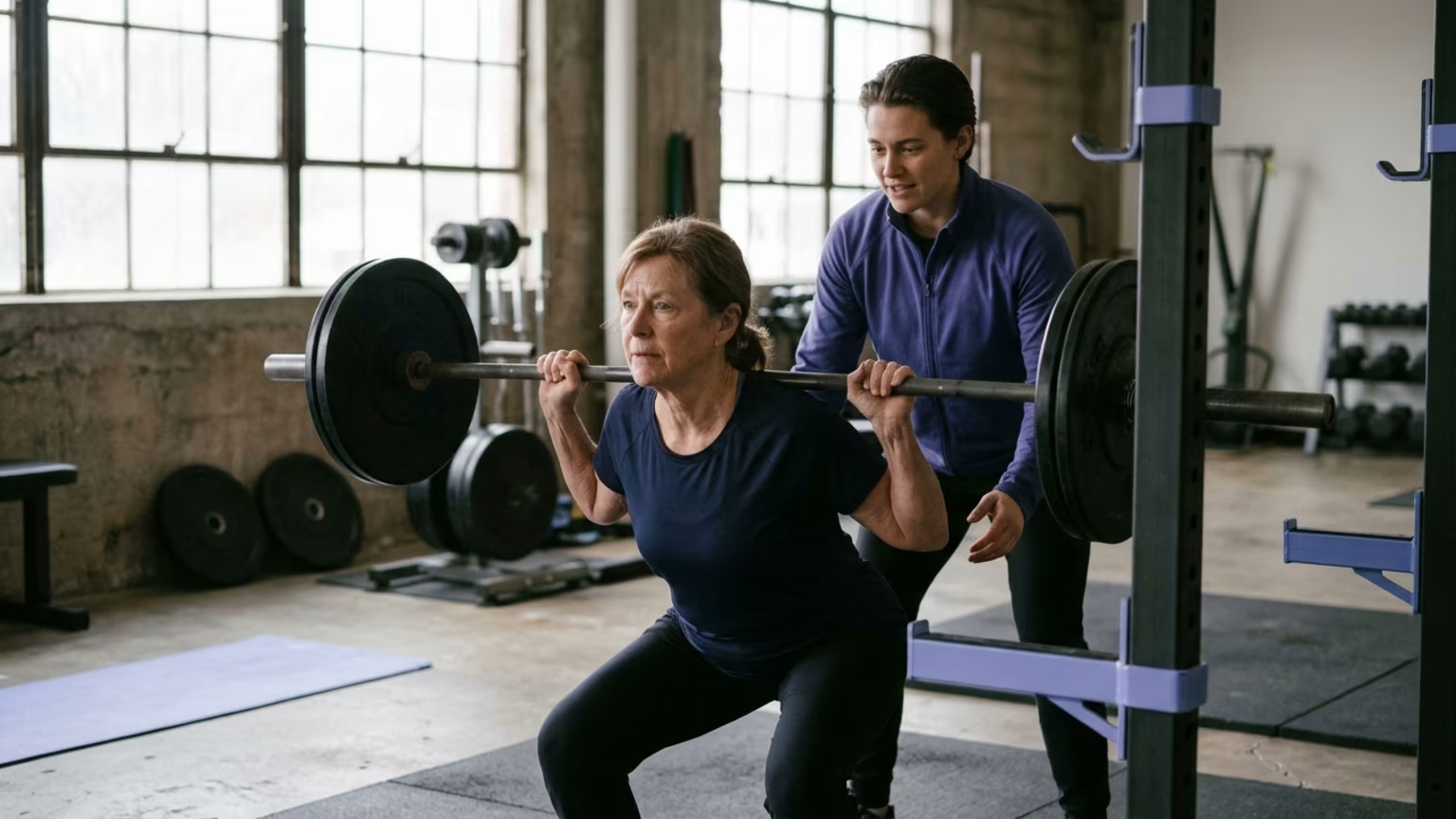
On October 27, 2026, Medscape Medical News reported preliminary results from FORTIFY Bones, a randomized trial presented at the American Society for Bone and Mineral Research (ASBMR) 2026 Annual Meeting in Boston. Over 12 months, high-intensity progressive resistance training showed a small lumbar-spine bone mineral density (BMD) advantage over moderate-intensity training and a home posture-and-balance program.
For adults rebuilding strength, the finding raises a specific question: does the amount of weight lifted matter for bone density? FORTIFY Bones adds evidence about that question. Its relevance becomes clearer when the training methods and measured outcomes are kept separate from broader claims about recovery.
The broader bone-health message already included several forms of activity. The International Osteoporosis Foundation’s World Osteoporosis Day 2026 guidance promoted regular weight-bearing activity and muscle-strengthening exercise. It also included balance exercises and fall-risk reduction.
That context matters because bone-health exercise is not simply a choice between lighter and heavier weights. The foundation’s guidance addresses several parts of staying active. Readers can find related context in our coverage of strength and balance within the wider bone-health picture.
FORTIFY Bones asked a narrower research question. According to Medscape, investigators designed it to isolate resistance training without adding impact exercise. They also wanted to test whether resistance-training intensity made a difference.
The investigator contrasted that design with LIFTMOR, which combined resistance and impact training. Separating those approaches helps researchers examine resistance training more directly. It does not establish that one complete exercise approach is better than another.
The new report therefore adds detail to an existing exercise discussion rather than replacing the broader guidance. Its main contribution concerns training load and a particular bone-density measurement.
Medscape reported that participants were assigned to a home posture-and-balance control program or one of two resistance-training groups. Both resistance-training groups exercised twice weekly. The main outcome was lumbar-spine BMD, with total-hip and femoral-neck BMD also assessed.
The groups differed in how heavy the training loads were:
The program included squats and dead lifts. Participants also performed step-ups and hip thrusts. Upper-body exercises included bench press, landmine presses and rows.
Participants received two individual sessions to learn the exercises. Small-group sessions followed for up to six weeks before training continued twice weekly. This teaching period was part of the intervention described in the report.
When investigators combined both resistance-training groups and compared them with the control group, they reported no BMD effect at the measured sites. That combined result is important. It means the trial should not be summarized as showing that resistance training in general improved bone density.
The positive finding emerged in separate comparisons involving the high-intensity group. Preliminary analyses suggested lumbar-spine BMD was approximately 1% greater in that group than in the moderate-intensity and control groups. Medscape described those differences as statistically significant.
High-intensity training did not show an effect on total-hip or femoral-neck BMD. The finding was therefore specific to the lumbar spine rather than a benefit across all measured locations.
Lora Giangregorio, a University of Waterloo kinesiology and health sciences professor, characterized the spine changes as small. As reported by Medscape, she said the preliminary findings suggest that moderate-intensity resistance training alone may not improve lumbar-spine BMD. High-intensity progressive training may produce small changes.
FORTIFY Bones enrolled 324 adults with an average age of 67, according to Medscape. Participants were predominantly women and White. A separate conference report in Consultant360 described participants as at least 50 years old with low BMD or increased fracture risk.
These details define the population behind the result. They should not be treated as incidental background when applying the findings to adults returning to movement after an orthopedic setback.
The trial excluded people with contraindications to heavy lifting. It also excluded people with recent fractures or joint replacements, among other conditions. Its high-intensity protocol is therefore not a universal starting prescription for someone recovering from injury or surgery.
Mary L. Bouxsein, a Harvard Medical School professor of orthopedic surgery and former ASBMR president, identified another boundary. In Medscape’s report, she cautioned that the older-adult findings may not apply to women going through the menopause transition. She called for more research in that group.
The clearest match is to the older adults studied, not to every person seeking stronger bones or rebuilding physical capacity.
The practical message is about matching the research question to the recovery question. FORTIFY Bones suggests that training load may matter for a specific bone-density outcome. A person’s recovery plan involves a separate decision about which goals and exercise demands fit their situation.
For someone returning after a setback, useful discussion topics include:
These are questions for an individualized conversation rather than a reason to copy the study’s repetition targets. Our article on adjusting training demands during recovery provides related context for understanding that distinction.
The report also does not change the role of osteoporosis treatment. Giangregorio explicitly cautioned against treating exercise as a replacement for medication. She also warned against claiming that these findings show exercise can reverse osteoporosis.
For readers with a fracture history, there is a separate bone-health message. The International Osteoporosis Foundation advises people who have had a fracture after age 50 to discuss bone-health assessment with a doctor. That recommendation is broader than deciding how much weight to lift.
The useful shift is from asking whether heavier training is automatically better to asking what a particular training choice is meant to achieve. Bone-density research can inform that discussion without deciding an individual treatment plan.
The available findings are preliminary conference results reported by Medscape. The investigators said further analysis was needed to confirm the precise effect size. The approximately 1% lumbar-spine difference should therefore remain an early estimate rather than a settled expectation for future participants.
The reported estimates did not account for exercise adherence. Investigators planned additional analyses, including sensitivity analyses considering adherence and nutrition. Those analyses may help clarify how the results should be interpreted.
Medscape reported 91% retention for assessments. That means participants returned for measurements, not that all completed the exercise program as prescribed.
Median exercise adherence was 92% in the moderate-intensity group and 86% in the high-intensity group. Keeping assessment retention separate from training adherence gives a more accurate picture of participation. A high follow-up rate should not be presented as complete participation in every workout.
The report described expected exercise-related adverse events. These included muscle strain, muscle or joint pain, tendonitis and worsening of preexisting conditions. Such events were reported more often among participants attending in-person resistance training than among those exercising at home.
One participant had a bladder prolapse considered possibly related to the intervention. Another participant’s vertebral fractures were initially considered possibly related but were attributed to metastatic cancer that developed during the trial.
Bouxsein said she was encouraged by the reported safety profile. The adverse-event details still matter when interpreting that assessment. They do not support describing the program as free of exercise-related problems.
The presentation did not report muscle-strength or functional results. Investigators planned further analyses of physical functioning, mobility and quality of life.
Bouxsein emphasized the importance of these outcomes for fall risk and quality of life. She also noted that most fractures in older adults result from falls. Those questions matter because a bone-density measurement addresses a different outcome from everyday movement or falling.
Another open question is whether the observed BMD difference translates into fewer fractures. The reported findings do not establish that outcome. Future analyses will help place the spine result within a fuller picture of what the program achieved.
Today, write one question for your next healthcare visit: Which outcomes should guide my return to strength training, and where does bone health fit?
Beyond a study’s bone-density result lies the longer task of rebuilding physical capacity, a subject ReboundBody covers through recovery education. Its independent articles explain rehabilitation and strength rebuilding for active adults facing orthopedic setbacks, with realistic limits and no promises about individual recovery.

Follow ReboundBody for practical articles on injury recovery, rehabilitation, mobility and rebuilding strength. New posts turn research into clear ideas for the road back to activity after injury or surgery.


Read practical guidance on injury recovery, rehabilitation, mobility and rebuilding strength as you work your way back to activity.
Explore Resources