

Why fragility-fracture recovery includes bone-health follow-up, what a pilot trial found, and why stem-cell repair approaches remain investigational.





An October 26, 2026 feature in Outlook Business emphasized a part of fracture recovery that can fade from view: ongoing bone-health follow-up. Its message was that treating the fracture should not end the conversation about osteoporosis care.
The feature quoted Dr. Pratik Kumar, a senior consultant in orthopaedics at Regency Healthcare in Gorakhpur. He said patients should understand why a medicine was prescribed and when to return for review. He also cautioned that feeling better does not necessarily mean the underlying fracture risk has resolved.
The development was a renewed emphasis on continuing care rather than an announcement of a new fracture treatment. For readers recovering after a minor fall or similar low-trauma event, it puts the follow-up appointment alongside the more visible work of returning to normal movement.
The feature's message builds on an established model of coordinated follow-up called a fracture liaison service. A UK osteoporosis charity describes these services as identifying people aged 50 and older after fragility fractures. They connect bone-health assessment and treatment with rehabilitation and falls services.
This model brings related parts of care into the same conversation. Treatment of the fracture addresses the immediate injury. Osteoporosis assessment asks about bone health and future-fracture risk. Rehabilitation and falls services address other parts of the recovery pathway.
A US example predates the October feature. UPMC says it launched its fracture liaison service in July 2023 to address delays in osteoporosis treatment after fragility fractures. Its account describes bringing an endocrinology assessment into the orthopedic inpatient pathway.
UPMC's process includes an in-hospital assessment and laboratory testing that covers vitamin D and kidney function. It also includes discussion with patients and family caregivers. Intravenous zoledronate is described as an option for eligible patients within that service, not a treatment recommendation for every person with a fracture.
The important context is continuity: the initial fracture episode becomes an opportunity to address bone health rather than a separate event. For background on the injury side of that process, ReboundBody explains how bone healing and rehabilitation fit together.
Recent research adds a preliminary finding to this service-based approach. A 2026 pilot randomized controlled trial in Osteoporosis International studied a territorially coordinated, digitally supported fracture liaison service following femur fragility fracture. It compared the service with usual care.
The service group had higher reported Barthel Index functional scores at 3, 6 and 12 months. At 12 months, the reported scores were 80.1 versus 61.2. These are scores on a functional measure, not percentages of patients who recovered.
The authors also reported more sustained osteoporosis-treatment prescribing in the service group. Taken together, those findings suggest that coordinated follow-up deserves attention for its possible connection with functional recovery as well as medication management.
The study found no significant differences in refractures or readmissions. It therefore does not establish that the service prevented repeat fractures. The authors described the model as feasible and called for larger studies.
That distinction matters when reading a positive headline. Better functional scores and fewer repeat fractures are different outcomes. Evidence supporting one should not be presented as proof of the other.
The trial also evaluated a coordinated service. Its findings are best understood as evidence about that care model rather than a reason to credit digital support alone for the reported difference.
The trial concerned people following a femur fragility fracture. That is the group most directly connected to its findings. The results should not become a forecast for every person recovering from a fracture or orthopedic operation.
The UK service guidance has a different purpose and scope. Its description covers people aged 50 and older after fragility fractures. That age threshold belongs to the service model being described; it should not be assumed to describe the trial participants or every bone-health service.
For ReboundBody's readers, the closest match is an adult whose recovery includes questions about both a low-trauma fracture and osteoporosis care. Someone recovering from a different injury may still recognize the value of clear follow-up, but that does not make the study directly applicable to their situation.
A group result is also not an individual recovery timetable. The functional scores offer a way to compare the study groups. They do not tell a reader what their own score should be or when normal activity should resume.
The practical value of this evidence is a clearer conversation with the treating team. It does not require choosing a medicine or exercise program from an article. The sources support asking how bone-health assessment and rehabilitation will stay connected after the initial fracture treatment.
For someone whose fracture followed a minor fall or similar low-trauma event, a useful question is whether osteoporosis and future-fracture risk need assessment. That is consistent with the identification and follow-up role described in the UK fracture liaison service guidance.
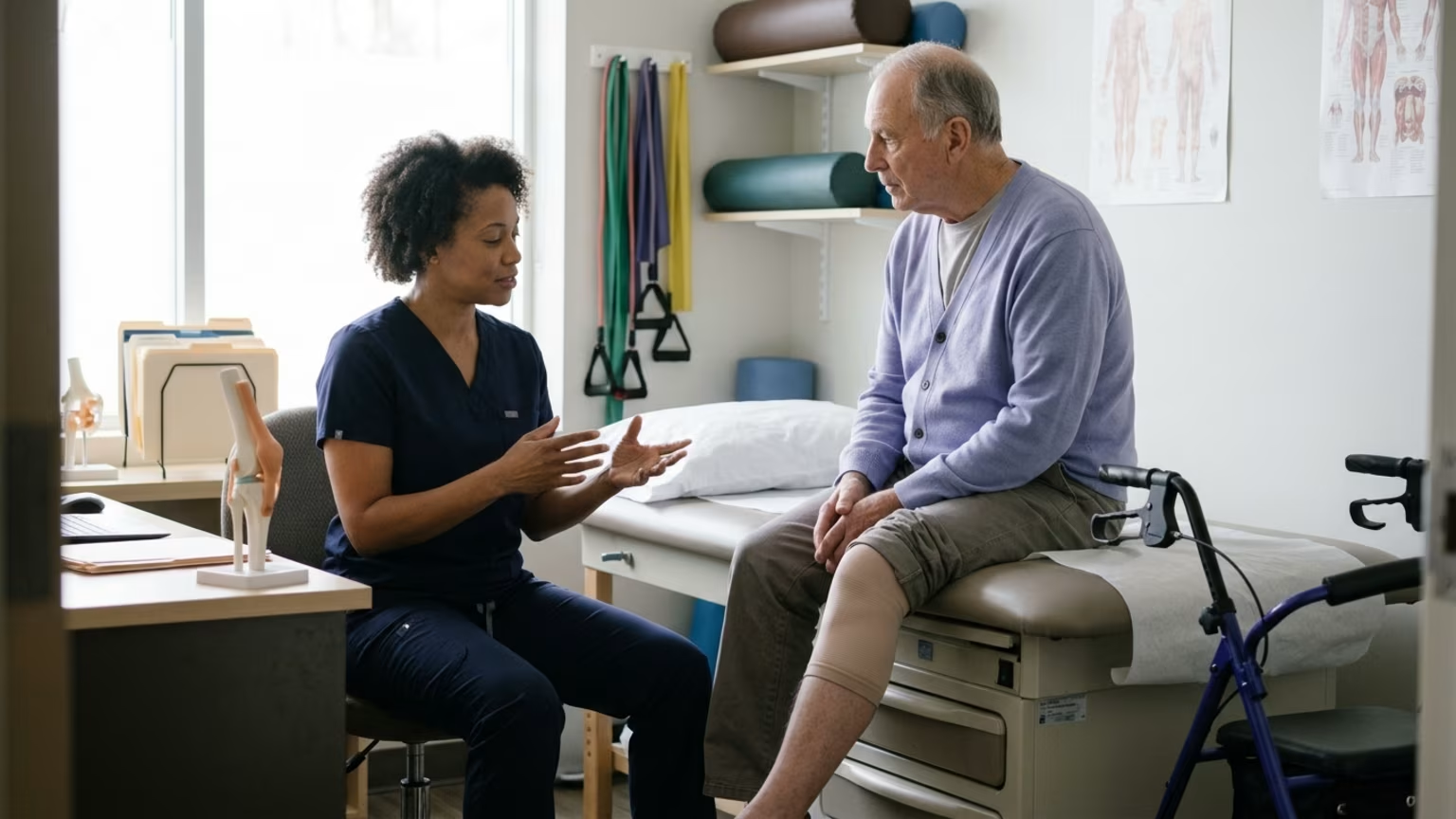
The discussion can also clarify who is responsible for the next stage of care. Is there a fracture liaison service involved? Which clinician will review bone-health findings? How will that review connect with rehabilitation or falls services?
These are coordination questions rather than a request for a particular test or treatment. Their purpose is to understand the pathway already being considered by the care team.
Kumar's advice in Outlook Business centers on knowing why a medicine was prescribed and how to take it. He also emphasizes knowing when to return for review and advises against stopping or changing treatment without medical advice.
A medication conversation can therefore focus on the reason for the prescription and the planned follow-up. Questions about how and when to take it belong with the prescribing clinician. The clinician can also explain what information will be reviewed at the next appointment.
The goal is understanding the existing treatment plan, not assuming that every person needs the same medicine or the same length of treatment.
The feature identifies nutrition and safe physical activity as recovery supports. It does not provide a rehabilitation protocol or nutrition target. Those details need to come from an individualized discussion with the treating team.
A useful way to connect the topics is to ask how the current rehabilitation plan fits with bone-health care. Nutrition questions can be included in that review rather than treated as a separate online search for a recovery product.
For readers trying to understand the transition back to activity, ReboundBody's coverage of how progression is considered after a setback provides related context. It is separate from decisions about a particular person's recovery plan.
Follow-up becomes more concrete when its purpose is clear. Kumar's message supports asking when the next review is due and what medication questions should be addressed there. The coordinated-service sources also support asking how assessment and rehabilitation will connect.
Family members can be part of that conversation. Kumar describes nutrition and safe activity as ways families can support recovery. UPMC likewise describes discussing treatment with patients and family caregivers.
For a broader view beyond the immediate injury, ReboundBody's guide to function and follow-up over the longer recovery period keeps the focus on understanding the next stage rather than meeting a fixed deadline.
The October feature provides clinician commentary, not clinical-trial evidence that a particular follow-up pathway produces a specific result. Its contribution is to highlight an ongoing care issue. The service research supplies a separate line of evidence about how coordinated care might work.
There is also an important boundary around the feature's future-facing bone-repair theme. A 2026 review of osteoporosis and bone-repair research discusses mesenchymal stem-cell-derived extracellular vesicles. It also identifies continuing challenges in research models and clinical evaluation.
A separate 2026 review concerns medication-related jaw osteonecrosis. It describes stem-cell-based and extracellular-vesicle strategies as supported mainly by preclinical or limited clinical evidence. The extracellular-vesicle work discussed in that review is preclinical.
The jaw review addresses a different clinical setting from routine recovery after a limb fracture. Together, the reviews support describing these approaches as investigational rather than established fracture-repair treatments. Further clinical research is needed before claims about their role in patient care can be settled.
The remaining service questions are more practical: which coordinated models work best and how well their results carry across care settings. For US readers, descriptions of services elsewhere are useful context rather than a promise that the same pathway is available locally.
That brings the October feature back to the follow-up appointment. Feeling better is an important part of recovery, but it need not close the conversation. The next review has a separate purpose: understanding bone health and how it connects with the return to activity.
Fracture-repair headlines can blur the difference between coordinated follow-up and experimental treatments, so ReboundBody separates research findings from open questions. For active adults in midlife and later life facing conflicting recovery claims, its independent coverage connects rehabilitation and return-to-activity topics with realistic limits to support informed conversations with qualified healthcare professionals.

Follow ReboundBody for practical articles on injury recovery, rehabilitation, mobility and rebuilding strength. New posts turn research into clear ideas for the road back to activity after injury or surgery.



Read practical guidance on injury recovery, rehabilitation, mobility and rebuilding strength as you work your way back to activity.
Explore Resources