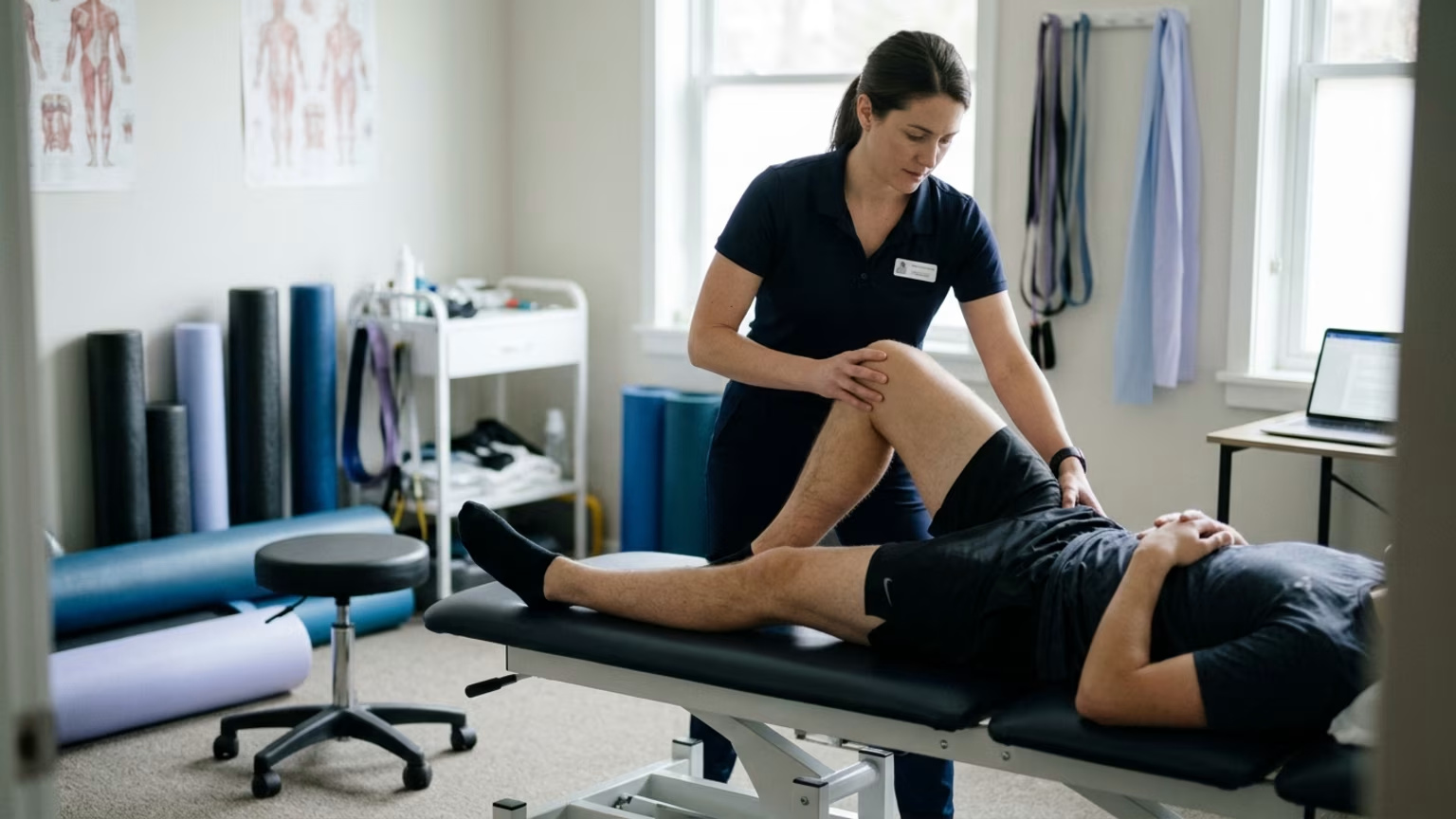

A small groin-pain study found no significant link between examination pain and measured performance. See who was studied and what remains uncertain.





A November 18, 2026 BIOENGINEER.ORG report described a small study in which pain during groin examinations was not significantly associated with measured strength or functional performance after statistical correction. The finding concerns physically active adults with persistent groin pain rather than a new rule for returning to sport.
The distinction matters when an examination result seems to tell a larger story about recovery. In this study, whether a test reproduced pain did not reliably indicate the results of specific strength, balance-reach or hopping measures. That gives clinicians and patients a focused question: What information does each part of an assessment actually provide?
Related research has examined how hip and groin pain are described. A November 13, 2026 scoping review of consensus statements addressed terminology for hip and groin pain. Naming or classifying a clinical problem is a different question from measuring how someone performs a physical task.
The study covered in the later report sits within that distinction. Its examinations recorded pain reproduction during adductor squeeze testing, hip tests and targeted palpation. Those findings described responses during particular examination maneuvers.
Strength and functional assessments supplied another kind of information. They recorded force production and performance on selected tasks rather than relying on whether an examination was painful.
This is the context for interpreting the update. The study compared types of assessment information. It did not replace the question of symptoms with a question of performance; it examined whether the answers were related.
According to the study report, researchers paired the pain examinations with handheld-dynamometer measurements of strength across several hip and knee movements. These were isometric tests, meaning force was measured during a held effort.
The functional measures were the modified Star Excursion Balance Test and the cross-over hop test. These provided balance-reach and hopping outcomes. Here, the term “functional performance” refers to those particular tasks.
Pain responses were common in some examinations. Palpation of the left adductor region provoked pain in 74.3% of valid observations. The left flexion-abduction-external-rotation test provoked familiar pain in 70.3% of evaluations.
These figures describe responses to particular examinations on the left side. They are not percentages of participants who had weak muscles, poor balance or difficulty hopping. Keeping that distinction clear is important when reading a report that includes both pain findings and performance measurements.
Researchers tested 448 associations between examination findings and measured strength or function. The analysis adjusted for age, body mass index and height. The researchers also applied false-discovery-rate correction to account for the multiple comparisons.
None of the tested associations remained statistically significant after that correction. In plain language, no tested relationship met the study's statistical standard once those adjustments were applied.
The authors concluded that pain-provocation findings should not be treated as stand-alone measures of functional capacity. They recommended combining clinical classification with objective strength and sport-specific evaluation. That conclusion concerns the role of different assessment methods rather than a particular exercise program.
The study assessed 37 physically active adults with clinically diagnosed groin pain lasting at least six weeks. Participants were 18 to 45 years old, with a mean age of 30.19.
Those details define the group behind the result. This was a study of ongoing groin pain in physically active adults within a particular age range. It was not a broad survey of everyone rebuilding movement after a physical setback.
For readers in midlife or later life, the age range deserves attention. The study does not directly establish what happens in adults aged 46 to 75. It also does not establish the same relationship in people recovering from surgery or other orthopedic conditions.
The findings are therefore most directly relevant to understanding assessment results in a similar groin-pain population. Readers with a different recovery history may recognize the broader question about symptoms and capacity without assuming that this study answers it for them.
The practical relevance is about how assessment results are explained. It is not a reason to change a rehabilitation plan based on a headline. The study supports discussing both symptoms and measured ability with a qualified clinician.
For someone trying to understand an assessment, useful questions include:
These questions keep clinical terms attached to their meaning. A “positive” pain-provocation finding in this report concerns pain reproduced during an examination. It should not be read as a strength score or a complete description of sporting ability.
The same care applies to the word “objective.” A measured result is more useful when its scope is clear. In this study, the report identifies the strength methods and the functional tasks rather than treating performance as one broad quality.
For readers moving beyond rehabilitation, the larger topic is the transition from basic strength to everyday tasks. The question is how a finding fits the activity being discussed, not whether one result can stand for every part of recovery.
Questions about the gap between daily activity and sport belong in that conversation as well. This study gives a reason to ask what an assessment measured before assigning it a larger meaning. Personal decisions about activity still require interpretation by the treating healthcare professional.
The study was exploratory and cross-sectional. It assessed relationships at one point rather than following recovery over time. It was not a rehabilitation trial or a test of return-to-sport decisions, so the findings are not a forecast of future performance.
The small sample also limited statistical power. The report notes that real associations may have been missed. A result that did not reach statistical significance is not proof that no relationship could exist in a larger or different sample.
The analysis had another important restriction. Information about sex and which side had symptoms was not retained in the analytical dataset. Researchers therefore could not examine sex-specific differences or compare symptomatic limbs with asymptomatic limbs.
The testing also covered only part of physical capacity. It did not assess eccentric strength, rapid force production, endurance or sport-specific loading. Balance reach and cross-over hopping were the functional tasks studied rather than a complete set of real-world demands.
These findings do not show that all participants had normal function. They also do not make pain unimportant or invalidate examination for diagnosis. The narrower finding is that the recorded pain responses did not reliably stand in for the measured outcomes in this sample.
The evidence comes principally from a single-study report rather than an independently replicated finding. It does not establish that a particular combination of tests improves outcomes or prevents reinjury. It also supplies no universal clearance threshold or validated return-to-sport checklist.
Those gaps leave several questions open. Would a larger study find relationships that this analysis missed? Would other strength measures or activity-specific tasks produce a different pattern? Would following people through rehabilitation change how useful these examination findings appear?
For now, the practical interpretation is modest: symptoms and relevant measures of capacity belong in the same clinical discussion. Which measures matter for an individual condition and intended activity is a question for qualified care.
For someone hoping to return to a familiar activity, a clearer picture may begin with allowing pain and performance to describe different parts of recovery.
Once groin-pain test results have been explained, the next question is how rehabilitation connects with usual activities, a transition covered by ReboundBody's independent recovery writing. Its articles put movement and strength rebuilding into plain language for adults facing that uncertain transition after an orthopedic setback, supporting more informed conversations with their healthcare team.

Follow ReboundBody for practical articles on injury recovery, rehabilitation, mobility and rebuilding strength. New posts turn research into clear ideas for the road back to activity after injury or surgery.






Read practical guidance on injury recovery, rehabilitation, mobility and rebuilding strength as you work your way back to activity.
Explore Resources