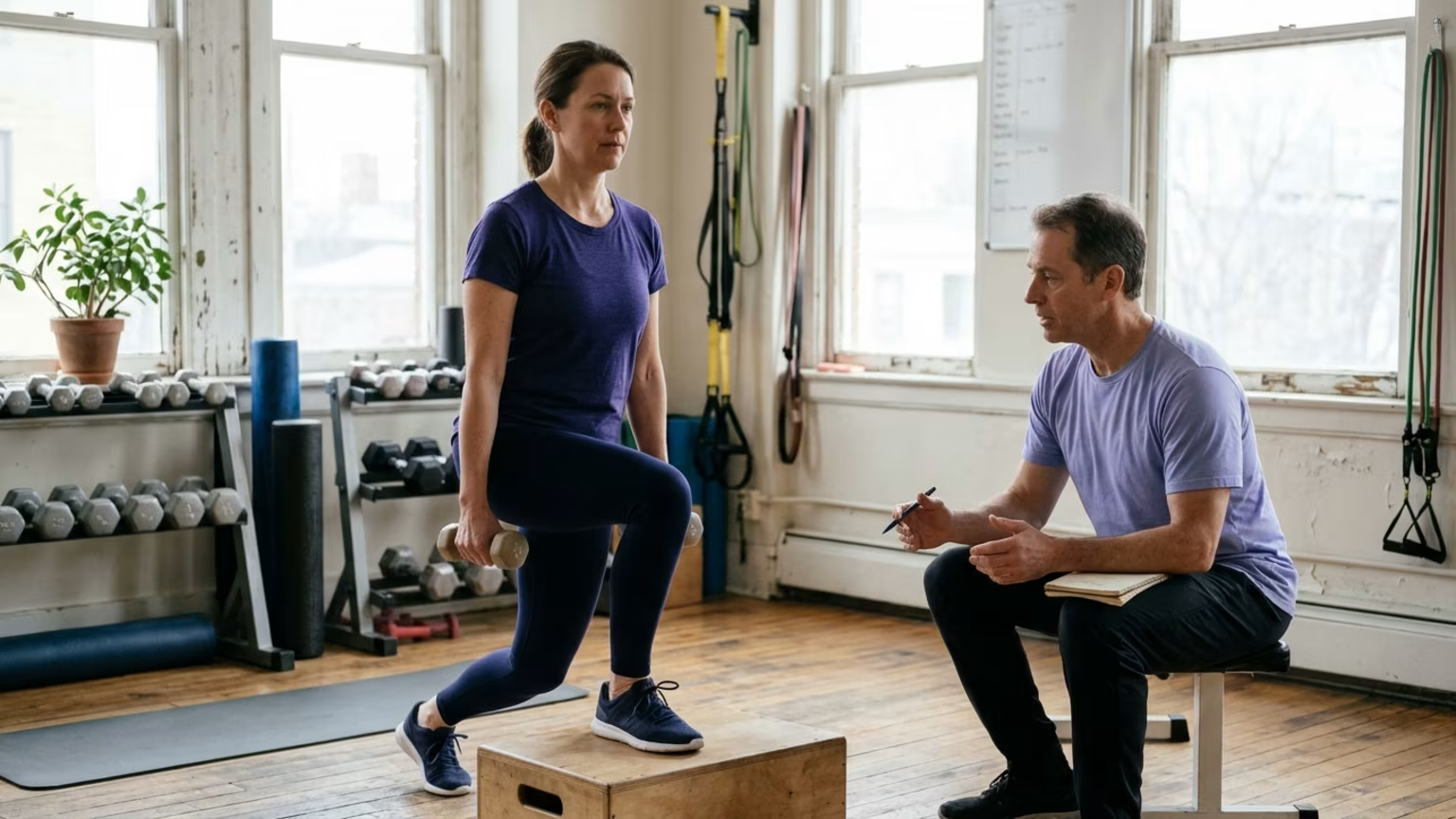

Understand gradual strength progression, the role of symptoms and function, and why changing one training variable can make responses easier to interpret.





Changing one training demand at a time can make strength progression easier to interpret, according to a sports-medicine clinic’s return-to-sport guidance. The broader principle is to increase demand gradually while considering performance and the response afterward. The single-variable approach is practical guidance, not a method shown to be safer or more effective than other approaches across rehabilitation settings.
An ICCUS Society consensus on athletic hamstring injuries supports individualized rehabilitation that progressively loads tissue. A narrative review of rehabilitation after ACL reconstruction also describes progression through decisions informed by movement, symptoms and performance. Together, they support thinking about the next demand in relation to current capacity rather than assuming an old workload is the right starting point.
Progression varies because the condition being treated and the activity being rebuilt are not the same for everyone. The hamstring consensus describes a path toward running and sport demands. The ACL review considers recovery after a specific operation and the criteria used during that process.
These sources concern athletic hamstring injuries and ACL reconstruction. They do not provide a shared protocol for joint replacement, fracture or tendon recovery. The ACL review also describes variable evidence for how exercise dose relates to outcomes and for specific cutoffs. Its return-to-running and return-to-sport thresholds depend on the population and protocol rather than serving as universal clearance standards.
Within those boundaries, the research highlights several factors that shape progression:
This makes progression a question of context rather than a contest to add more. A change in resistance and a change in running speed place different demands within a recovery plan. Their relevance depends on what the person is rebuilding.
It also helps to separate a long-term goal from the next decision. A previous workload may describe where someone hopes to return. It does not establish what demand belongs in the next stage of rehabilitation.
No. Added resistance is one form of progression, but the sources describe changes in duration, movement range and task complexity as well. The hamstring consensus also discusses running dosage and intensity.
The ACL review describes progressing resistance, range or task complexity in relation to technique and symptoms. That means the weight used is only part of the picture. A useful description of progression needs to identify which part of the activity is becoming more demanding.
The hamstring consensus offers a sport-specific example. It describes gradually increasing running dosage, duration and intensity while progressing toward sprinting and agility. It also places those demands within broader decisions about sport-specific workloads and readiness.
These examples show why “doing more” is an incomplete description. More resistance is different from a longer effort. A more complex task is another kind of change again.
A clearer account names the demand rather than using “harder” as a catch-all term:
The point is not to work through this list in a fixed order. It is to make the progression being discussed clear. ReboundBody’s explanation of training demands beyond weight provides further context for that distinction.
Changing one variable at a time is a useful way to make a response easier to interpret. The clinic’s return-to-sport explainer argues that changing duration, intensity and complexity together makes it harder to identify what prompted a symptom flare.
The practical value is clarity. When several demands change together, the description of what happened becomes less specific. Keeping other parts of an activity relatively stable provides a clearer starting point for discussing the response.
As an organizing strategy, this approach focuses on three questions:
Those questions describe a way to understand a progression plan. They do not specify which variable a particular person should change. That choice belongs within the injury-specific plan and its clinical criteria.
The distinction matters because recording a response and selecting a treatment are different tasks. A clear description can help explain what followed a change without claiming to prove exactly why it happened. The information becomes part of a clinical discussion rather than a stand-alone decision about the next workload.
This is also why a sudden return to several parts of a past workload can be difficult to interpret. The research supports measured increases guided by performance and response. Describing one change clearly keeps attention on that relationship instead of treating completion alone as evidence of progress.
Readiness is a decision based on several kinds of information, not pain alone. The ACL review describes progression using symptoms, movement and strength alongside task performance and response to loading.
Its assessment picture includes:
These categories keep the question broader than “Did it hurt?” They also keep it broader than “Did I finish?” Completing a task is one observation within a larger picture of function and recovery.
The review’s approach supports tracking what changed and what followed. A useful account distinguishes the demand from the response: the activity became longer or more resistant, then symptoms and function were observed. That provides more context than simply describing a session as good or bad.
ReboundBody’s guide to recording symptoms and daily function addresses this observation side of recovery. The purpose is to make a pattern easier to discuss rather than turn a symptom record into permission to advance.
Symptom monitoring is not self-clearance for activity. After surgery or when restrictions apply, progression should follow the treating clinician’s plan. Recurring swelling or worsening symptoms also calls for discussion with that clinician rather than an independent increase in demand.
For a return to demanding recreation or sport, the target activity matters too. The hamstring consensus considers sport-specific workloads and readiness. That connects the progression decision to what the activity will eventually require rather than to a single successful exercise.
A useful conversation starts with the specific demand under consideration. “What would support a longer effort?” is a more focused question than “Can I do more?” It gives the discussion a defined activity and a defined change.
Questions grounded in the sources include:
These questions connect the person’s goal with the criteria being used in care. They also help explain the reasoning behind a progression decision rather than reducing it to a date or a previous workload.
The central idea is measured change. The hamstring consensus and ACL review support gradual progression informed by performance and response within injury-specific care.
Changing one variable at a time adds a practical way to describe that process. It makes the question more precise: what changed and what followed? Broader readiness still rests on the clinical picture and the demands of the intended activity.
For further background, ReboundBody’s discussion of load changes during strength rebuilding connects these ideas with the wider recovery process.
Progress does not have to be described only by how much more someone did. Sometimes the useful part of a smaller step is being able to see what changed.
Choosing which activity demand to increase raises a practical question; ReboundBody adds educational context rather than making the personal training decision. For adults unsure about resuming normal activity after formal rehabilitation, its independent articles explain strength rebuilding and movement recovery to support better-informed discussions with qualified healthcare professionals.

Follow ReboundBody for practical articles on injury recovery, rehabilitation, mobility and rebuilding strength. New posts turn research into clear ideas for the road back to activity after injury or surgery.






Read practical guidance on injury recovery, rehabilitation, mobility and rebuilding strength as you work your way back to activity.
Explore Resources