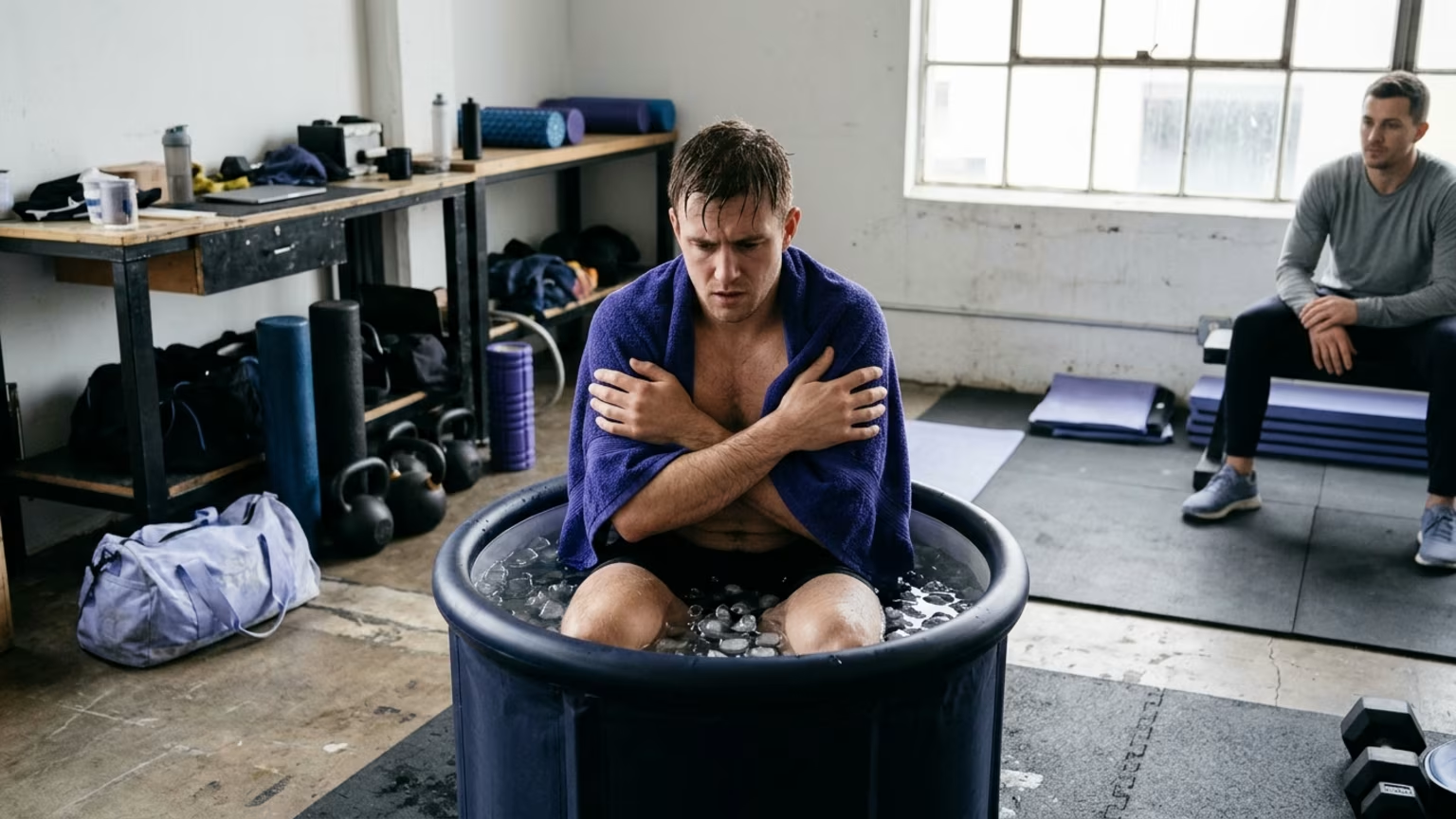

A small ice-bath study found short-lived pain relief without a clear strength-recovery advantage. Here is how to read the findings and their limits.





On November 9, 2026, New Scientist reported on a study that separated two outcomes often grouped together: feeling less pain and regaining muscle strength. Cold-water immersion was associated with less pain the day after strenuous exercise. The study did not establish that it restored strength better than passive rest.
The distinction matters when reading claims about ice baths. A recovery method might change how someone feels without producing a matching change in physical performance. This trial measured both outcomes, along with markers related to muscle damage and cellular stress.
Its most useful contribution is not a verdict that cold is bad or heat is best. It is a clearer question: what does a recovery method actually improve?
The wider evidence was already unsettled before the latest news coverage. A 2026 umbrella review available through PubMed Central examined reviews of cold-water immersion. It described evidence for objective performance and several physiological markers as mixed, dependent on context or insufficient.
Those outcomes included creatine kinase and other blood or physiological measures. The review's findings do not support treating every recovery outcome as interchangeable. A result about soreness answers a different question from a result about performance.
That background helps explain why a single study can produce findings that seem to conflict. Less discomfort, a change in a blood marker and restored strength are separate observations. They need not move together.
Lead author Freya Bayne made a related point in comments to New Scientist: recovery methods should be selected for the desired outcome rather than assuming that one method works for everything. That shifts the discussion away from finding a universal winner. It asks whether the evidence matches the benefit being claimed.
According to the University of East London, researchers randomly assigned 40 healthy, physically active adults to different recovery conditions after demanding exercise. The participants regularly strength-trained.
They completed intense eccentric knee-extension exercise intended to stress the quadriceps. The researchers then compared:
New Scientist reported that average muscle strength fell 36% immediately after the exercise. That drop gave the researchers a way to follow how strength returned during the observation period.
At 72 hours, the cold-water group had regained about 82% of maximum strength. The passive-rest, hot-water and hot-air groups had regained about 89%, according to New Scientist.
The statistical detail belongs alongside those figures. The University of East London summary says the differences in strength recovery between the groups were not statistically significant. The study therefore did not establish that cold-water immersion caused poorer strength recovery.
The observed numbers are worth reporting, but they are not a firm ranking of the methods. They show what happened in this sample. They do not justify presenting the numerical gap as a proven treatment effect.
New Scientist reported less self-reported pain in the cold-water group at 24 hours. Pain had increased again by 48 hours. By 72 hours, none of the groups reported a significant reduction in pain or soreness.
That pattern makes the timing of a claim important. Describing cold as providing next-day pain relief is different from describing it as producing lasting relief. In this study, the early finding did not continue through the later follow-up.
A headline focused only on the first pain measurement would leave out that change over time.
The researchers also measured creatine kinase-MM, or CK-MM. This is a muscle enzyme measured in blood as a marker associated with muscle damage. New Scientist reported that CK-MM in the cold-water group remained 25% above normal at 72 hours.
The report also said CK-MM returned to normal faster in the hot-water group than in the passive-rest and hot-air groups.
Heat produced another measurable response. According to the University of East London, heat-based treatments increased expression of heat shock protein 72, or HSP72. This cellular stress protein is associated with protective and repair-related processes.
However, the university emphasized that these marker changes did not translate into significantly better strength recovery or lower soreness during the observation period. That is an important check on claims that heat clearly accelerated recovery.
The blood and cellular findings add information. They do not replace the strength results or the participants' reports of pain. Reading the findings together gives a fuller picture than selecting whichever result makes one method look best.
This was a study of healthy adults who were physically active and regularly trained for strength. It examined their response to an exercise session designed to produce muscle damage. Those features define the population and setting behind the results.
The study was not a clinical trial of orthopedic rehabilitation. It did not establish what cold exposure does after surgery or during treatment of an injury. It also does not establish outcomes for midlife and older adults rebuilding capacity after a physical setback.
A shared goal does not erase that difference. Both a strength-trained study participant and a person in rehabilitation may want to regain strength. Their recovery situations are not automatically equivalent.
The passive-rest comparison also needs context. In this experiment, it was a 30-minute period at room temperature after exercise. It was not a recommendation about how much activity someone should do across an injury recovery or rehabilitation program.
For ReboundBody readers, the relevant connection is the distinction between comfort and capacity. Applying a particular heat or cold method to an individual recovery plan remains a separate decision for qualified care.
The practical value is a better way to evaluate a claim, not a reason to replace a treatment plan. Before calling a recovery tool effective, it helps to identify the outcome being discussed.
A report about pain relief answers whether people felt less pain at a measured time. A strength result answers whether performance on the study's strength measure had returned. A blood-marker result describes a biological measurement.
In this trial, those answers did not all point in the same direction. That is why a broad statement such as “this improves recovery” needs more detail.
For someone rebuilding strength, useful questions for a healthcare discussion might include:
These questions do not require choosing cold over heat or heat over rest. They help separate the reason for using a method from assumptions about what it accomplishes.
A temporary change in soreness should not stand in for an assessment of strength or function. That is an interpretation of the distinct outcomes measured in this study, not a rehabilitation protocol tested by the researchers. Personal decisions about activity and treatment belong with the healthcare professionals involved in the person's care.
For broader context, ReboundBody discusses how symptoms change as activity increases and readiness for activity beyond pain relief. These related topics help frame questions about what progress means without turning a recovery headline into an individual exercise plan.
The same reading approach applies to claims about heat. A favorable laboratory marker is worth noting, but a claim about restored strength should be supported by strength findings. The outcome named in the claim should match the outcome actually measured.
The trial followed one exercise bout over 72 hours. It does not answer what happens with repeated use over a longer period.
Bayne told New Scientist that several other questions remain open. These include whether results would differ with:
Those are meaningful differences in the situations being studied. A result from one exposure after one demanding session does not settle how every version of a recovery method performs.
Mike Tipton of the University of Portsmouth also cautioned against treating the findings as a reason to abandon ice baths altogether. Speaking to New Scientist, he identified repeated activity in heat and multi-day events as contexts where cold-water immersion may help.
That was expert commentary about other settings, not an outcome demonstrated by this trial. It points toward the need to match future research to the conditions in which people use these methods.
Further evidence may clarify which outcomes respond to cold or heat and when those responses matter. The useful next step for research is to make those goals explicit rather than treating recovery as one single result.
Keep the recovery goal clear. Comfort deserves attention without being asked to prove more than it measures.
Deciding how much weight to give an ice-bath claim is an information question, and ReboundBody addresses it through independent recovery writing. For adults sorting through competing claims about recovery tools, the site's clear explanations distinguish evidence from uncertainty so conversations with their healthcare team can begin with a better understanding.

Follow ReboundBody for practical articles on injury recovery, rehabilitation, mobility and rebuilding strength. New posts turn research into clear ideas for the road back to activity after injury or surgery.






Read practical guidance on injury recovery, rehabilitation, mobility and rebuilding strength as you work your way back to activity.
Explore Resources