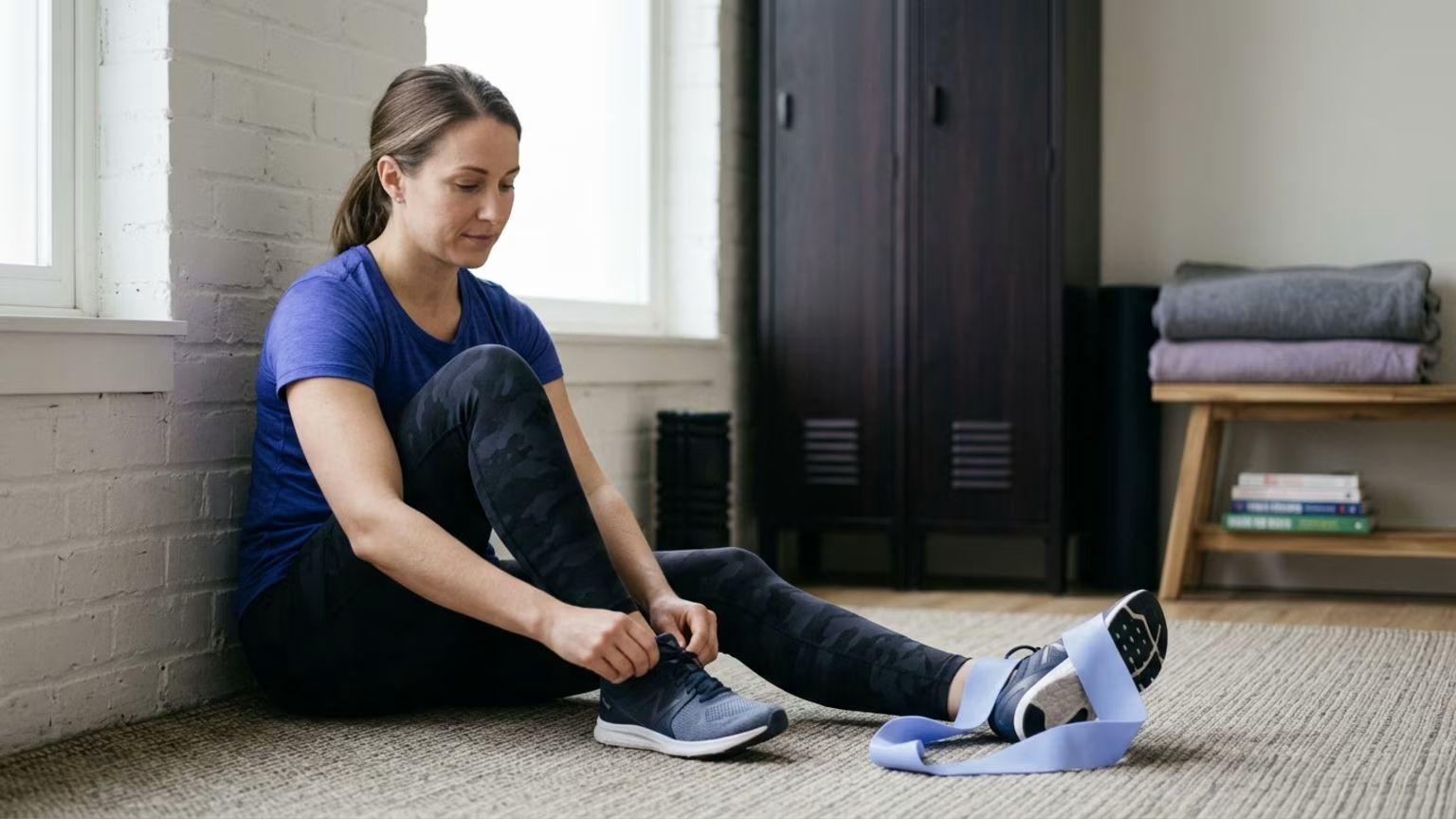

Returning to exercise requires more than waiting for pain to fade. Learn how strength, coordination, and confidence affect your readiness to resume activity.





Waiting for the pain to fade is not the same as being ready to return to your sport. For many active adults recovering from an orthopedic injury, the absence of pain feels like a clear green light. They assume that a quiet joint means their body is fully prepared to resume its normal routine. This common belief sets up a misleading expectation about how physical capacity is restored.
It reduces a complex biological and mechanical process to a single symptom. Pain is indeed a crucial marker of tissue healing. However, assuming symptom relief equals physical readiness often ignores the loss of strength and coordination that occurs during downtime.
Current rehabilitation research shows that returning to activity is better understood as a staged progression rather than a pass or fail moment. In clinical literature, pain is only one piece of the broader readiness puzzle. A review of on-field rehabilitation after anterior cruciate ligament injury describes progression starting from controlled running and simple drills. This progression moves toward multidirectional movement, sport-specific skills, practice simulation, and eventually full play.
The review identifies four broad aims for on-field rehabilitation that span multiple physical systems. The first aim is to restore movement quality, ensuring the mechanics of the joint function properly. Rebuilding physical conditioning is the second aim, which focuses on overall stamina and work capacity. The third aim focuses on restoring sport-specific skills through targeted practice. The final aim is to progressively develop training load so the body can handle repeated stress.
Achieving these aims requires more than simply waiting for symptoms to subside. Clinicians look at a wide range of progression considerations to assess how the body handles movement under load. These considerations include swelling, range of motion, perceived instability, strength, balance, movement quality, and coordination. They also include a person's tolerance of increasing exercise demands and their fear of reinjury.
These different physical and psychological capacities need not recover at the exact same time. The review describes progression criteria spanning hopping, running, movement quality, and psychological comfort. The medical literature treats these as distinct goals rather than assuming a quiet joint has automatically recovered full function. Evaluating these systems independently provides a much clearer picture of overall physical readiness.
Readiness also means different things at different stages of the recovery timeline. Becoming active again is not necessarily the same as returning to full sport demands. The reviewed staged models transition from controlled, predictable activity to increasingly complex and reactive tasks. Following this staged approach is a core element of returning to exercise after injury.
The idea that pain dictates readiness persists because it makes logical sense on the surface. When an injury happens, pain is usually the most immediate, restrictive, and distressing symptom. Our instincts tell us that pain indicates damage, so a lack of pain must mean the damage is gone. This intuitive reasoning leads many to believe that their physical structures are perfectly capable of handling stress again.
Historically, some older models of rest and recovery reinforced this simplified view of healing. Patients were often told to rest until the pain stopped, at which point they were cleared for normal activities. This oversimplification ignores the reality of muscle atrophy and neuromuscular detraining that occurs during inactivity. When you rest an injured joint, the surrounding muscles lose strength and power very quickly.
The nervous system also becomes less efficient at coordinating complex movements or maintaining balance. None of these deficits cause pain while you are sitting on the couch or walking slowly. Consequently, a person might feel entirely symptom-free while resting but remain completely unequipped for the unpredictable demands of their sport. A sudden return to high-level activity without rebuilding these capacities often exposes hidden vulnerabilities. Understanding this disconnect is essential for anyone returning to sport after orthopedic surgery.
A 2026 review of on-field rehabilitation after anterior cruciate ligament injury identified 38 sources on the topic. The evidence base was largely descriptive in nature, focusing on observed clinical practices. Among the 32 articles rated by evidence level, 27 were classified as level four or five evidence. The review also included two randomized controlled trials, highlighting a need for more rigorous future research.
The review found that progression is generally described as criterion-based rather than time-based. However, the specific functional criteria varied widely across sources and different rehabilitation phases. In the reviewed literature, some early-phase criteria allowed a strength asymmetry of approximately 20 to 30 percent between limbs. This leniency suggests that early activity does not require perfect symmetry, provided the loads remain controlled.
Later-phase criteria were much stricter and sometimes required full symmetry before progression to more demanding activities. This significant variation argues against presenting one single threshold as universally appropriate for all stages. The review does not establish a universal test battery for on-field rehabilitation, nor does it identify a single validated strength symmetry threshold. Furthermore, the authors note there is limited actionable guidance for standardizing practice across different clinics.
The researchers caution that their findings may not generalize well beyond anterior cruciate ligament injuries and contact team sports. A separate 2026 review abstract focusing on ankle sprains reached a similar conclusion regarding the lack of universal standards. That abstract reports there is no consensus or gold-standard test battery to evaluate functional recovery after an ankle injury. This persistent lack of universal standards means that readiness assessments must remain highly adaptable.
A person who feels less pain may still need to rebuild strength, stamina, balance, coordination, or confidence before resuming a familiar activity. The rehabilitation literature treats these as distinct considerations that require specific, targeted attention. In practice, this means working with a treating clinician to connect readiness measures to your actual intended activity. A test designed for competitive athletes may not be relevant or safe for an adult returning to a basic gym routine.
A useful conversation focuses on the specific demands your activity places on the recovering area. You can structure this discussion by breaking the physical requirements down into specific categories. These categories help clinicians and patients define what true readiness looks like for a particular movement goal. Discussing these specific areas ensures that no critical component of physical function is overlooked.
The first area of focus involves evaluating symptoms and the joint's response to loading. You should discuss what happens during the activity and afterward, including any delayed reactions. This includes tracking pain, swelling, perceived instability, or a loss of motion following exercise. Monitoring these factors is a key part of understanding your body's tolerance. For practical tracking strategies, read our guide to symptoms during rehabilitation.
Strength and control are also primary discussion topics for any clearance evaluation. Clinicians must determine what strength, balance, or functional movement measures are appropriate for your specific injury and activity. Endurance and repeated effort are equally important to discuss, as fatigue changes how we move. The goal is to determine if you can tolerate increasing running loads or repeated activity, not just a single controlled effort. This approach ensures your body can handle the accumulated fatigue of a full session.
Coordination and task complexity represent another crucial step in the readiness progression model. You and your clinician must evaluate whether you have progressed from predictable movements to relevant multidirectional, reactive, or sport-specific tasks. Finally, confidence and comfort play a massive role in actual readiness and injury prevention. Does the person feel coordinated and comfortable, and is fear of reinjury affecting movement or participation? Addressing these psychological factors is absolutely critical for a successful return.
These discussion prompts are drawn from specific rehabilitation literature, not a universal clearance checklist for every adult. You should discuss what would count as tolerating the current stage well enough to progress to the next. You should also define what physical response would mean holding or adjusting the current plan. You can explore how these assessments function in practice by reading about return-to-activity testing after injury.
The absence of pain does not capture the full reality of returning to physical activity. Current evidence outlines a staged progression that evaluates strength, movement quality, exercise tolerance, and confidence alongside symptom relief. Because available reviews report varied criteria and no universal test battery, readiness remains a highly individualized and ongoing conversation.
Active adults should discuss their specific goals with a qualified professional rather than looking for a single timeline. Focusing on the actual demands of your intended activity provides a clearer roadmap for safely restoring function. Evaluating how your body responds to increasing loads over time is more useful than waiting for an arbitrary date. Pain is an important signal, but it is only the first chapter of the recovery story. True readiness requires rebuilding the physical capacity, endurance, and confidence needed to move well again.
Overcoming the fear of reinjury or doing too much too soon requires realistic expectations about the rehabilitation process. ReboundBody helps active adults navigate this uncertainty by explaining physical recovery and strength rebuilding without making medical promises. We provide clear, evidence-aware content so readers can better understand their situation and make more informed decisions with their healthcare team. Browse Resources

Follow ReboundBody for practical articles on injury recovery, rehabilitation, mobility and rebuilding strength. New posts turn research into clear ideas for the road back to activity after injury or surgery.



Read practical guidance on injury recovery, rehabilitation, mobility and rebuilding strength as you work your way back to activity.
Explore Resources