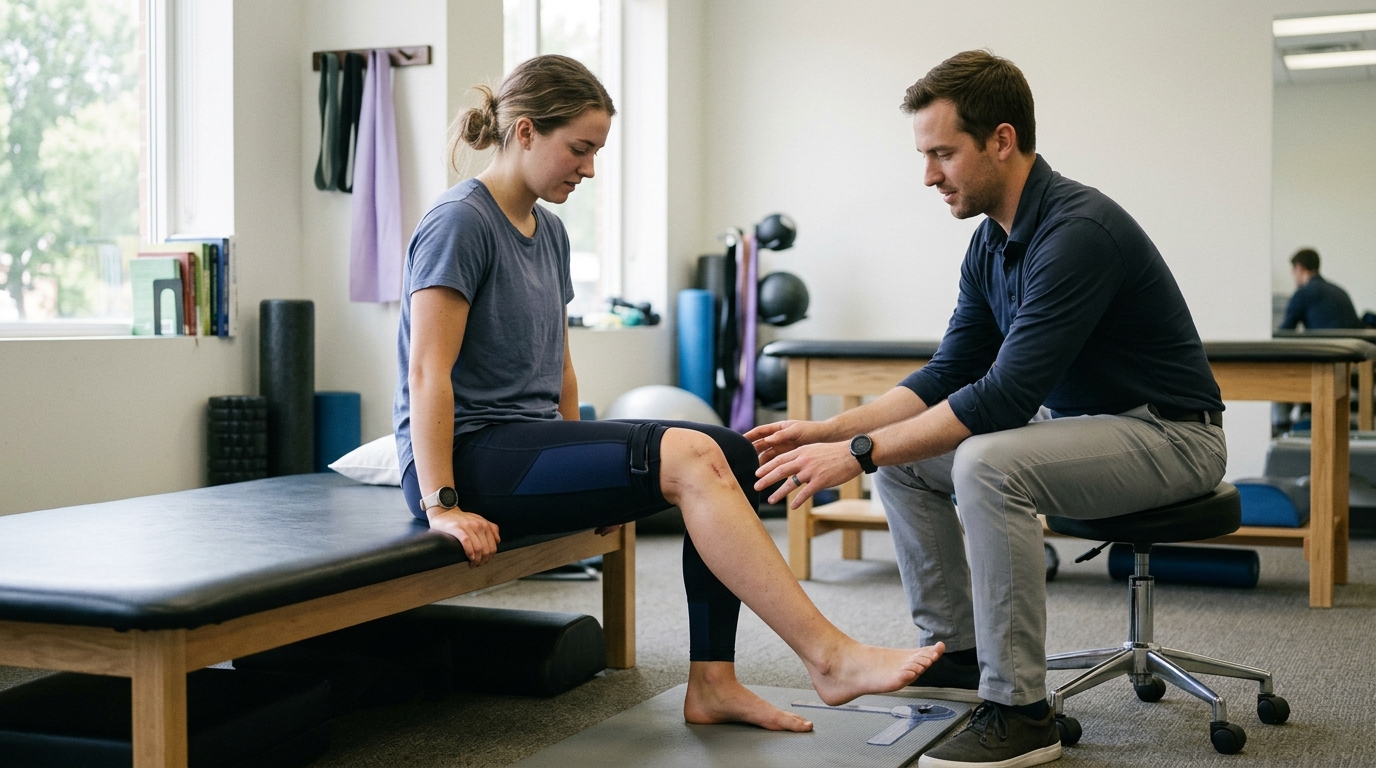

Waking up with persistent Achilles or knee soreness requires managing your training loads, building muscular strength, and using structured progression stages to stay healthy.





Running injury prevention is not a collection of rigid rules, special footwear choices, or guaranteed exercise routines. It is a continuous process of balancing training demands against your current physical capacity. Real injury prevention involves managing training changes, building baseline strength, and respecting recovery needs. It does not promise that an active runner will never feel sore or experience a physical setback.
Every running step places forces through your bones, tendons, and muscles. When training increases faster than your body can adapt, tissue irritation can occur. Research shows that running injuries stem from a mix of training exposure, personal history, and lifestyle factors. By learning how these elements interact, recreational runners can make practical training decisions, navigate minor flare-ups, and build durable routines over time.
This guide provides a comprehensive review of the scientific evidence behind running injuries. You will learn why common guidelines like the 10 percent rule have limitations, how to structure training changes safely, and how to use walk-to-run intervals after a break. You will also discover practical ways to log your workouts and recognize warning signs that require clinical evaluation.
Recreational running offers major cardiovascular and mental health benefits. However, physical setbacks remain common across all experience levels. Systematic reviews show that overall injury incidence in runners averages around 40 percent, with broad study ranges stretching from 20 percent to nearly 80 percent. These wide ranges occur because different research studies define injuries differently. Some studies count any ache that interrupts a single run, while others require at least seven days of missed training or a visit to a medical clinic.
Research consistently shows that running injuries most frequently affect the lower extremities. The knee, lower leg, ankle, and foot account for the highest proportions of reported issues. Common concerns include patellofemoral pain, Achilles tendon irritation, plantar fascia discomfort, and bone stress reactions. While these anatomical sites represent the most common problem areas, every runner possesses a unique structural and training profile.
A history of previous injury is one of the strongest and most recurring risk factors identified in sports medicine literature. Tissues that have been previously injured may have reduced load capacity if rehabilitation was incomplete. Furthermore, male runners with very high weekly training distances show higher injury rates in long-term observational studies.
The scientific consensus makes one point clear: no single factor causes running injuries. Equipment, running mechanics, weekly distance, and lifestyle habits all interact. Looking for a single cause usually leads to oversimplified solutions that fail to address the total training picture.
For decades, coaches and magazines have recommended the 10 percent rule. This guideline advises runners never to increase their weekly mileage by more than 10 percent from one week to the next. It is simple to calculate and easy to remember. However, systematic reviews evaluating training load changes have found no strong evidence that the 10 percent rule functions as a universal boundary for injury prevention.
Rigid percentage limits fail because they treat all miles as identical. Running ten easy miles on flat pavement creates a very different physical demand than running ten miles with steep hill repeats or sprint intervals. A runner could keep their total weekly mileage perfectly steady while introducing intense speed work that overloads their Achilles tendons. Focusing entirely on total weekly distance creates a false sense of security.
Recent research has highlighted the importance of single-session spikes. A 2025 study found higher rates of running-related overuse injury when a single run exceeded the runner's longest run of the previous 30 days by more than 10 percent. As that single-session spike grew larger, the risk of developing an overuse injury increased further. A runner might maintain stable weekly mileage, but if they suddenly double the distance of their weekend long run, their tissues face an unaccustomed spike in load.
Technology studies evaluating the acute-to-chronic workload ratio also show that large training spikes correlate with higher injury rates. In these models, injury risk rises when training over a single week substantially outpaces the average training completed over the prior month. While workload ratios provide useful insights, they are not exact calculators. Runners should treat percentage rules as rough planning prompts rather than guaranteed safety shields. You can read more about overall conditioning in our injury prevention resources section.
Many runners believe that hard surfaces like asphalt and concrete cause injuries, while soft surfaces like grass or dirt prevent them. Biomechanical studies do show that running on hard concrete produces higher peak acceleration forces compared to running on synthetic tracks or grass. However, laboratory measurements of force do not directly match real-world injury rates.
Systematic reviews examining running surfaces provide mixed and limited evidence. Some research notes a slight association between running on concrete and lower-extremity pain in women, but no significant association has been found in men. Similarly, running on hilly terrain has not been definitively linked to higher injury rates in large-scale reviews. Surface hardness is only one small part of the total physical demand placed on the body.
Running on soft, uneven trails changes muscle activation patterns. Trails require the stabilizing muscles of the feet, ankles, and hips to work harder to maintain balance. Switching abruptly from flat roads to technical trails can strain tendons even if the surface feels softer underfoot. Downhill running dramatically increases impact forces on the knees and quadriceps, while steep uphill running places high demands on the calves and Achilles tendons.
Instead of labeling surfaces as inherently safe or dangerous, runners should view changes in terrain as new training stimuli. If you decide to introduce trail running or hill repeats, reduce your total distance initially. Give your muscles and tendons several weeks to adapt to the new mechanics before increasing your volume.
Strength training is widely promoted as an essential tool for injury prevention. Many runners perform bodyweight exercises, lift weights, or take group fitness classes to protect their joints. The scientific evidence regarding strength training and running injury prevention, however, is nuanced.
Some clinical trials show mixed results for self-directed strength programs. In a randomized study of first-time marathon runners, a basic self-directed strength program did not reduce overuse injuries that led to race noncompletion. The injury rate was roughly seven percent in both the strength training group and the control group. Similarly, a pilot study found that simply swapping running mileage for general strengthening did not improve injury outcomes.
Conversely, a 2025 randomized controlled trial examined a comprehensive, online multicomponent exercise program in recreational runners. This program included targeted strengthening, neuromuscular control, and movement education. Runners in the intervention group experienced significantly lower overall injury rates (4.62 injuries per 1,000 hours) compared to the control group (8.71 injuries per 1,000 hours). Overuse injuries were substantially reduced, though acute injuries like sudden ankle sprains showed no difference.
These contrasting findings show that the type, structure, and execution of a strength program matter. General resistance training builds muscular capacity, improves joint stability, and supports bone density. However, strength training does not create an impenetrable shield. If a runner lifts heavy weights and increases their weekly mileage at the same time, total physical stress may exceed their recovery capacity. Explore our strength training and return to sport articles for detailed guidance on balancing gym work with running.
Musculoskeletal adaptation occurs during periods of rest, not during the run itself. When you run, you create microscopic stress in your muscle fibers, tendons, and bones. During recovery, your body repairs this tissue, making it stronger and more resilient to future demands. Without adequate rest, microscopic stress accumulates and can eventually lead to overuse injuries.
The International Olympic Committee consensus on athletic training load highlights the importance of non-training stressors. Training capacity is directly influenced by sleep duration, nutritional intake, hydration, and psychological stress. High levels of life stress or poor sleep impair tissue repair and reduce neuromuscular coordination. When personal or professional stress increases, your running capacity often temporarily decreases.
Many runners attempt to compensate for poor sleep or excessive training by purchasing recovery gadgets. Massage guns, compression boots, and ice baths are popular consumer items. While these tools may provide temporary comfort or sensory relief, research does not show that they prevent injuries. They cannot replace adequate calories, proper hydration, and eight hours of quality sleep. To learn more about the biological mechanisms of rest, visit our recovery science articles.
Injury risk and recovery rates vary from one runner to another. A training routine that feels effortless for a 25-year-old may overwhelm a 55-year-old returning from a long break. Understanding the personal factors that modify recovery can help you set realistic expectations.
Age is an important modifying factor. As we age, tendons naturally lose some elasticity, and muscle protein synthesis slows down. Bone remodeling also requires more time. Older recreational runners often need longer rest intervals between hard workouts to achieve the same tissue adaptation. While masters runners can maintain exceptional endurance, ignoring the need for extra recovery often leads to persistent tendon irritation.
Previous injury history plays a major role in tissue tolerance. Scar tissue, altered joint mechanics, or residual muscle weakness can persist long after initial pain resolves. If a runner previously suffered from plantar fasciitis or a calf strain, those specific tissues remain more vulnerable to sudden spikes in training volume. Building joint range of motion and tissue tolerance through mobility and movement guides can help address these residual deficits.
General daily activity also influences your physical baseline. An individual who sits at a desk for nine hours per day possesses different connective tissue readiness than someone who works on their feet. Sudden changes in work routines, footwear, or hobbies add hidden physical stress. Accounting for these background demands helps runners plan realistic training progressions.
Returning to running after an injury or a long sedentary period requires a systematic approach. Many runners make the mistake of attempting continuous running too soon, which frequently triggers symptom recurrence. A structured, walk-to-run interval framework provides a controlled way to reintroduce impact forces.
Before beginning any running progression, you must establish a stable baseline. Health service protocols from Oxford University Hospitals and the NHS recommend that individuals should be able to complete 30 minutes of brisk walking without pain before attempting to jog. If brisk walking causes discomfort, running will place excessive force on healing structures.
Once you achieve pain-free walking, begin with alternating intervals of walking and easy jogging. Walk breaks lower cumulative joint stress and prevent fatigue-related form breakdown. Training sessions should initially occur every other day, providing a mandatory rest or cross-training day between runs.
Below is an illustrative six-week walk-to-run progression adapted from established health service return-to-activity protocols:
Throughout this progression, apply the principle of advancing distance and duration before speed or intensity. Do not introduce speed intervals, hill repeats, or race-pace efforts until you can comfortably complete 30 minutes of continuous running. For additional rehabilitation templates, consult our library of rehabilitation and recovery resources.
If you are recovering from a diagnosed bone stress injury (BSI), generic progression schedules are not sufficient. Clinical guidelines for tibial bone stress injuries require resolution of localized bone tenderness, pain-free daily walking, and functional loading tests before running begins. High-risk bone stress sites may also require radiological confirmation of bone healing.
Keeping a basic training log is one of the most effective habits for injury prevention. A training diary allows you to look back and identify what changed in the days or weeks leading up to an ache. When runners rely purely on memory, they often miss subtle training spikes or lifestyle changes that triggered tissue irritation.
Tracking symptom behavior provides valuable clues about tissue health. Healthy post-exercise muscle soreness typically peaks 24 to 48 hours after a novel workout, feels diffuse across muscle bellies, and improves with gentle movement. Overuse injuries, by contrast, often produce sharp or localized pain that worsens with continuous impact.
A common warning sign of bone stress injury is a deep ache that appears at a predictable point in a run and steadily worsens as impact continues. Unlike mild muscle tightness, bone pain does not warm up or fade during exercise. If you notice pinpoint bony tenderness along the shin, foot, or hip, pause impact training and seek a medical assessment.
Health service guidelines advise pausing your running progression if pain exceeds a mild level, if symptoms persist for more than 48 hours after a session, or if you notice joint swelling. Stepping back for a few days to let tissues settle prevents minor irritations from developing into chronic injuries.
Navigating physical setbacks can feel overwhelming. When persistent symptoms disrupt your training, consulting a healthcare professional provides clarity. Physical therapists and sports medicine physicians can evaluate movement patterns, assess tissue capacity, and rule out serious underlying pathology.
Here are practical questions to guide your discussion with a clinician:
Working collaboratively with a clinician ensures that your return plan matches your specific diagnosis. It eliminates guesswork and helps you progress with realistic confidence.
Running injury prevention is not about finding a flawless training formula. It is about understanding that your body has a finite capacity to absorb physical stress at any given moment. Injuries occur when cumulative demands outpace the rate of tissue repair.
To build a sustainable running routine, focus on consistent habits rather than quick solutions:
Listen to your body's feedback. When symptoms persist, worsen during activity, or alter your normal walking gait, pause your progression and consult a medical professional. Sustainable running is built through patience, consistent recovery, and gradual progression over months and years.
The single-leg hop test is frequently discussed online, but medical literature does not support it as a definitive self-diagnostic tool. While hopping on an injured bone will often provoke pain, the test lacks validated accuracy for diagnosing stress fractures. Hopping on an unstable or high-risk bone stress injury can also aggravate tissue damage. If you suspect a bone stress injury due to localized tenderness and persistent pain, seek a clinical evaluation rather than testing the leg with high-impact hops.
Footwear changes running mechanics slightly, but research does not show that any specific shoe model or drop height prevents injuries across all runners. Switching shoes simply redistributes forces to different parts of the foot, ankle, and leg. A shoe with more cushioning may reduce impact forces at the heel while increasing stability demands elsewhere. Choose running shoes that feel comfortable immediately, and introduce new footwear models gradually over several weeks.
Complete rest is rarely the best approach for uncomplicated running-related overuse issues. While you should stop the specific activity that provokes significant pain, low-impact cross-training helps maintain cardiovascular fitness and supports blood flow. Activities such as stationary cycling, swimming, rowing, or upper-body strength training can often continue safely. Always ensure that your chosen cross-training alternative remains completely pain-free during and after exercise.
Morning stiffness that lasts for several minutes when stepping out of bed is a classic hallmark of Achilles tendon irritation. Tendons receive limited blood flow and often feel tight after hours of immobility. If the stiffness eases after a short walk and does not cause a limp, it may represent mild tendon reactivity. However, if the pain persists throughout the day, worsens during walking, or produces visible swelling, you should reduce running volume and consult a physical therapist for a targeted loading plan.

Use ReboundBody resources to understand common recovery stages, rehab terms, movement limits and strength rebuilding. Each guide is designed to make a complex comeback easier to understand.


Read practical guidance on injury recovery, rehabilitation, mobility and rebuilding strength as you work your way back to activity.
Explore Resources