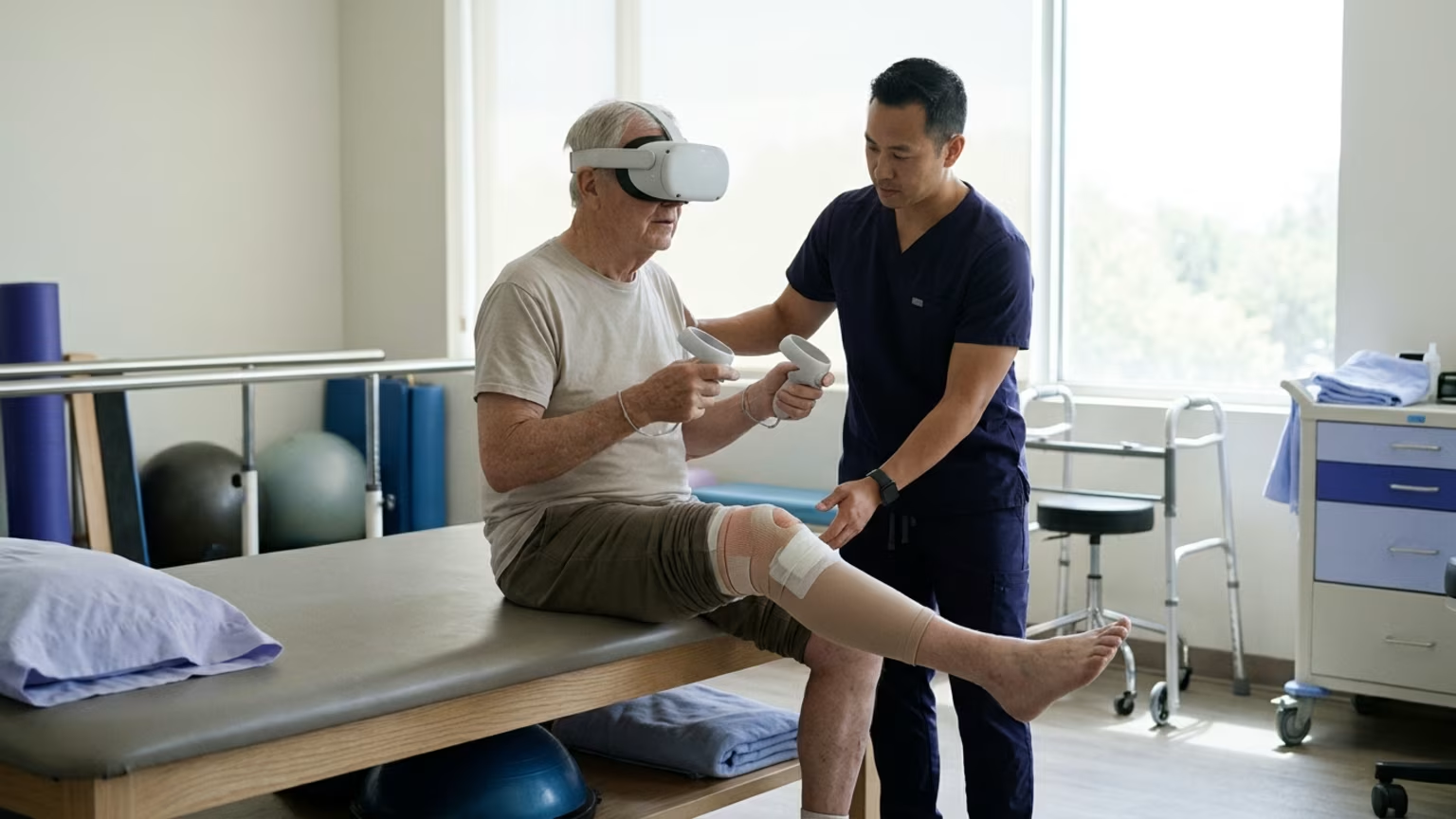

A small knee replacement trial links immersive VR to earlier movement. See what the study measured and why it does not change standard rehab.





In a November 23, 2026, trial summary, OrthoEvidence reported that patients who took part in an immersive virtual reality (VR) exercise-and-rest program got moving sooner after total knee replacement than patients who received standard care without VR. The VR group also moved farther and reported less pain after moving.
OrthoEvidence lists the study as published ahead of print in Pain Management Nursing, with DOI 10.1016/j.pmn.2026.01.014. The trial focused on a specific part of recovery: getting moving in the period right after surgery.
Digital rehabilitation was already being studied after knee replacement, but the term covers different kinds of care. The 2020 VERITAS trial compared a home virtual-therapy program with traditional physical therapy in 306 total knee replacement patients. Remote clinician oversight was part of the home program. That trial asked how physical therapy could be delivered at home, not whether immersive VR helped with the first attempt to get moving after surgery.
A 2025 review indexed by PEDro looked at 14 randomized trials with 1,123 older adults who had knee osteoarthritis or had undergone total knee replacement. For some measures of pain and function, VR and other digital approaches generally did as well as or better than conventional rehabilitation. But results for knee stability were inconsistent. One study favored conventional rehabilitation for function. The answer depended in part on which outcome researchers looked at.
A 2026 review in the Journal of Medical Internet Research compared several digital approaches after total knee replacement, including VR, remote rehabilitation and rehabilitation robots. Across studies, the review reported an average difference of 5.92 degrees in active knee flexion in favor of VR over conventional rehabilitation. Active knee flexion means how far patients could bend the knee on their own. The review also reported a difference of 9.53 points in favor of VR on the Hospital for Special Surgery knee score.
The review authors concluded that digital approaches may help with pain, knee bend and knee function, but it remained unclear how the approaches compared with one another. Those pooled findings answer a different question from the new trial. Bending the knee farther is not the same outcome as moving a greater distance soon after surgery.
OrthoEvidence describes the new study as a single-blind randomized trial. Patients were assigned by chance to either the immersive VR exercise-and-rest program or standard postoperative care without VR. The results compare those two groups rather than describing how patients felt before and after trying VR on their own.
The main measure was how far patients moved after surgery. The trial also measured how soon they first got moving, how long they walked and how often they walked. Other measures included fear of movement, mobility and patient satisfaction. Patients rated pain on a visual scale.
OrthoEvidence reports statistically significant differences in favor of the VR group for distance, time to first movement and pain after movement. These are separate results. Getting moving sooner tells you when activity began. Moving farther tells you how much ground patients covered, and the pain rating describes how they felt after that activity.
That timing is worth keeping in mind when reading the pain result. The reported difference was in pain after mobilization. It was not a general finding about pain throughout recovery. Likewise, a result for distance does not tell you whether patients walked more often. Each measure answers a narrower question than whether recovery as a whole went better.
The trial included 31 people undergoing primary total knee arthroplasty, the medical term for a first total replacement of the knee. It studied patients getting moving soon after that operation. It did not study people recovering from a repeat knee replacement or a different orthopedic procedure.
The distinction also matters when comparing this result with the wider research. The 2025 review included people with knee arthritis as well as people who had undergone knee replacement. Those populations can sit side by side in a review, but the early mobility result here comes from the surgery group in this specific trial. It is a finding about a particular procedure and a particular stage of recovery.
The practical takeaway is a question for the surgical or physical therapy team, not a reason to change a rehabilitation plan. For someone interested in VR, the most useful starting point is what the team is trying to help them do now. A conversation about getting moving for the first time is different from a conversation about rebuilding capacity for everyday activity.
Questions that keep the discussion tied to that stage of recovery include:
The second question can be useful even if VR never comes up again. It gives the patient and therapist a way to talk about what happened during an activity without reducing it to distance alone. If worry about moving is part of that conversation, it may help to have some context for talking about fear of movement after knee replacement.
For readers who are looking ahead to regular exercise or recreation, it helps to keep that goal separate from the first mobility milestone. The team can explain how it views progress now and what it would look at when discussing a return to usual activities. That same distinction is useful when reading about another approach studied for early movement after knee replacement.
The OrthoEvidence summary does not give group-by-group numbers for distance, time to first movement or pain. It also does not give confidence intervals for those results. The summary tells readers which group did better on those measures, but not by how much or how precise the estimates were. With only 31 participants, a larger trial would help show whether the findings hold up.
The summary does not describe the exercise-and-rest program in enough detail to judge how it might work in another setting. It also does not establish whether using the program outside the immediate postoperative setting would be practical, safe or effective. Those are separate questions from whether the study groups differed on early mobility.
The findings do not establish a lasting benefit for strength, independence or return to sport. To answer those questions, researchers would need to track those outcomes beyond the first stage of recovery. The study does not support replacing supervised rehabilitation with VR.
Let the first steps be a milestone, not a forecast.
The physical therapist is a point of contact for day-to-day questions about getting moving after knee replacement. ReboundBody explains where early mobility findings fit so active adults can ask their healthcare team clearer questions about the later transition from formal rehabilitation back to everyday activity.

Follow ReboundBody for practical articles on injury recovery, rehabilitation, mobility and rebuilding strength. New posts turn research into clear ideas for the road back to activity after injury or surgery.





Read practical guidance on injury recovery, rehabilitation, mobility and rebuilding strength as you work your way back to activity.
Explore Resources