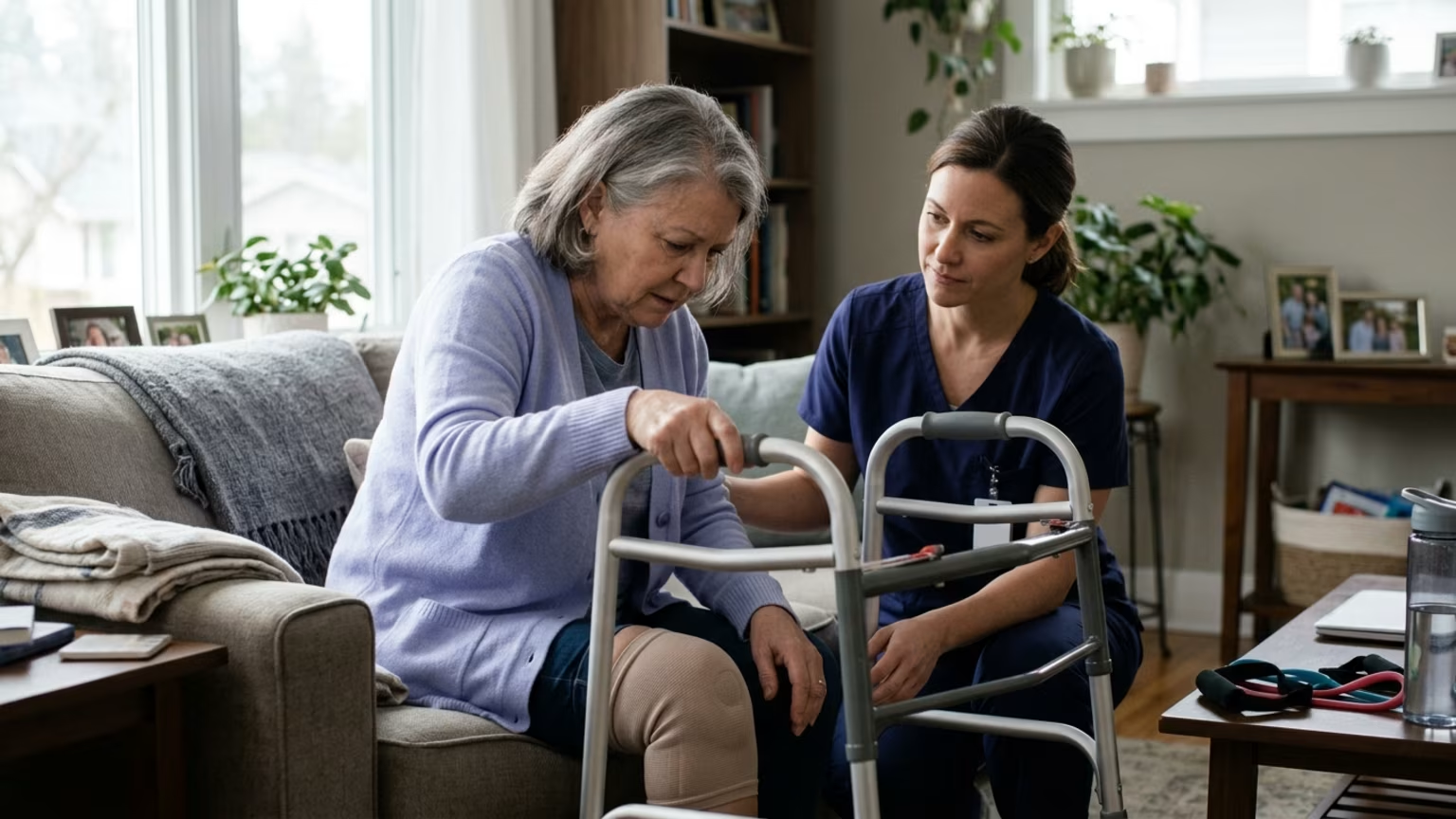

Recent reporting and preliminary research put fear after knee replacement in context, with individualized progression and symptoms that need assessment.





On October 14, 2026, The Epoch Times published a report about rebuilding movement and confidence after knee replacement. Its central message was to follow activities permitted by the surgical team and progress toward harder strengthening as the individual rehabilitation plan allows. Amber Yang wrote the feature with commentary from Scott Wang, identified as director of the Heng-Xin Rehabilitation Clinic in Taipei.
The report addresses a practical concern: how to approach movement when exercise feels worrying after surgery. It describes recovery as a gradual process rather than a test of willingness to attempt harder exercises.
A separate September review adds research about addressing fear alongside physical rehabilitation. Read together, the sources offer context for a care conversation about both movement and confidence.
The starting point in The Epoch Times feature is the plan already established by the surgical and rehabilitation team. The report says exercise type and intensity should match the procedure, recovery stage and individual condition.
That is the guidance context behind its exercise examples. An activity mentioned in a health article does not replace the instructions attached to a person's surgery.
The feature describes early rehabilitation as guided and relatively simple. Examples include:
More demanding strengthening comes later in the progression described by the report. The important distinction is between an example of an exercise and a decision that someone is ready for it.
For readers thinking about rebuilding strength for everyday lower-body tasks, this keeps the focus on the purpose of rehabilitation. The question is how a movement fits the current plan and the activities the person hopes to resume. It is not simply whether the exercise looks easy or difficult on a screen.
On September 30, 2026, the Journal of Orthopaedic Surgery and Research published a systematic review and meta-analysis of psychologically informed physical therapy. The review included seven randomized controlled trials with 944 participants.
This approach considers psychological barriers alongside physical recovery. In the review, results favored psychologically informed physical therapy for knee function, pain catastrophizing and fear of movement. Pain catastrophizing refers to patterns of alarming or strongly negative thinking about pain.
The useful addition is that confidence was examined as a recovery outcome rather than left outside the rehabilitation discussion. Fear can be something to describe to the treating team, not a concern that must remain unspoken until strength improves.
These outcomes also need to stay separate. A change in fear-of-movement scores is a different finding from a change in pain intensity. Likewise, an improvement on a knee-function measure does not mean every measure of physical function improved.
For readers, the study creates a reasonable discussion point: whether fear is interfering with participation in the rehabilitation plan. It does not make the reader responsible for selecting a psychological treatment or deciding how it should be delivered.
The Epoch Times feature focuses on recovery after knee replacement. The research review covers a broader group of people recovering from lower-extremity surgery.
The included procedures were total knee arthroplasty, hip arthroplasty, ACL reconstruction and fracture fixation. Total knee arthroplasty is the knee-replacement procedure included in that group.
The review did not report separate numerical results for knee-replacement patients. Its combined results therefore should not be presented as a measured benefit specifically established for people after knee replacement.
That distinction matters when reading a headline about confidence after surgery. The review is relevant to the conversation because it includes knee replacement and examines fear of movement. However, it does not provide a knee-replacement-only answer about how much benefit someone should expect.
The appropriate connection is a question for the treating team about fear and participation. It is not a prediction that a particular therapy will produce the same result for every reader.
The practical value of the feature lies in connecting its examples to an existing rehabilitation plan. It offers topics to discuss rather than a self-directed exercise program.
The report mentions chair-assisted squats and deeper squats as later strengthening examples. It says their timing, depth and frequency should be determined by the individual rehabilitation plan.
The appearance of a squat in the article is therefore not a reason to add it independently. Nor does it establish a milestone that every person recovering from knee replacement must reach in the same way.
Useful questions for the rehabilitation team include:
These questions keep the decision with the professionals who know the procedure and current recovery stage. They also make an exercise headline more useful by turning it into a discussion about relevance.
According to Wang's advice as reported by The Epoch Times, discomfort does not automatically mean the replacement has been damaged. That reassurance is different from saying every symptom should be ignored.
The feature advises assessment for persistent or worsening pain. It also treats sharp pain or increasing discomfort during an exercise and worsening swelling as reasons to reconsider the activity and seek guidance.
The report identifies the following as reasons for prompt medical assessment:
These symptoms should not be explained away as a lack of confidence. The article identifies them as reasons for assessment without establishing that any one symptom always means a particular complication.
This leaves room for both reassurance and attention to symptoms. Someone does not need to assume that all discomfort means damage. They also do not need to dismiss a concerning change to prove that they are committed to rehabilitation.
If fear is interfering with rehabilitation, the research supports raising that concern with the treating team. The conversation can identify which permitted activity feels worrying and whether that worry is limiting participation.
For example, a reader might ask: “I am worried about damaging the replacement during the activities in my plan. Can we discuss that concern?” This describes the problem without assuming its cause or choosing a treatment in advance.
For related reading, ReboundBody discusses guarded movement and confidence during recovery. The purpose of that broader context is understanding the recovery experience, not deciding whether a particular postoperative symptom is harmless.
The Epoch Times article is a reported health feature, not a clinical guideline or a trial. Its exercise examples need to be read in that format. The feature does not establish a universal progression schedule or a single safe pain threshold. Neither source establishes a return-to-sport timetable after knee replacement.
The review authors described their findings as preliminary. They cited the small number of trials and substantial differences between them. Results for fear of movement varied considerably across the included studies.
The review also found no between-group differences on several other measures of physical function or on pain-intensity measures. This helps explain why improvement in selected outcomes should not be described as improvement across all aspects of recovery.
Open questions include which psychologically informed approaches are most useful and how they should be incorporated into rehabilitation. The authors called for larger studies with enough participants to test effects reliably, along with standardized protocols.
For an individual reader, those research questions are separate from the immediate conversation about permitted activity. The practical discussion can stay specific: what the current plan allows and what concern is making participation difficult.
Let the next stage be a conversation about your recovery, not a test set by a headline.
Deciding when walking gives way to harder strengthening belongs within an individual recovery plan; ReboundBody explains the wider context around that transition. Its independent articles help adults in midlife and later life understand the gap between formal rehabilitation and ordinary activity, with clear coverage of mobility and strength rebuilding rather than personal treatment directions.

Follow ReboundBody for practical articles on injury recovery, rehabilitation, mobility and rebuilding strength. New posts turn research into clear ideas for the road back to activity after injury or surgery.






Read practical guidance on injury recovery, rehabilitation, mobility and rebuilding strength as you work your way back to activity.
Explore Resources