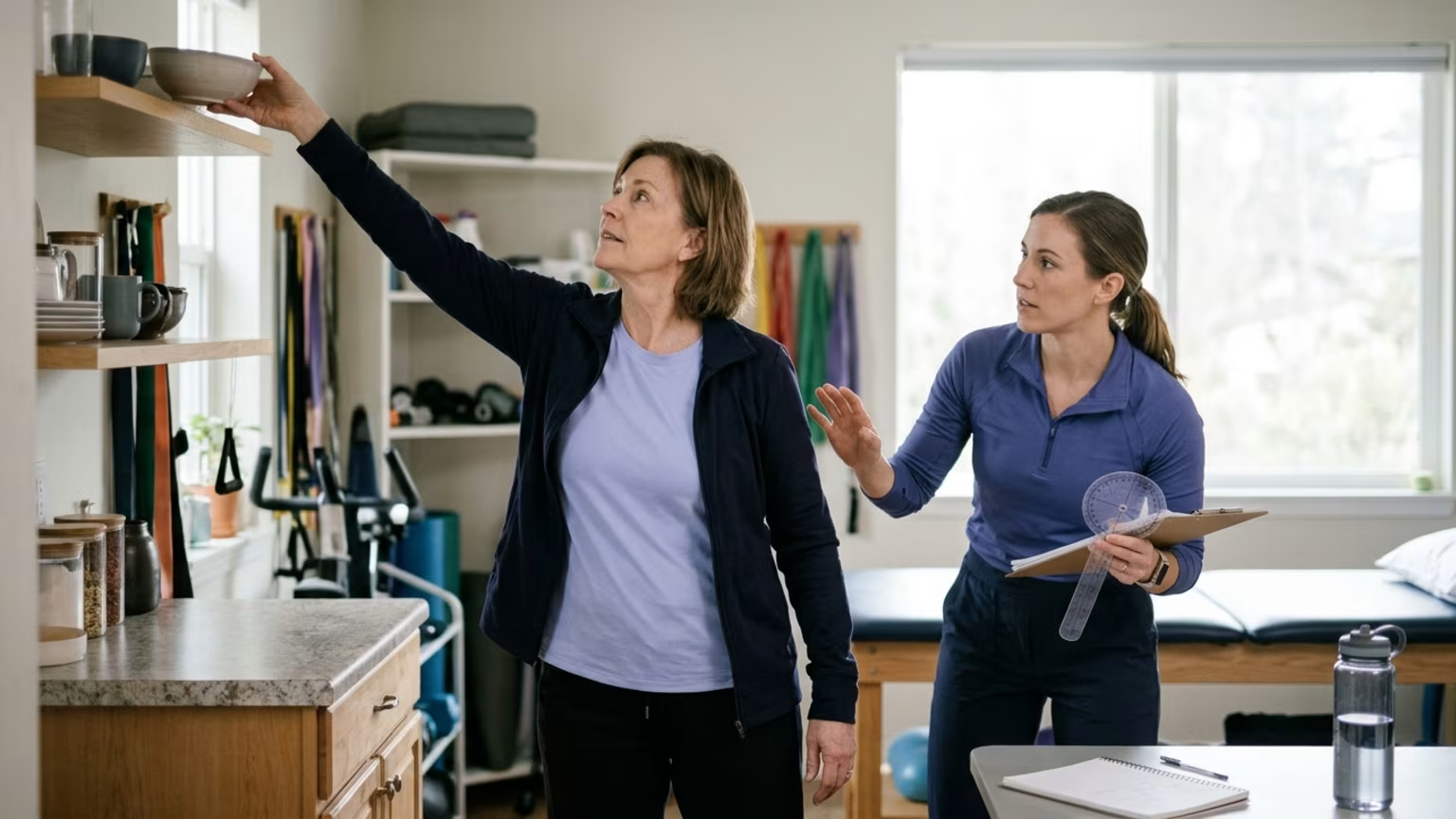

Learn why range-of-motion gains are only one recovery measure and how to connect joint measurements with walking, stairs and personal activity goals.





A 2026 secondary summary of knee replacement research reported no statistically significant stair-climbing advantage for active resistance exercise over conventional exercise. That result matters to anyone using joint measurements to understand recovery. It puts a familiar expectation into focus: better movement at the joint should mean easier movement in daily life.
It is reasonable to see an improving range-of-motion number as reassuring. The measurement offers something concrete during a recovery that may otherwise feel hard to judge. If a knee bends farther during an assessment, it makes sense to hope that stairs and walking will become easier too.
The common belief is not simply that joint motion matters. It is that enough improvement in the measurement should also confirm a broader return to normal activity. Under that view, the number becomes a stand-in for recovery itself.
That expectation deserves a fair hearing. A joint-motion measurement gives the recovery conversation a clear reference point. It can help answer a focused question about how far the joint moved during assessment.
The difficulty comes when that focused answer is asked to settle a much larger question. Being able to record more movement is different from establishing that a particular daily task has become easier. Both questions matter, but they need to remain distinct.
The best-supported correction is straightforward: range of motion belongs in the recovery picture without becoming the whole picture. The knee replacement research summary reported different results across joint motion and functional outcomes. An improvement in one measure did not establish improvement across every measure tested.
In that summary, knee flexion ROM improved compared with conventional exercise. Knee flexion refers to bending the knee. Yet the stair-climbing comparison did not show a statistically significant difference between groups.
This supports a narrower reading of progress. A better bending measurement is evidence about bending. Whether stairs have become easier remains a separate question that deserves its own assessment.
For a recovery discussion, it helps to keep several questions visible:
These questions need not compete for importance. They help describe different parts of the same recovery story. Understanding the distinction between a joint measurement and everyday function makes room for both measurable progress and meaningful activity goals.
The 2026 summary examined active resistance exercise after total knee arthroplasty, the operation commonly called knee replacement. It compared that approach with conventional exercise in the included trials. The reported findings concerned outcomes immediately after the intervention.
The summary reported improvements in several areas:
It also reported no statistically significant between-group difference for the six-minute walk test. The same was true for the stair-climbing test and knee extension ROM. Knee extension refers to straightening the knee.
The useful detail is the contrast within the findings. Walking speed showed a reported advantage, while the six-minute walk test did not show a statistically significant between-group difference. Knee bending and knee straightening also had different results.
That pattern argues against describing the intervention with a single broad statement such as better function across the board. Naming the outcome preserves information that a general success label would hide. It also helps explain why a ROM result should not substitute for a task-level result.
The wording about statistical significance matters. The stair-climbing finding concerns a comparison between groups. It should not be rewritten as a finding that every participant had the same experience or that nobody improved.
This evidence concerns people after knee replacement and results measured immediately after the intervention. It does not establish a rule for every joint or orthopedic condition. The cited report is also a secondary summary rather than the original journal article.
Source type matters when reading related advice too. The Nova Physical Therapy article about stiffness after knee replacement mentions a 2026 APTA total-knee-arthroplasty guideline. That article is a practice blog, not the guideline itself. Its mention of the guideline should not be treated as direct access to the guideline's recommendations.
Taken together, these boundaries make the research useful as an example of why outcomes need separate interpretation. They do not turn it into a personal exercise recommendation or a universal ROM target for returning to activity.
The practical response is not to dismiss the joint measurement. It is to connect that measurement with the activity question it is meant to inform. The following questions offer a way to organize a conversation with a treating healthcare professional, rather than a self-directed recovery test.
The first question is about the result itself. Did the assessment show a change in joint motion? Was there a change in a walking test or in pain? Keeping those descriptions separate avoids making one result carry more meaning than it supports.
A useful question is: “What does this measurement show about my progress?” That invites an explanation of the actual finding before moving to its practical meaning. It also gives the clinician a chance to explain why that measure is being followed.
The next question concerns the activity the person hopes to resume. Walking and stairs are clear examples from the knee replacement summary. A personal recovery conversation may also focus on reaching or a recreational activity.
Naming the task makes the goal more specific than simply wanting a better number. “How will we assess progress with stairs?” asks a different question from “How much farther does the knee bend?” The first asks about an activity, while the second asks about joint motion.
Neither question needs to replace the other. The aim is to understand how each fits into the larger plan. ReboundBody's overview of daily tasks in rehabilitation offers related context for keeping ordinary activities in that discussion.
It is also useful to ask what would count as improvement in the chosen activity. Is the discussion about the joint measurement or performance during a specific test? Is it about how the activity feels in daily life?
These are questions for clarification, not instructions to create a home testing program. The purpose is to understand what the healthcare team is evaluating. A clear explanation should connect the assessment with the goal rather than leave the person to infer that connection from a number alone.
This distinction also helps when reading research headlines. A report of improved ROM should prompt a look at the functional outcomes actually measured. In the knee replacement summary, the separate results were essential to understanding the overall finding.
Questions about individual activity progression belong with the treating professional. A research comparison describes findings across study groups. A personal recovery discussion needs to address the person's condition and intended activity.
A useful way to frame that discussion is: “How does this result fit with the activity I want to return to?” This keeps the measurement in view without asking it to serve as a stand-alone permission slip. It also keeps the next decision tied to qualified care rather than an isolated degree value.
Range of motion is a useful recovery measure, but its meaning is specific. It describes joint movement during an assessment. Everyday function asks a broader question about performing a task.
The knee replacement summary makes that distinction concrete: reported improvements in knee bending did not come with a statistically significant advantage on every functional test. The clearest approach is to name each result accurately and connect it with the activity that matters.
A better joint measurement can remain meaningful progress without being the final answer about walking or stairs. Recovery conversations are more informative when they give both measurements and daily activities a clear place.
A larger joint angle is a measurement result, while returning to daily activities remains a personal recovery question. ReboundBody translates rehabilitation research into plain-language articles for active adults after injury or surgery. Its editorial coverage supports understanding of mobility and strength rebuilding without turning study findings into individual care instructions.

Follow ReboundBody for practical articles on injury recovery, rehabilitation, mobility and rebuilding strength. New posts turn research into clear ideas for the road back to activity after injury or surgery.






Read practical guidance on injury recovery, rehabilitation, mobility and rebuilding strength as you work your way back to activity.
Explore Resources