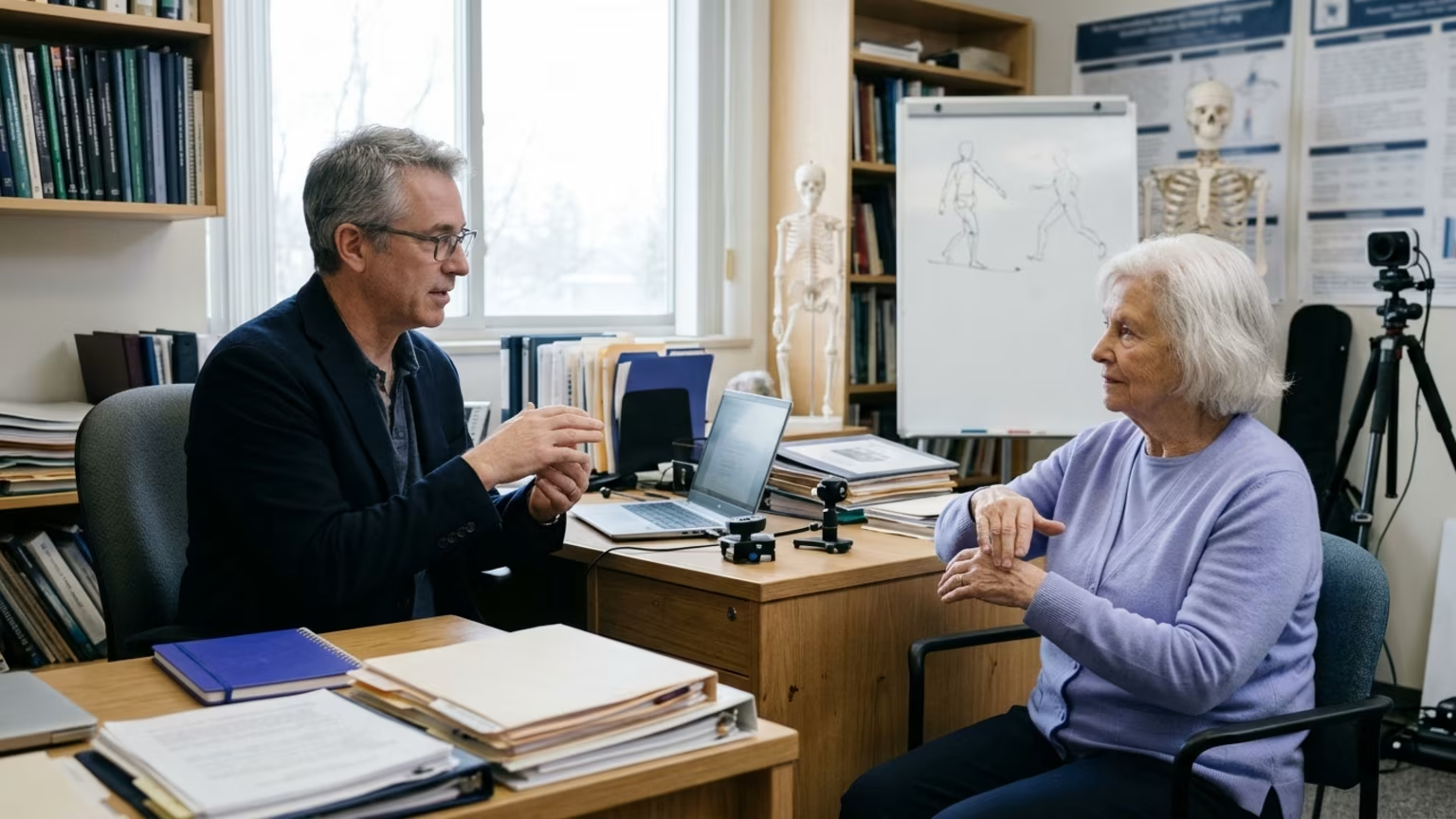

Li Li's movement-span proposal adds adaptability to the aging discussion. Read its relevance to rehabilitation and the questions still open.





On November 9, 2026, Georgia Southern University announced that kinesiology professor Li Li had proposed “movement span” as a dimension of aging. The university describes it as how long a person can move confidently, comfortably and independently in their environment. The proposal shifts attention toward movement variety and adaptability alongside the amount and intensity of activity.
The idea becomes clearer on a familiar walk. A step total records how much walking took place. Li asks a different question: what happens when an unexpected obstacle requires a change in stride or direction?
According to the university, the concept appears in a recently published research essay titled “Movement span: Extending the discourse on aging beyond life span and health span.” It offers another way to frame discussions about aging and everyday function. For adults rebuilding movement after an orthopedic setback, its most useful role may be to sharpen the questions they bring to rehabilitation.
Before this announcement, public-health advice already addressed several aspects of physical activity. The World Health Organization (WHO) says its guidelines specify frequency, intensity and duration. It also emphasizes that any amount of activity is better than none and that all activity counts.
The WHO's guidance includes limiting sedentary time and muscle strengthening. Those messages remain relevant to this discussion. Movement span adds a question about how people move within their surroundings rather than setting aside the value of being active.
This is an important distinction because “beyond step counts” can sound like “step counts do not matter.” That is not what the university's account establishes. Li's point is that an activity total does not describe every aspect of moving well.
Nor is amount the only idea in existing guidance. The WHO addresses both activity and sedentary behavior rather than treating one exercise target as the whole picture. A fair reading of movement span places adaptability beside those concerns.
For readers, the comparison is not a contest between exercise volume and movement quality. It is a reason to ask how different kinds of movement fit everyday function while keeping established activity advice in view.
Georgia Southern says Li sees movement span as an added dimension alongside lifespan and health span. The central question is how long movement remains confident, comfortable and independent. The environment matters because moving well includes responding to what is happening around a person.
His walking example makes that distinction concrete. Repeating the same route at the same pace describes a familiar pattern of activity. Adjusting stride or direction around an unexpected obstacle adds a demand that the walking total alone does not capture.
In Li's account, adapting to change and shifting between activities are parts of moving well. The emphasis is not simply on collecting more types of exercise. It is on whether movement can respond to the demands of daily life.
That is the main contribution of the proposal: it gives adaptability a clearer place in the conversation about aging. A discussion based only on amount might ask how much activity occurred. A discussion informed by movement span would also ask how that activity worked in its setting.
The words in the definition are worth noticing. “Confidently” brings the person's experience into the question. “Comfortably” and “independently” keep the focus on everyday function rather than a performance total alone. These are ways to understand Li's framing, not separate test results.
Li also recommends considering the concept in clinical practice and public-health assessments. That proposal extends the discussion beyond an individual exercise log to how movement is considered more broadly.
The framework is about aging broadly. The university's account does not identify a studied group with a particular injury or operation. Its relevance to orthopedic recovery is therefore a possible use for discussion rather than a finding from a recovery population.
For an active adult in midlife or later life, the idea may speak to a familiar concern: whether movement supports ordinary life as well as planned activity. The framework puts words around that concern without assigning a personal target.
The WHO's guidance has a broader stated reach. It includes adults and older adults as well as people living with chronic conditions or disabilities. That provides public-health context but does not make every movement demand appropriate for every person.
A person recovering from surgery and a person thinking about long-term mobility may both find the language useful. Their clinical needs still require separate consideration. A shared concept is not the same as a shared rehabilitation plan.
For readers in rehabilitation, movement span is most useful as a discussion prompt. It broadens the conversation from activity totals to the everyday situations those totals are meant to support. The goal is to connect the research idea with personal priorities through qualified care.
Possible questions for a rehabilitation professional include:
These are questions about understanding a plan. They are not a list of exercises or a reason to test an unexpected challenge. The university's obstacle example illustrates adaptability; it does not tell a recovering reader to practice avoiding obstacles.
Decisions about balance work or direction changes belong in a conversation with a rehabilitation professional who understands the procedure, symptoms and current recovery stage. The same applies to gradually rebuilding activity demands. Movement span supplies a topic for that conversation rather than the next level of difficulty.
There is also a useful distinction between a broad goal and the way progress is tracked. “Moving independently in daily settings” can express what matters to someone. The clinical team can discuss which parts of that goal are relevant to the person's current care.
For readers organizing those priorities, placing movement within the wider recovery picture offers a related way to think about the journey. Activity habits and functional goals can be discussed together instead of being treated as competing interests.
Existing clinician guidance remains the starting point for personal decisions. The WHO's advice also remains in view: activity matters, muscle strengthening matters and sedentary time deserves attention. Adding a question about adaptability does not require discarding those foundations.
Several questions need answers before movement span becomes more than a proposed framework. Georgia Southern's announcement describes a research essay rather than a clinical trial. It reports neither a validated score nor evidence that an intervention built around the idea improves recovery or prevents disability.
Measurement is one open issue. Li hopes to investigate whether mainstream devices could help assess movement span. The announcement supplies no specific device, measurement method or clinical threshold. Device-based assessment is a future possibility in this account rather than an available way to grade someone's recovery.
Another question is how the concept would be used in practice. Li recommends including it in clinical and public-health assessments. The announcement does not establish a change to rehabilitation protocols or an endorsement of the framework by the WHO.
Useful next questions concern how adaptability would be defined consistently and how meaningful changes would be judged. Those are questions raised by the proposal, not findings answered by the announcement. Until they are addressed, movement span is best understood as a way to organize discussion rather than to score success.
Return to the familiar walk in Li's example. The step total still describes activity, while the response to an obstacle highlights a different part of the experience. The value of movement span is the invitation to notice both: how much movement happens and how well it fits the world a person needs to move through.
Turning movement variety into an exercise assignment skips the clinical context emphasized here. ReboundBody explains emerging movement ideas without presenting them as personal care instructions. Its independent articles help active adults understand rehabilitation, strength rebuilding and return to activity while recognizing where decisions need a healthcare professional's input.

Follow ReboundBody for practical articles on injury recovery, rehabilitation, mobility and rebuilding strength. New posts turn research into clear ideas for the road back to activity after injury or surgery.






Read practical guidance on injury recovery, rehabilitation, mobility and rebuilding strength as you work your way back to activity.
Explore Resources