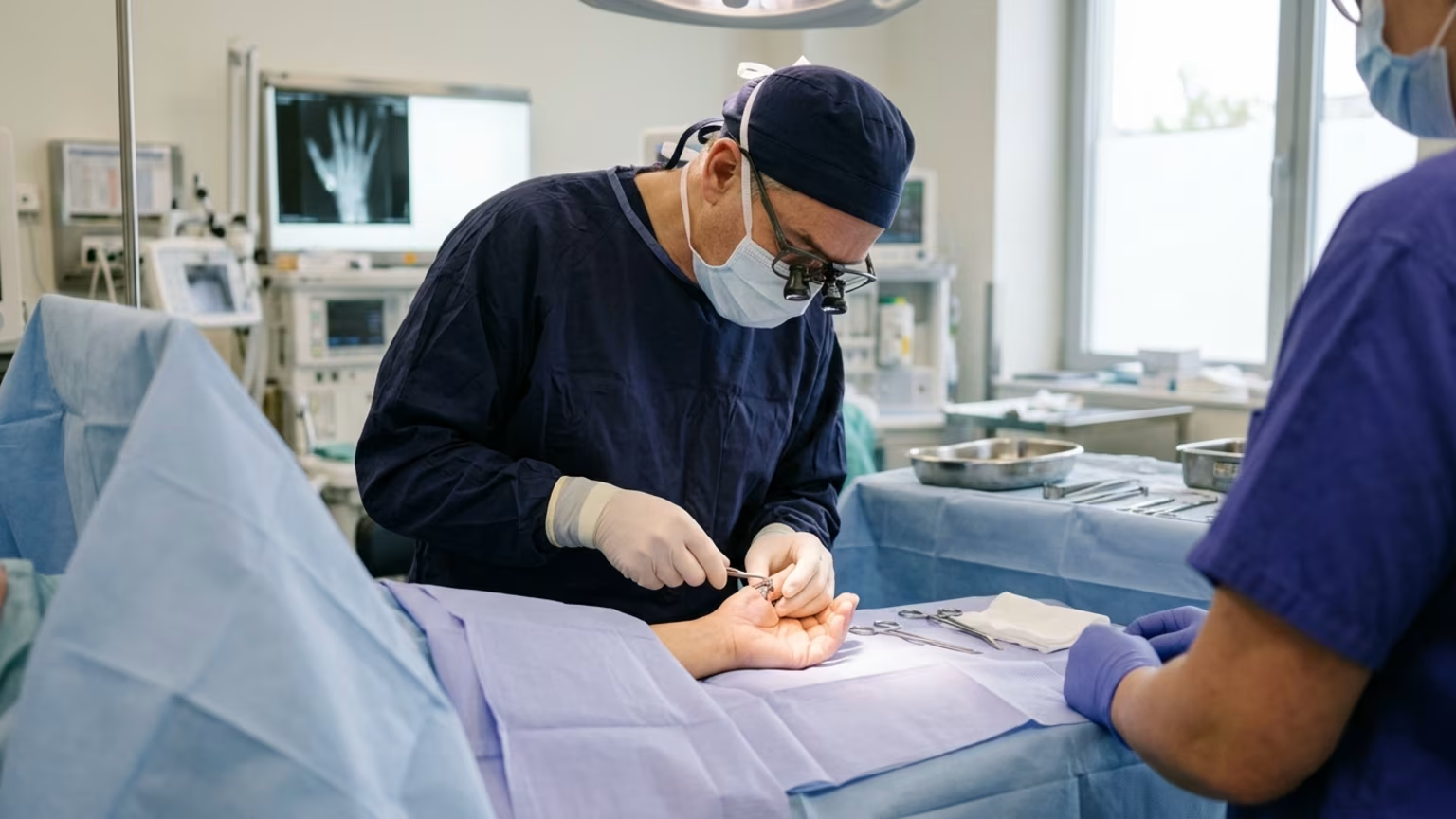

A Northern Nevada thumb replacement report highlights a cementless implant, patient selection, nonsurgical options and unanswered outcome questions.





On October 16, 2026, Becker’s Spine Review examined the TOUCH CMC 1 prosthesis following Northern Nevada’s first reported thumb replacement using the device. The publication identified Timothy Dooley, MD, of Great Basin Orthopaedics in Reno as the surgeon who performed the operation. Becker’s had reported the regional milestone on October 1, 2026.
Becker’s describes the implant as a cementless, dual-mobility ball-and-socket replacement for the thumb carpometacarpal joint. That joint is usually shortened to CMC. It sits at the base of the thumb.
The reports describe a newer U.S. surgical option and explain why a hand surgeon might consider it. For readers weighing treatment choices, the central issue is how that option fits the location of their arthritis and their goals for hand function.
The October 1 Becker’s report explains that cartilage wear at the thumb CMC joint can cause pain and stiffness. Swelling and reduced grip strength can also occur. These symptoms provide the background for the treatment discussion, but they do not identify which treatment fits a particular person.
In the October 16 article, Dooley described conservative care as his initial approach. He named bracing, steroid injections and activity modification. He said some people manage without surgery through these measures.
That is a description of his clinical approach, not a new national treatment guideline. It also keeps the implant story in perspective: a new operation does not remove nonsurgical options from the conversation. ReboundBody’s overview of care options that do not involve surgery provides related reading about that broader discussion.
For advanced thumb arthritis, Becker’s says traditional surgery has often involved removing the trapezium bone. The replacement approach instead aims to preserve the joint’s anatomy. These are different surgical approaches, so the reason for choosing between them matters as much as the implant’s design.
Earlier thumb replacements also shape the context. Dooley told Becker’s that previous implants had been “fraught with complications.” He expected some surgeons to remain skeptical of newer designs. The latest report therefore sits within a longer history of interest in thumb replacement and concern about its reliability.
According to Becker’s, the TOUCH CMC 1 had been used in Europe for roughly a decade. It was relatively new to the United States when the report appeared. Dooley attended a training course in Las Vegas as he evaluated the implant after its U.S. arrival.
The cementless, dual-mobility ball-and-socket description identifies the type of replacement being discussed. For a reader, those design terms are useful starting points for understanding a proposed operation. The next question is what the design is intended to achieve in daily hand use.
Dooley’s stated rationale centers on thumb length. He told Becker’s that maintaining that length might help preserve pinch and grip strength. His explanation connects the implant’s anatomical goal with functions that matter to patients.
The distinction between those functions is worth keeping in view during a treatment conversation. A claim about preserving anatomy and a claim about improving usable strength are not interchangeable. Each needs its own explanation and supporting evidence.
The report adds detail about why a surgeon would consider this replacement now. It also gives readers a more specific subject to discuss than a broad claim that a newer implant must be better. The useful comparison is between the proposed procedure and the alternatives that fit the same person’s arthritis.
The clinical discussion in Becker’s concerns arthritis at the thumb CMC joint. Its relevance is therefore to people discussing treatment for thumb-base arthritis, rather than to everyone with hand pain or weakness.
Dooley described the implant as potentially useful “in the right patient.” He also said some people would not be good candidates. The report gives a specific reason why the pattern of arthritis matters.
The nearby scaphotrapeziotrapezoid joint is often shortened to STT. Becker’s reports that arthritis extending into this joint may make isolated CMC replacement unsuitable. Replacing only the CMC joint could leave another source of pain untreated.
This does not create a universal rule that every person with STT arthritis must receive the same treatment. It explains why identifying the affected joints is part of assessing the proposed operation. The implant needs to be considered in relation to the problem it is meant to address.
For readers, the key distinction is between having thumb-base symptoms and having a pattern of arthritis that fits a particular procedure. A regional report about implant use cannot make that individual assessment. A qualified hand specialist can discuss the diagnosis and how the location of arthritis affects the available choices.
The report offers a starting point for questions, not a reason to change an existing treatment plan. Its most useful themes are the diagnosis, the alternatives and the outcomes that matter to the person considering surgery.
A conversation with a hand specialist could include the following questions.
Which joint or joints appear to be causing the problem?
This question follows directly from the report’s discussion of CMC and STT arthritis. It asks the clinician to connect the diagnosis with the operation being considered. It also leaves room to explain whether another affected joint changes the options.
How do my usual activities affect the treatment discussion?
The research packet identifies activity demands as a relevant topic for specialist review. Describing the movements a person wants to regain gives that discussion a practical focus. It does not establish which operation they should have.
What nonsurgical options remain relevant in my situation?
Bracing and steroid injections were among the approaches Dooley discussed. So was activity modification. Asking about their role keeps the conversation broader than whether a particular implant is available locally.
Why is replacement being considered instead of another operation?
This invites an explanation of the proposed procedure’s goals and the reasons it fits the person’s anatomy. It also creates room to discuss the alternative of trapezium removal described by Becker’s. The question is about the reasoning behind the choice, not about assuming either approach is preferable.
What recovery and follow-up would be expected with the proposed procedure?
Readers can ask how the healthcare team would assess progress and what follow-up would involve in their case. Questions about pain relief and usable hand function belong alongside questions about the implant itself. A procedure’s name is not a complete recovery plan.
ReboundBody’s discussion of recovery milestones beyond calendar dates offers related context. Its guide to planning for the early weeks after surgery addresses the practical side of preparing for a surgical recovery.
These questions are prompts for discussion. They are not a treatment sequence or a recommendation to pursue replacement. Decisions about the procedure and rehabilitation remain with the person and their treating healthcare team.
The Becker’s report does not give the procedure date or patient details. It provides no postoperative results or follow-up duration. It also does not report complications, revision data or a head-to-head comparison with trapezium removal.
Those gaps define what the regional milestone establishes. It documents reported local adoption of the implant. It does not demonstrate that the operation improves strength or produces better outcomes than established surgery.
Becker’s identifies sustained pain relief and improved function as outcomes surgeons will want to assess. Reliable implant performance and fewer complications also matter before wider adoption. These are evidence needs described in the article, not results already established for this device.
The next useful evidence would connect the proposed anatomical benefits with measured patient outcomes over time. That would help readers and clinicians judge whether preserving thumb length translates into a meaningful benefit. It would also clarify how the replacement compares with other approaches for appropriately selected patients.
Seen in that light, the October headline has a narrower but useful meaning. Northern Nevada had a first reported use of another thumb replacement option. The next milestone is not another regional first, but a clearer account of how patients fare afterward.
Pain relief and useful thumb strength are the outcomes at issue, and ReboundBody places surgical claims within the wider recovery picture. When competing messages about implants and other treatments make choices harder to understand, its independent articles help midlife and older adults interpret rehabilitation evidence and prepare informed questions for their clinicians.

Follow ReboundBody for practical articles on injury recovery, rehabilitation, mobility and rebuilding strength. New posts turn research into clear ideas for the road back to activity after injury or surgery.





Read practical guidance on injury recovery, rehabilitation, mobility and rebuilding strength as you work your way back to activity.
Explore Resources