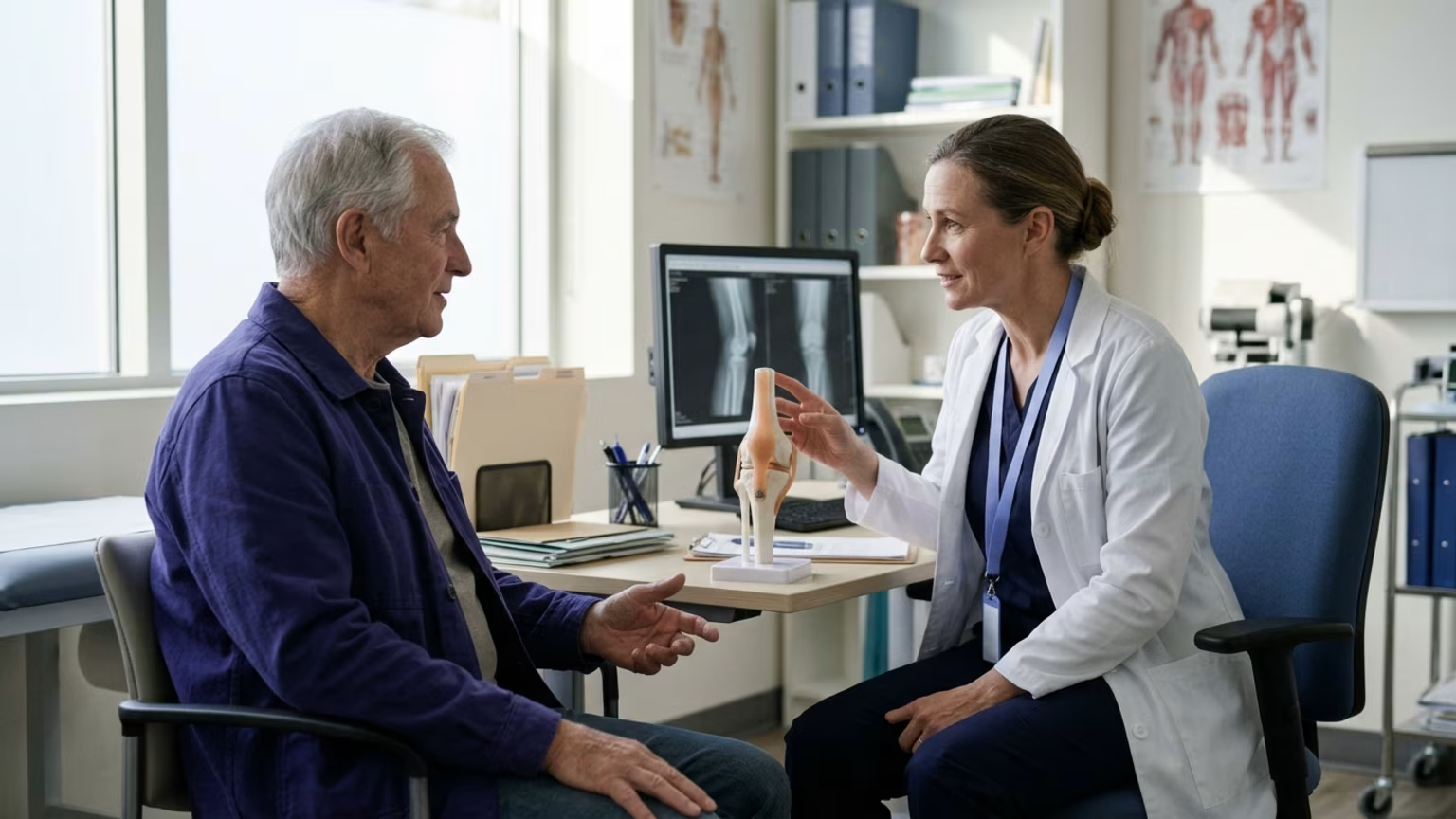

A JBJS roundup highlights 15-year partial knee replacement survival data, with context on implant choices and recovery expectations.





On November 15, 2026, OrthoBuzz introduced JBJS Paper Roundup, a monthly video series whose first installment reviewed long-term results after partial knee replacement. The featured study reported estimated revision-free survival of 85% at 15 years among 2,234 knees.
According to OrthoBuzz, knee surgeon Dr. Kash Akhtar hosts the series. Its first review covered Tsukamoto et al.'s study of unicompartmental knee arthroplasty (UKA), also called partial knee replacement.
The study abstract reports that technology assistance and fixed-bearing implant design were associated with lower revision risk. Higher surgeon volume was also associated with lower risk. For adults considering surgery or already recovering, the findings add a long-term durability perspective to discussions about life after knee replacement.
The evidence behind the new discussion came from operations performed years earlier. The study abstract describes a retrospective review of primary UKAs performed at one tertiary academic center from 2000 through 2021. In other words, the researchers looked back at care that had already taken place.
Researchers estimated revision-free survival and analyzed factors linked with revision risk. The central question was whether the knee replacement remained free from revision surgery over time. They also examined whether surgical features and implant choices were associated with that outcome.
The outcome's name matters. Here, “survival” describes the knee replacement remaining free from revision. It does not refer to the patient's survival, and revision-free does not necessarily mean symptom-free.
That is the evidence context entering the roundup: a long-term review of surgical outcomes. The new video series brought attention to an existing study rather than introducing a new recovery program or changing rehabilitation guidance.
According to the study abstract, estimated revision-free survival was 92% at 10 years and 85% at 15 years. A total of 118 knees were revised. The most frequent revision was conversion to total knee arthroplasty, also called total knee replacement.
The abstract reports these associations in univariable analyses, which examine factors separately:
The authors' conclusion also identifies fixed-bearing design as associated with lower revision risk. The hazard ratios describe comparisons in revision risk during follow-up. They are not additional implant-survival percentages and should not be added to the reported survival estimates.
Technology assistance had a specific meaning in this cohort. It was used in 59% of cases and included:
The combined technology finding should therefore not be treated as a robotics-only result. The broad label matters when comparing a study headline with the particular equipment a surgical practice uses. A discussion about technology is more useful when everyone is clear about which type is being discussed.
The study concerned people undergoing primary partial knee replacement at the center studied. Mean patient age was 65 years. Fixed-bearing implants were used in 78% of cases.
These details make the findings relevant background for discussions about UKA in a similar surgical setting. They do not turn the study group into a stand-in for everyone facing knee surgery. The paper studied partial knee replacement rather than all knee operations.
The abstract reports that 97% of the cohort was White. That limited racial representation is an important reason to be cautious about assuming the results apply equally across a broader patient population.
For an individual reader, the useful next question is whether the study matches the operation under discussion. Someone considering partial replacement is asking a different surgical question from someone already living with a total knee replacement. An orthopedic surgeon can explain how this UKA evidence relates to that person's diagnosis and surgical options.
For someone considering partial knee replacement, the study offers useful topics for a surgeon visit. Its practical value is a more focused conversation about the choices made in that practice, rather than selecting an implant or surgical technology from a headline.
Questions supported by the study's findings include:
These questions keep the decision tied to the person's circumstances and the surgeon's experience. They also give the surgeon room to explain why a particular approach is being considered.
The surgeon-volume finding deserves a conversation alongside the implant and technology findings. It is part of the study's conclusion, not simply background information. Asking about experience keeps the discussion broader than the name of a device or the presence of robotic equipment.
For someone already recovering, the main concern may be the transition from supervised rehabilitation to normal activity. Long-term implant data belongs in that conversation, but it addresses a different part of recovery from deciding what comes next in daily life.
The abstract also reports that mean Knee Society Score improved from 47 before surgery to 75 at five years. That is a separate outcome measure from implant survival. Neither result supplies an exercise plan or shows that reaching a particular recovery milestone improves implant durability.
Questions about the next stage belong with the team overseeing recovery: What is the current goal? How will progress be assessed? How will the plan change as formal rehabilitation ends? These questions connect the discussion to the person's present needs rather than treating a long-term percentage as an activity target.
If the main concern is day-to-day progress, a broader explanation of knee replacement recovery offers a place to frame those questions. For later-stage concerns, context on activity after joint replacement provides further reading about life beyond the early recovery period.
The abstract classifies the study as Therapeutic Level III evidence. Researchers reviewed past care rather than randomly assigning surgical approaches. The reported associations do not establish that technology assistance or fixed-bearing design caused better survival.
The univariable comparisons also leave questions about how the studied factors relate to one another. Further comparative research would help separate the contributions of technology assistance, implant design and surgeon experience. The current findings identify associations worth discussing rather than settling which feature is responsible for the outcome.
The 85% estimate is a cohort-level finding, not a forecast for an individual knee. It also does not give an implant a fixed expiration date. A reader's expected outcome remains a question for their orthopedic surgeon.
Open questions include whether similar results would appear across other centers and how specific forms of technology compare over long-term follow-up. Those questions matter when translating a broad study finding into a discussion about the options available in a particular practice.
Better context belongs alongside qualified care, not in place of it.
Partial knee replacement follow-up rests with the treating healthcare team, while ReboundBody adds an independent editorial perspective. Its articles address uncertainty about leaving formal rehabilitation by explaining recovery and return to normal activity in clear language. That context helps adults understand questions for their care team without turning research findings into personal treatment instructions.

Follow ReboundBody for practical articles on injury recovery, rehabilitation, mobility and rebuilding strength. New posts turn research into clear ideas for the road back to activity after injury or surgery.






Read practical guidance on injury recovery, rehabilitation, mobility and rebuilding strength as you work your way back to activity.
Explore Resources