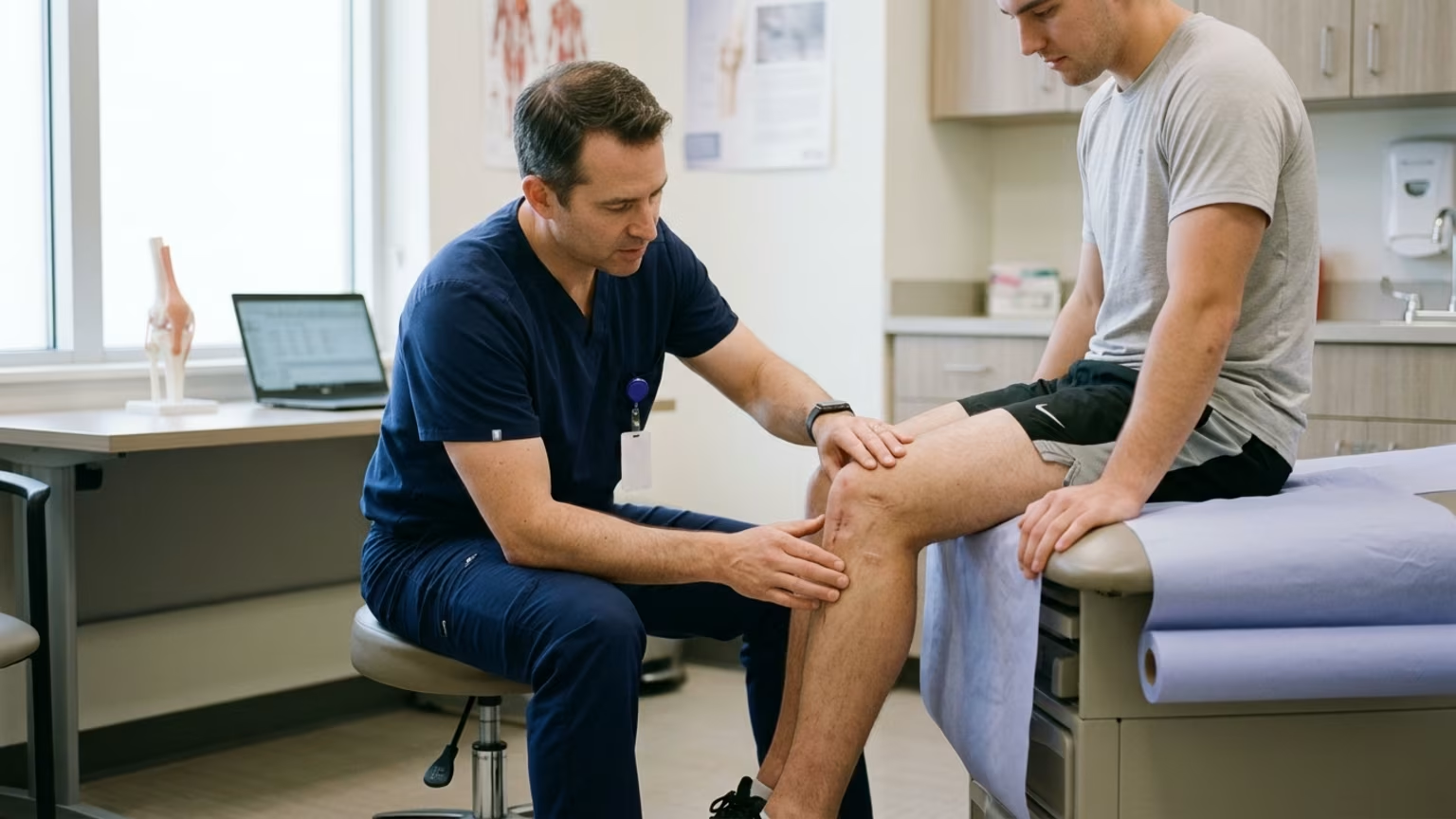

A small ACL trial reported similar one-year results for peroneus longus and hamstring grafts. See the findings, reporting issues and recovery context.





On November 16, 2026, Orthopedic Reviews published a randomized trial comparing peroneus longus and hamstring tendon autografts for primary reconstruction of isolated anterior cruciate ligament (ACL) tears. The authors reported improved knee-function scores in both groups and described their one-year outcomes as comparable.
The report adds a direct comparison to an important surgical discussion: which graft fits the person having ACL reconstruction? Alongside knee outcomes, the researchers examined graft diameter and findings at the location where the tendon was harvested.
The useful update is that peroneus longus performed well enough in this trial for the authors to describe it as a possible alternative. Understanding that finding means looking at the results alongside the broader evidence on graft choice and rehabilitation.
Before this trial, the broader evidence did not identify a universally superior autograft for return to sport. A 2026 narrative review in Current Reviews in Musculoskeletal Medicine recommended individualizing the choice rather than treating one option as best for everyone.
The review identified age and anatomy as relevant factors. It also highlighted sport, activity level and reinjury risk. That framework puts the individual patient at the center of the discussion rather than starting with a fixed ranking of grafts.
The review focused on patellar tendon, hamstring and quadriceps grafts. It therefore provides general context for graft selection rather than independent confirmation of this trial's peroneus longus findings. ReboundBody's related coverage examines how broader graft evidence informs return-to-sport discussions.
This distinction matters when reading a new comparison. A trial asks how particular groups performed under the conditions studied. A surgical discussion asks how those findings fit someone's anatomy and goals. The new report contributes to that discussion without replacing the broader selection framework.
The trial assessed patient-reported knee function with the IKDC and Lysholm scores. It also assessed knee stability clinically and followed participants for one year.
According to the authors, both graft groups improved on IKDC and Lysholm scores compared with their scores before surgery. The authors reported no statistically significant difference between groups in IKDC scores or postoperative Lachman stability.
These findings form the basis of the paper's overall description of comparable outcomes. The study considered both what participants reported about their knees and what clinicians found during stability assessment. Those are related parts of the result rather than a single measure of recovery.
The paper reported a mean graft diameter of 9.9 ± 0.6 mm in the peroneus longus group. The corresponding hamstring measurement was 8.5 ± 0.5 mm.
That is a finding about the grafts used in this study. It should remain separate from the finding about knee-function scores. A larger measured diameter does not by itself establish a better personal outcome or explain which graft a particular patient should receive.
For the peroneus longus group, the researchers compared the operated and unoperated sides. They reported no significant difference in ankle range of motion or AOFAS foot-and-ankle scores. The reported mean donor-ankle AOFAS score was 97.42 ± 1.7.
The authors also reported no deep infections or graft re-tears in either group during the study. Four participants in the hamstring group had harvest-site pain or altered sensation. According to the paper, those symptoms resolved within six months.
Together, these results show why a graft comparison involves more than knee scores alone. The study also examined the area where the tendon was harvested and recorded postoperative events. Each finding contributes a different part of the overall comparison.
The study was conducted between August 2022 and May 2024. It included skeletally mature patients with a primary ACL tear and no additional ligament injury.
The results section reports 42 analyzed participants. Of these, 20 received hamstring grafts and 22 received peroneus longus grafts. The reported average age was 26.52 years, and 90.5% of participants were male.
That population matters for readers in midlife or later life. A young and predominantly male sample limits confidence about how directly the results apply to older adults or a broader range of patients. The reported averages describe the study group rather than an age-based rule for choosing a graft.
The trial also concerned primary reconstruction of isolated ACL tears. Its findings should not automatically extend to revision surgery or complex knee injuries involving other ligaments. For an individual reader, the relevant question is how closely their situation matches the people studied.
For someone considering ACL reconstruction, the report offers a concrete comparison to discuss with an orthopedic surgeon. It does not provide a stand-alone reason to choose a graft or change an existing treatment plan.
The broader graft-choice review supports considering individual anatomy and activity goals. The trial adds findings about knee function and the tendon-harvest location. A useful discussion brings those subjects together rather than focusing only on a reported graft diameter.
Questions that follow from the evidence include:
A separate 2026 narrative review of ACL rehabilitation recommends criterion-driven progression. In plain language, that means assessing clinical findings and functional progress rather than relying on a universal schedule tied to graft type.
The review includes symptoms, swelling and motion in that assessment. It also considers walking, strength and performance on functional tasks. Patient-reported function and psychological readiness are part of the picture too.
This helps separate two questions that can become mixed together: which graft to use and how recovery is progressing. A graft comparison provides information about surgical options. Rehabilitation assessment addresses the person's current symptoms and abilities.
ReboundBody's coverage of exercise research after ACL surgery addresses that separate recovery topic. For personal planning, the treating team remains responsible for interpreting measured progress and deciding how it affects activity. The rehabilitation review cautions against applying universal graft-specific timelines.
The trial's small sample and one-year follow-up leave long-term graft survival and revision outcomes uncertain. A result that is not statistically significant does not prove that two grafts are equivalent. Likewise, the absence of reported re-tears or deep infections does not establish zero risk. The ankle findings do not rule out donor-site effects in other patients or over longer follow-up.
The paper also contains reporting discrepancies that affect interpretation:
These issues are why precise claims about faster harvesting or better thigh-muscle preservation should not be drawn from this report. They also make the paper's broad conclusion more useful than a confident ranking based on every reported measurement.
The authors call for larger and longer multicenter studies. Those studies would help clarify durability and late complications while providing a stronger basis for comparing patient groups.
For readers, the practical next step is a discussion about relevance rather than a change based on the headline. The November 16 report adds a side-by-side comparison to the graft-choice conversation. Its value is in sharpening the questions asked before surgery, not closing that conversation.
Similar ACL graft scores can become oversimplified treatment claims online, a confusion ReboundBody addresses through clear reporting with realistic limits. Its independent coverage of rehabilitation and return to activity helps adults in midlife or later life sort conflicting messages and form better-informed questions for their healthcare team.

Follow ReboundBody for practical articles on injury recovery, rehabilitation, mobility and rebuilding strength. New posts turn research into clear ideas for the road back to activity after injury or surgery.






Read practical guidance on injury recovery, rehabilitation, mobility and rebuilding strength as you work your way back to activity.
Explore Resources