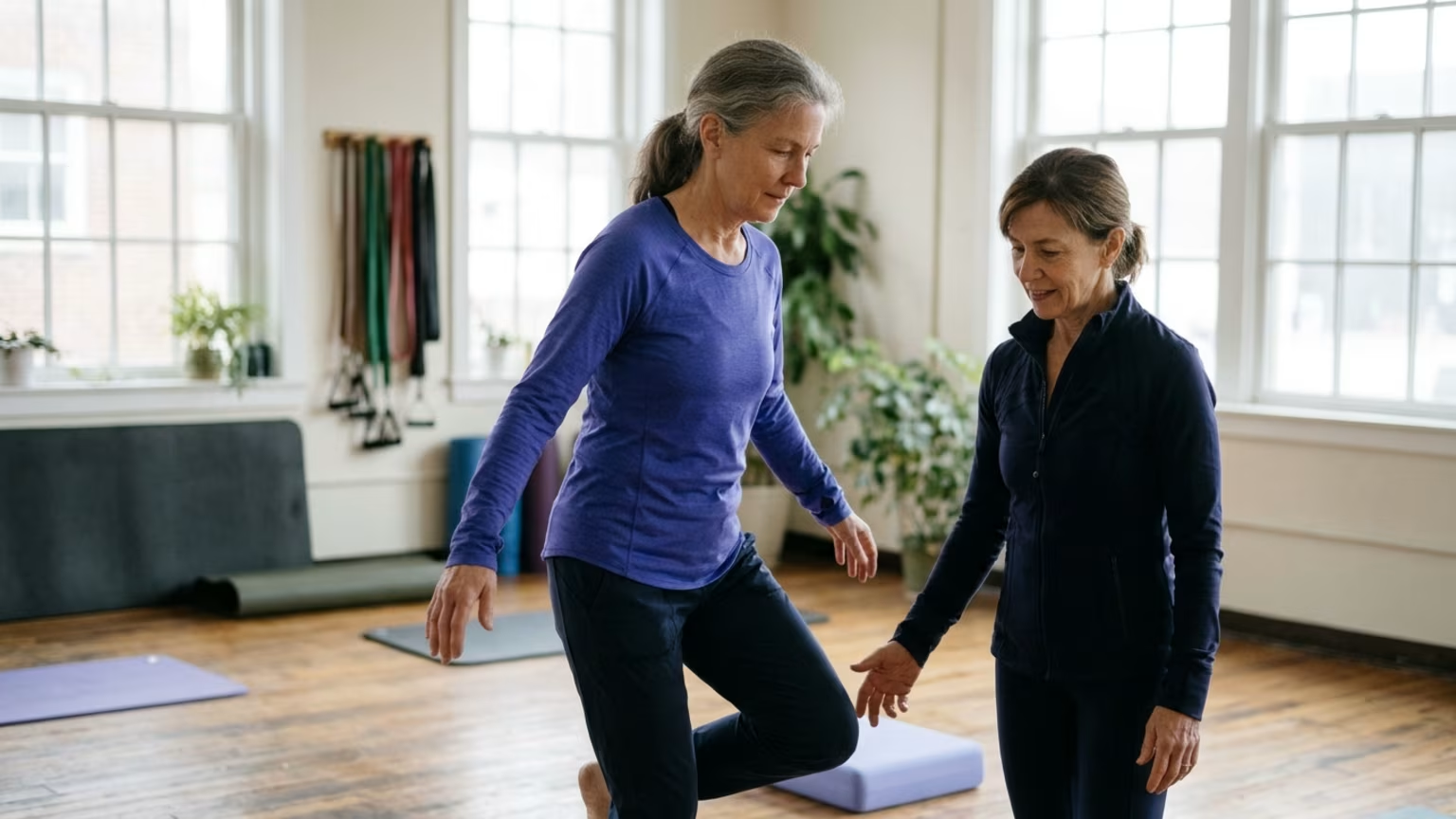

A 24-week trial found sensorimotor training gains in older adults. Understand the measured results, study limits and relevance to recovery discussions.





On May 29, 2025, Frontiers in Physiology published a randomized trial that reported improvement across all assessed physical-capacity tests in a sensorimotor training group. According to the PEDro trial record, the study ran for 24 weeks and compared sensorimotor training with aqua aerobics, Pilates and a control group.
The report describes sensorimotor training as combining sensory and movement demands to challenge coordination, balance and body control. Rather than focusing only on producing force or reaching farther, this approach includes how movement is controlled.
Looking back at the findings, the study offers a useful example of research that considers several physical capacities together. Its results are worth understanding through the tests researchers used and the people who took part.
The news coverage placed the findings within a broader active-aging discussion: exercise can include balance and functional work alongside strength and aerobic activity. The starting point was therefore not a single definition of fitness. It was a question about how different exercise approaches relate to different physical abilities.
This distinction matters when interpreting a workout headline. Strength, flexibility and agility are separate outcomes in this report. A program’s result on one measure does not describe every part of its value.
The trial also treated the exercise options as distinct programs rather than grouping them together as general activity. That allowed researchers to examine patterns across the groups and across the tests.
The appropriate context is a comparison study, not a replacement for existing clinical advice. For readers accustomed to seeing exercise described mainly through effort or duration, the report brings coordination and body control into the discussion. Those qualities are the reason to pay attention to the sensorimotor approach here.
According to PEDro, researchers assessed strength and flexibility using the Rikli and Jones battery. They assessed agility and speed using the Timed Up and Go test. These measures define the scope of the reported results.
The sensorimotor group showed statistically significant improvement across all assessed tests. The aqua-aerobics group improved on selected measures rather than across the full set. Those improvements included:
This pattern suggests that the sensorimotor program addressed several measured capacities in the same trial. Aqua aerobics also produced gains, though the pattern was more selective. That is a more useful reading than dividing exercise types into those that work and those that do not.
The control and Pilates groups did not show statistically significant improvement in the assessed variables. That finding belongs to these programs and these outcomes. It does not establish that Pilates is ineffective in general.
There is also an important distinction between improvement within a group and a difference between groups. PEDro reports that the between-group interaction effects were not significant for the Timed Up and Go test. In other words, the sensorimotor group’s improvement on that test did not establish a clear advantage in its pattern of change over the other groups.
Taken together, the results support interest in sensorimotor training for several physical capacities. They do not produce a simple ranking in which one exercise mode wins on every measure.
Woman & Home presented the study in coverage aimed at adults over 55. The PEDro record describes the participants as older adults. That distinction is useful because a news audience is not the same thing as a detailed study eligibility description.
The trial included 153 participants divided as follows:
The groups were uneven in size. Woman & Home also described the sample as small and predominantly female. Those features limit how confidently the findings can be extended to a broader population.
For ReboundBody readers, the most important population boundary concerns recovery status. This was not a trial of a post-surgical rehabilitation program or a test of recovery after an orthopedic injury. An overlap in age does not make the participants interchangeable with someone rebuilding movement after a specific physical setback.
The relevant takeaway is therefore about the kinds of capacity that deserve attention in older-adult exercise research. Applying that evidence to a particular injury or operation remains a separate clinical question.
For someone returning to activity, this study may help put more precise language around the goal of getting fitter. In this report, fitness was examined through strength, flexibility, agility and speed. The sensorimotor approach also brought coordination and body control into focus.
That language can support a discussion with a qualified healthcare professional about what a recovery plan is intended to rebuild. Useful questions include:
These are questions about purpose and measurement. They are not instructions to add a particular exercise or replace an existing program. A study becomes more useful when its outcomes help clarify a conversation rather than take the place of one.
The findings also give readers a way to examine broad claims about exercise. A statement that a program improves fitness is less informative than a description of what researchers actually measured. In this trial, the reported gains came from named tests rather than an assessment of every daily activity a participant might value.
For readers thinking about the next stage after a setback, that distinction connects with the difference between feeling better and being ready for activity. The useful question is what evidence supports the next step, rather than whether a program has an appealing label.
There is a separate issue of how a program fits into ordinary life. ReboundBody’s discussion of building a lasting strength-training routine after a setback addresses that broader recovery topic. A favorable study result and an appropriate personal plan are different pieces of the same conversation.
The available trial summary reports statistical significance but does not provide numerical effect sizes. These materials therefore do not show how large the changes were or whether participants experienced improvements that mattered in everyday life. A favorable test result is not a complete description of practical benefit.
Woman & Home also reports that initial fitness, diet and medication were not accounted for. This leaves questions about how those factors related to the observed results. It is a reason to keep the interpretation tied to the study rather than turn its findings into a broad prediction.
The available record does not provide a detailed intervention protocol. It does not support a home exercise sequence or a recommendation about how often to perform it. The term sensorimotor training describes an approach here, not a ready-made program that readers can reproduce from the report.
The comparisons also have clear boundaries. The trial summary lists no running group, so it offers no direct comparison with running. It also does not establish that sensorimotor training reduces falls or prevents reinjury.
Further research could clarify which participants benefit most and which program features matter. Questions also remain about how long improvements last and how well test changes translate into activities that people want to resume. Those are meaningful next questions rather than reasons to disregard the findings.
For now, the study adds a measured observation: an exercise approach centered on sensory and movement demands produced gains across several assessed capacities. It makes body control part of the fitness conversation without settling every decision about recovery.
The quieter lesson is that rebuilding physical capacity is not only a matter of doing more. How movement is organized deserves a place in the picture too.
Fitness-test improvements leave personal recovery choices open, especially when the research was not designed around orthopedic care. ReboundBody translates rehabilitation and strength-rebuilding evidence for active adults. Its independent articles place findings within realistic limits so readers can better understand physical recovery without being offered medical promises.

Follow ReboundBody for practical articles on injury recovery, rehabilitation, mobility and rebuilding strength. New posts turn research into clear ideas for the road back to activity after injury or surgery.






Read practical guidance on injury recovery, rehabilitation, mobility and rebuilding strength as you work your way back to activity.
Explore Resources