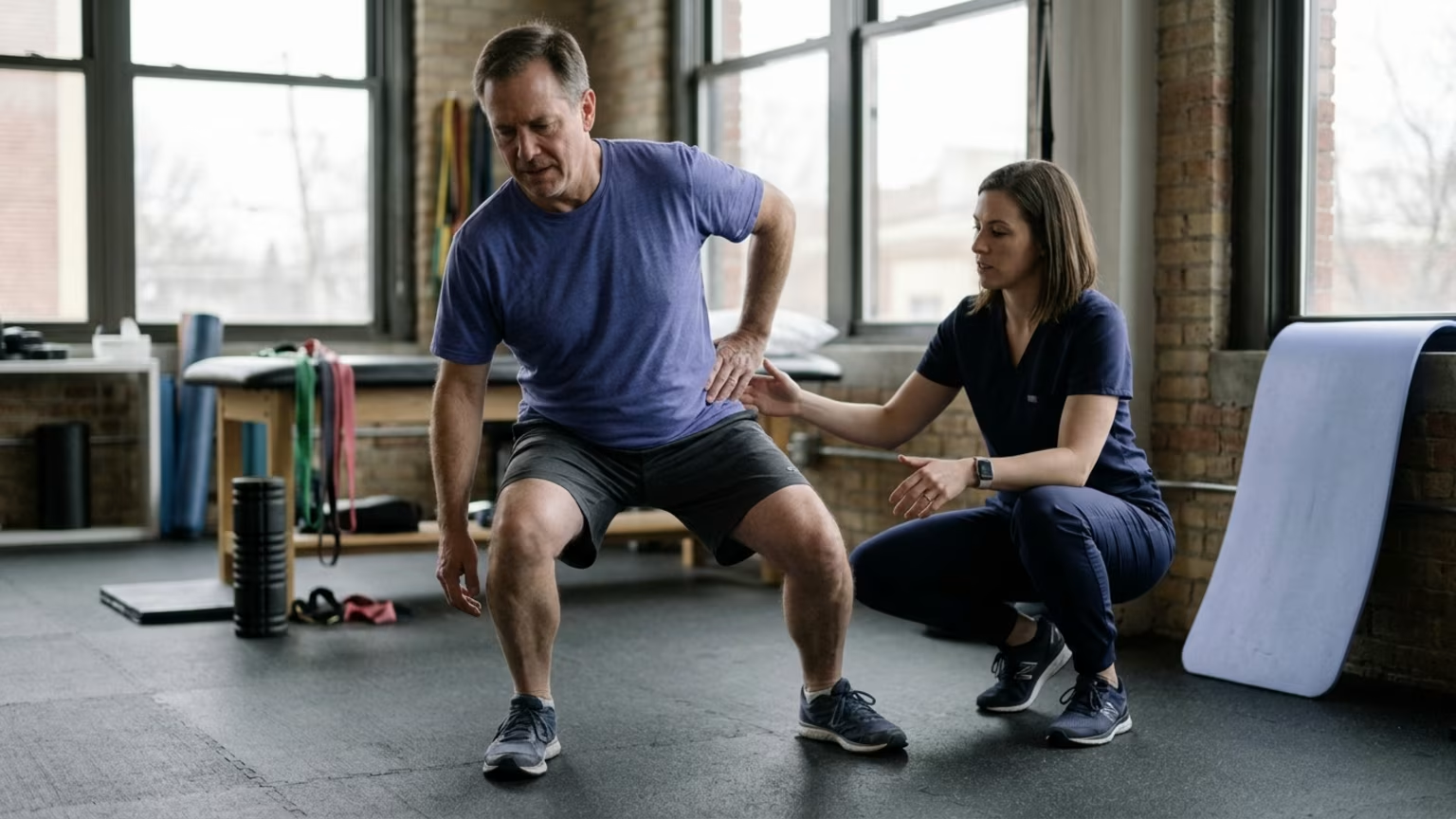

Knee osteoarthritis studies show why walking speed and motion at nearby joints matter when discussing a stiff joint and a changed walking pattern.





The joint that feels stiff is not the whole movement story.
When a knee feels limited, it is reasonable to expect that knee to explain an altered walk.
But research on knee osteoarthritis shows why walking pace and motion at other joints also deserve attention.
A familiar belief is that a stiff joint acts like a single blocked hinge. Under this view, reduced knee motion explains a changed walk. Any difference at the hip or ankle is then treated as a direct response to the knee's restriction.
That explanation makes intuitive sense. The knee is where the limitation is felt, so it seems like the obvious place to look for the cause. Measuring how far it bends also offers a clear way to describe the problem.
The belief can lead to a simple expectation: restore the joint's motion and the larger movement should return to normal. Yet that expectation leaves an important question unanswered. How much of the observed walking pattern reflects the joint itself, and how much reflects the way the walking task is performed?
The better-supported view keeps the joint and the task in the same picture. For walking, that means considering pace alongside motion at the knee and nearby joints. A difference at the ankle or hip may reflect walking speed rather than a direct effect of knee stiffness.
This is not an argument for ignoring joint motion. It is a reason to connect that measurement with the activity being observed. A knee-bending measurement and an observation of walking answer related but different questions.
The first describes motion at one joint. The second places that motion within a task that also involves the hip and ankle. Research in knee osteoarthritis shows why separating those questions matters.
For recovery discussions, this shifts the focus from finding a single joint to blame toward understanding the pattern in context. It also supports looking beyond joint-angle measurements when discussing progress.
A study described in the ZHAW research record compared 23 people with knee osteoarthritis affecting one knee with 28 age-matched controls. The participants with osteoarthritis were awaiting total knee replacement.
At their preferred walking speeds, the groups showed differences across several joints:
Looking only at these results could suggest that the knee condition explained a chain of changes through the leg. But the researchers also compared the groups at matched walking speeds. Under those conditions, the observed joint-motion differences were not statistically significant.
The authors concluded that the differences appeared to be mainly related to slower walking speed. Pace was therefore central to interpreting the pattern, rather than a minor detail to set aside.
A separate study in the UNESP research record included 71 women. Of these, 39 had knee osteoarthritis and 32 were controls. Their mean ages were about 67 and 65 respectively.
The osteoarthritis group walked 11% more slowly than the control group. The study also reported longer stride times and longer support periods. These included the part of walking when both feet were on the ground.
The authors interpreted this pattern as possibly reducing knee pain or loading. This offers a useful alternative to viewing every altered movement as a mistake. A pattern may represent an adjustment to the task rather than simply poor movement.
These findings come from specific groups with knee osteoarthritis. The first involved people awaiting knee replacement. The second involved older women. They do not establish the same explanation for every stiff joint or every stage after injury or surgery.
The speed-matched finding also does not mean the groups were identical or that knee osteoarthritis has no effect on walking. It means the differences measured in that study were no longer statistically significant when speeds were matched. Nor does this result amount to advice to walk faster.
Finally, the possible protective role described by the second study was an interpretation. It did not prove why each participant walked that way. Neither study established that a particular movement difference causes damage or needs to be removed.
The practical value of this research is not a new walking rule. It is a clearer way to organize a conversation with a qualified rehabilitation professional. Joint motion matters, but so does the activity in which that motion is being used.
A broad description such as “my knee movement is different” leaves room for several meanings. A discussion about walking can be more specific: what happens at the knee while the foot is on the ground? What is happening at the hip and ankle during the same walk?
These questions connect the area that feels limited with the larger activity. They also give a professional a clearer account of what the person wants to understand. The focus becomes the task that matters rather than a joint measurement considered alone.
A joint measurement still has a place in that discussion. The point is to ask how it relates to walking, not to replace it with a visual judgment of the whole person.
Walking speed belongs in descriptions of movement and comparisons over time. A change in pace can change the meaning of what is observed, as the ZHAW study showed.
For example, a comfortable walk and a walk performed at a specified pace are different comparison conditions. Recording which condition was used helps keep the discussion clear. It avoids treating every visible difference as if it occurred during the same task.
This is a question of fair comparison rather than choosing a preferred speed. The relevant discussion is how the pace of a test fits the question the clinician is trying to answer.
Useful questions for a rehabilitation conversation can bring the joint and the activity together:
These are questions for interpretation, not a self-assessment score. Decisions about whether a pattern needs attention belong within an individual assessment by a qualified professional.
The same conversation can include how joint motion fits into broader rehabilitation goals. Instead of making one measurement stand for all recovery, it gives that measurement a defined role. The person and clinician can discuss both the joint finding and the activity they are trying to understand.
When a joint feels stiff, looking at the whole walking pattern adds context that a joint measurement alone does not provide. The knee osteoarthritis studies make one point especially clear: walking speed can shape the differences seen at several joints.
The most useful question is therefore not just “Which joint moves less?” It is also “What task was performed, and under what conditions?” Keeping both questions in view supports a more informed discussion about movement and recovery.
Turning observations about a stiff knee and a changed walk into questions for a healthcare visit is where ReboundBody's educational role fits. ReboundBody explains mobility and rehabilitation for active adults in midlife and later life through evidence-aware articles with realistic limits and no medical promises.

Follow ReboundBody for practical articles on injury recovery, rehabilitation, mobility and rebuilding strength. New posts turn research into clear ideas for the road back to activity after injury or surgery.






Read practical guidance on injury recovery, rehabilitation, mobility and rebuilding strength as you work your way back to activity.
Explore Resources