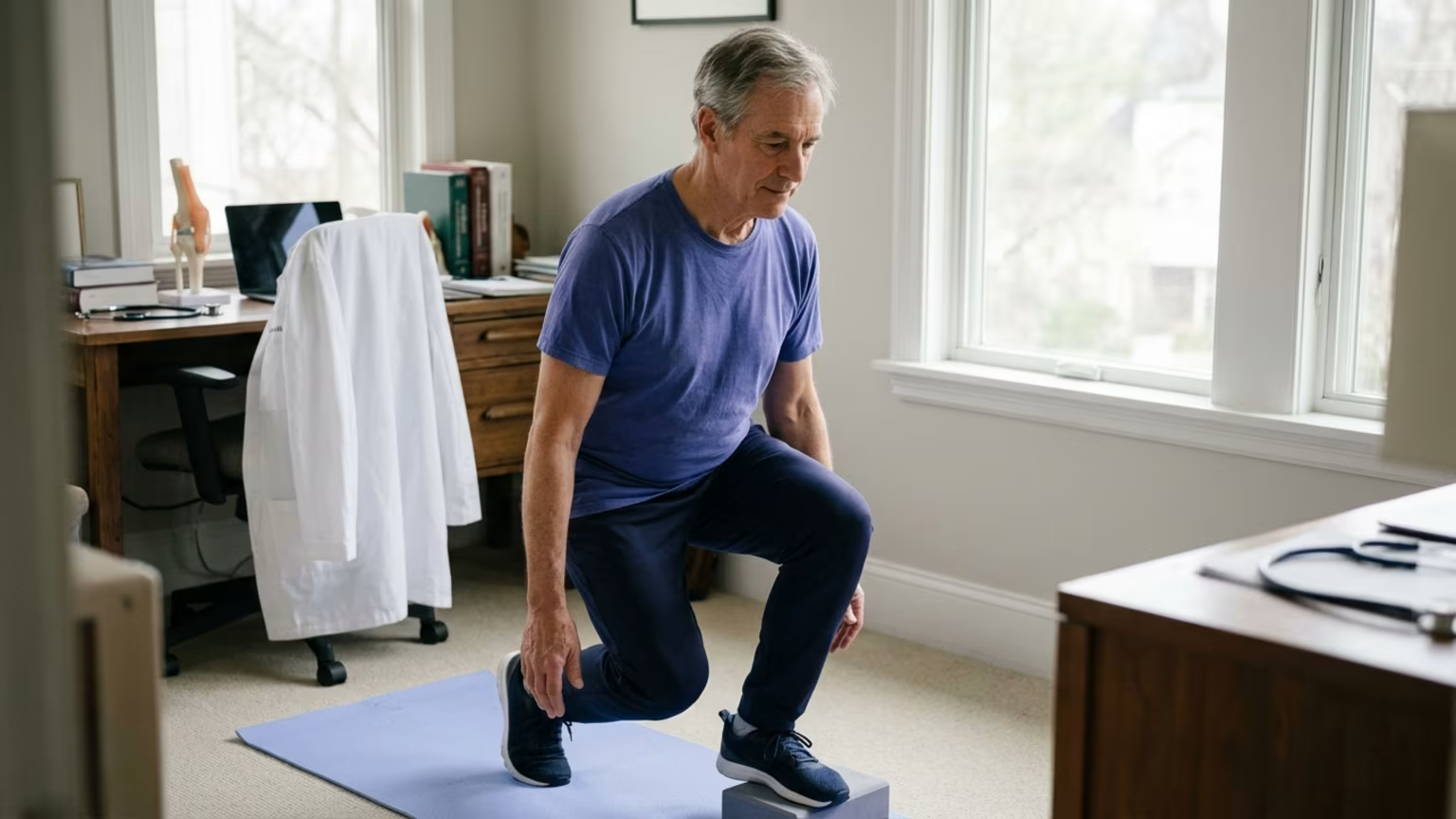

A surgeon’s seven-move knee routine highlights strength, balance and coordination. Here is how it fits with knee osteoarthritis exercise evidence.





On October 16, 2026, Men’s Journal profiled orthopedic surgeon Howard Luks, described as 63. The feature presented a seven-exercise knee routine developed with performance coach Brett Poniros and Luks’s partners. Its stated goals reach beyond strength to include balance, coordination and handling changes in movement and load.
According to the feature, Luks reconsidered his training after noticing that conventional weightlifting had not addressed his balance and agility. His perspective came from treating injured knees and from his own running, hiking and cycling. The resulting routine combines squatting and stepping with jumping and quick-feet tasks.
For adults trying to understand knee function after a physical setback, the useful development is this wider view of training. The exercises are the headline. The more useful discussion concerns the different movement qualities the surgeon and coach want to address.
The clinical background predates this feature. A 2026 peer-reviewed review, Knee osteoarthritis management across the joint-preservation continuum: current evidence and future directions, describes exercise as an important part of knee osteoarthritis rehabilitation. It highlights strengthening the quadriceps and hip muscles.
The review describes several types of exercise that may be selected according to patient needs:
That range matters because the clinical discussion is not limited to lifting weights. Strengthening sits within a broader set of exercise options. The review’s emphasis is on matching those components to the person rather than presenting one fixed routine for everyone.
The same review reports that AAOS supports supervised, unsupervised or aquatic exercise to improve pain and function in people with knee osteoarthritis. That is the established clinical context against which the feature should be read. Exercise was already supported within osteoarthritis care; the feature introduces a particular practitioner-designed selection of movements.
The connection is a shared interest in strength and movement. It is not a newly established clinical preference for these seven exercises over the other options described in the review.
The Men’s Journal feature lists these movements:
Luks stresses the importance of the quadriceps for knee health. Poniros adds a broader training aim: movement through a full range of motion alongside speed and balance. He also describes preparing people to move in different directions under different loads.
Together, those aims explain why the menu contains more than conventional strength exercises. The jumping and quick-feet elements reflect the coach’s interest in speed and changing movement demands. The routine is intended to address several qualities rather than treating strength as the only goal.
The feature also emphasizes controlled movement. It presents easier variations such as starting without added weight or using a shallow squat. Bodyweight squats and supported step-ups appear among its options.
These details help explain the approach without turning the article into an exercise session. The exercise names describe the menu. The discussion of strength, balance and control describes what its designers hope to train.
That distinction makes the feature more useful than a simple list of movements. It gives readers a way to separate a training goal from the exercise chosen to address it. The broader clinical review uses a similar needs-based approach when describing how different exercise components may fit into osteoarthritis rehabilitation.
The feature centers on Luks’s experience and the routine developed with Poniros and his partners. His age is part of the profile. It is not an age-based eligibility rule for the exercises.
The peer-reviewed review addresses knee osteoarthritis care. Its discussion of quadriceps and hip strengthening belongs to that clinical setting. Readers recovering from a different knee problem should keep that population in view when interpreting its findings.
For ReboundBody’s audience, this distinction is especially relevant. A person returning after surgery is asking a different question from someone considering general fitness training. A reader with recurring knee symptoms may also have different goals from the surgeon described in the feature.
These are different contexts, not interchangeable versions of the same exercise decision. The shared interest in stronger knees does not erase the importance of the condition being managed or the stage of recovery.
The feature is most relevant as an introduction to movement qualities. The review provides clinical context for exercise in osteoarthritis. Neither source describes a study group consisting of all adults returning from orthopedic injury or surgery.
The practical value is not choosing all seven exercises. It is recognizing that an exercise discussion can involve several separate goals. In the feature, those goals include strength, balance and coordination. They also include range of motion and responses to changes in direction or load.
That provides a more precise vocabulary for conversations with a qualified healthcare professional. Instead of treating “stronger knees” as a single outcome, a discussion can identify which movement quality an exercise is meant to address. ReboundBody’s explanation of how strength relates to readiness for activity offers related context for that distinction.
Useful questions raised by the feature include:
These are questions about the purpose and fit of exercise. They do not require adopting the featured routine. For readers organizing that conversation, keeping track of questions for an orthopedic follow-up can help separate a general fitness headline from an individual recovery decision.
The easier variations in the feature are also worth reading in context. They show that its designers describe ways to change an exercise’s demands. Their presence should not be read as a replacement for the plan already set by a treating professional.
For someone after surgery, the connection between an exercise and the current stage of rehabilitation remains a personal clinical question. Understanding why recovery milestones matter alongside the calendar can provide context without assigning a new exercise or changing a treatment plan.
The feature is not a clinical trial or a professional guideline. The available sources do not establish that this particular seven-move routine improves outcomes. They also do not show that it prevents knee injuries or reverses joint damage.
The jumping and twisting movements raise a separate suitability question. The sources do not establish that those drills are appropriate for every adult with knee pain, osteoarthritis or a prior injury. For readers with substantial symptoms or rehabilitation restrictions, the feature does not provide personal clearance to perform them.
Other questions remain unanswered in the supplied evidence. It does not identify the best combination of these exercises for a given condition. It also does not establish which elements are necessary or whether this routine offers advantages over another tailored program.
The clinical review supports selecting exercise components according to patient needs. The feature offers one surgeon’s and coach’s approach to a broader set of movement goals. Those contributions can sit beside each other without being treated as the same kind of evidence.
The lasting observation is quieter than the headline: strength is one part of the movement picture described here. A useful recovery discussion leaves room for the other parts without assuming that every exercise belongs in every person’s plan.
Knee exercise decisions sit with the treating healthcare team; ReboundBody’s role is to make the research behind those conversations easier to understand. Its independent editorial coverage explains rehabilitation and strength rebuilding for active adults navigating injury, surgery or recurring physical problems, with realistic limits rather than personal treatment direction.

Follow ReboundBody for practical articles on injury recovery, rehabilitation, mobility and rebuilding strength. New posts turn research into clear ideas for the road back to activity after injury or surgery.






Read practical guidance on injury recovery, rehabilitation, mobility and rebuilding strength as you work your way back to activity.
Explore Resources