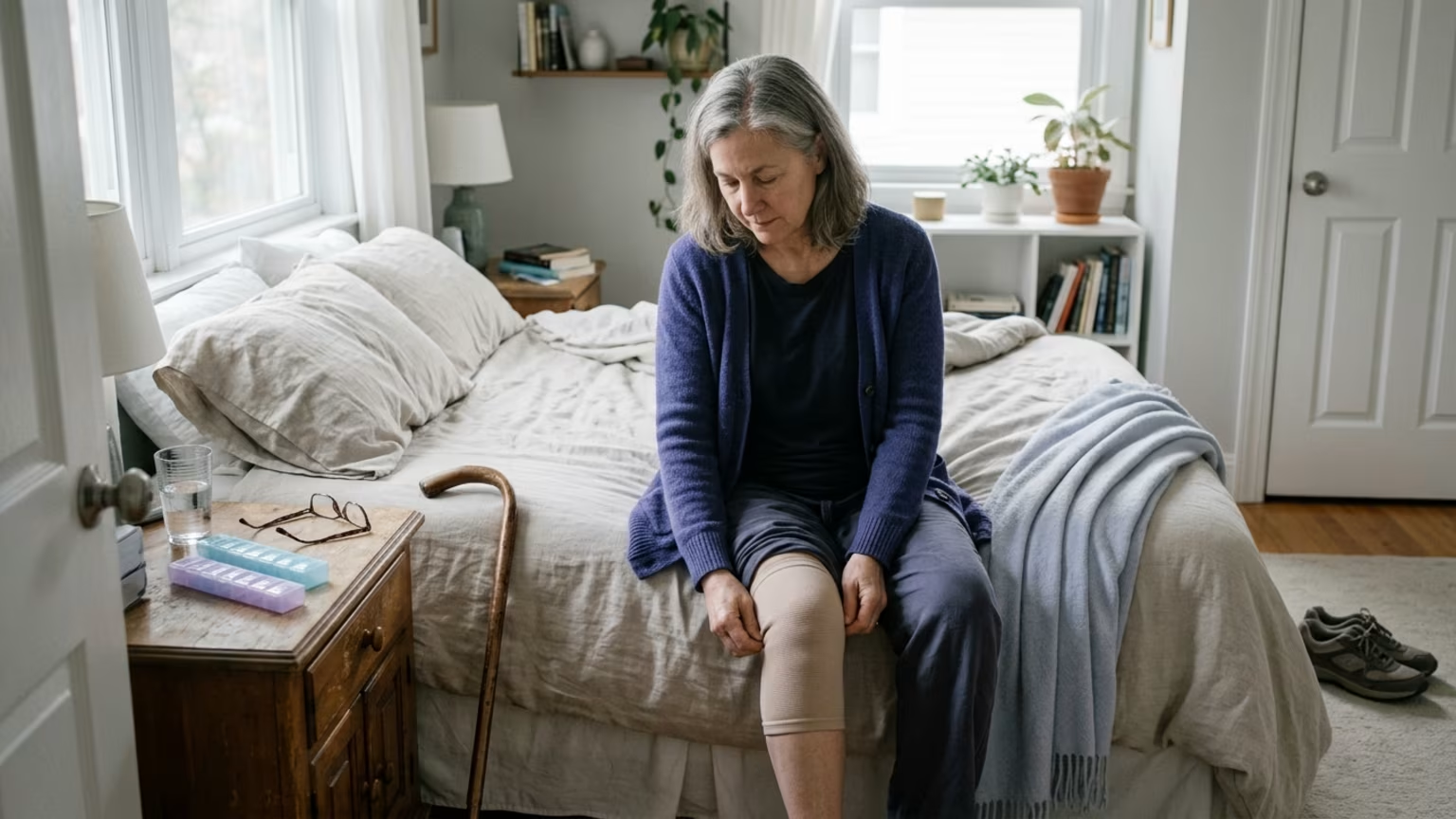

Understand the evidence on sleep and daily stiffness, why one day's mobility is not a recovery verdict, and what to discuss with your clinician.





Day-to-day mobility changes do not have one explanation that can be identified from stiffness alone. Research links sleep with musculoskeletal symptoms and recovery, but it does not establish why a particular person feels less comfortable moving today.
The useful starting point is to separate what changed from what it means. A difficult day is information to describe. By itself, it is not enough to label recovery a success or a setback.
That distinction matters when formal rehabilitation is ending and normal activity still feels uncertain. The aim is not to dismiss a change. It is to understand the question it raises and bring a clearer account to the professionals guiding recovery.
The answer varies partly because “my mobility feels worse” can describe several different concerns. It might refer to a stiff sensation, difficulty with a particular task or a change in measured movement. Those descriptions ask different questions about recovery.
Consider the difference between saying “my joint felt stiff” and identifying the movement that was difficult. The second description gives a clinician a more specific question to address. It does not establish the cause, but it makes the concern clearer.
It helps to separate these observations:
Sleep belongs in that context because it has a documented relationship with musculoskeletal symptoms and postoperative recovery. Activity and stress may also be things a reader wants to mention. However, the approved evidence does not establish either as the cause of an individual's daily stiffness.
This is an important distinction between recording context and assigning blame. Describing a busy day or a poor night does not require deciding that it caused the next day's experience.
For background on the terms used in recovery discussions, ReboundBody explains how mobility relates to other physical abilities.
Sleep is relevant to discuss during recovery. The strongest postoperative finding here concerns an association between sleep quality and functional recovery, rather than a direct test of next-day stiffness.
A prospective cohort following hip-fracture surgery followed participants for 13 months. Better sleep quality was independently associated with better functional recovery.
“Associated” means that the study found a relationship. It does not mean that changing sleep alone caused recovery to improve. The finding also comes from a specific hip-fracture population, so it should not be treated as an answer for every orthopedic injury or surgery.
A meta-analysis in Sleep Medicine Research examined pain and sleep disturbance in musculoskeletal disorders. Its abstract describes the relationship as bidirectional. In plain language, the relationship is discussed in both directions rather than as a simple one-way explanation from sleep to pain.
The available summary does not establish the strength of that relationship or whether it differs by anatomical pain location. Pain findings also should not be relabeled as proof about stiffness.
The practical implication is straightforward: sleep is useful information for a recovery conversation. It is not a stand-alone explanation for a difficult movement day or a treatment plan for stiffness.
A useful question for a clinician is: “Does my sleep difficulty need attention as part of my recovery care?” That keeps the discussion focused on the person's situation rather than turning a research association into a personal conclusion.
One stiff day is not enough information to make that judgment. It also is not enough information to declare that the change is harmless. Both conclusions go beyond the description itself.
The hip-fracture cohort examined functional recovery over time. Its finding gives sleep a place in the larger recovery discussion. It does not turn a single day's experience into a test of whether someone is recovering well.
A more useful distinction is between an observation and a verdict:
The first statement describes the concern. The second adds an interpretation that needs more information.
The same reasoning applies to an unusually comfortable day. Feeling better during one activity is worth describing, but the decision to change activity demands belongs within an individual recovery plan.
This approach does not ask someone to ignore symptoms or think positively about them. It asks them to keep the description separate from the conclusion. That leaves room for a qualified clinician to interpret the change in context.
Readers approaching the end of formal care can also use this overview of planning beyond physical therapy to frame questions about the next stage.
Use observations to prepare for a conversation rather than to score each day as good or bad. A short note can keep the experience specific without becoming a personal diagnostic test.
The following prompts organize information. They are not an exercise protocol or a validated method for deciding whether a symptom is safe.
Replace a broad label such as “everything was worse” with the movement that prompted the concern. The point is not to create a technical assessment. It is to make clear what you want help understanding.
If there was no particular task, describing the sensation itself is still useful. There is no need to force the experience into a number.
“My sleep was poor” and “this movement felt stiff” are observations. “Poor sleep caused the stiffness” is an explanation.
Keeping them separate allows both details to be discussed without treating their timing as proof of cause. The same approach applies when noting activity or stress.
The most useful question may be about meaning rather than measurement. For example: “Does this change affect the plan we agreed on?” That is different from asking whether the day was a success.
A note can also preserve uncertainty. Writing “I am not sure whether the movement changed or whether it felt different” is more precise than choosing an explanation without enough information.
There is no need to turn this article into a testing schedule. The purpose of the note is to help explain a concern and support an informed discussion.
Questions about changing exercises or increasing activity should go to the clinician overseeing recovery. A pattern noticed at home is a topic for that discussion, not an automatic instruction to alter the plan.
Persistent or concerning changes deserve discussion with the treating clinician. The evidence here does not supply a universal symptom threshold or a rule for how long to wait.
Useful questions include:
These questions leave personal decisions with the professionals who know the recovery history. They also make room for the reader's main concern, whether that is discomfort or uncertainty about normal activity.
The goal is not to arrive with a self-diagnosis. It is to arrive with a clear description and a question that matters.
A variable day is information, not a complete recovery assessment. Sleep has a documented relationship with musculoskeletal symptoms and with functional recovery after hip-fracture surgery. Those findings provide context without explaining every fluctuation.
The useful middle ground is neither dismissal nor an immediate conclusion that recovery has gone backward. It is a specific account of what changed, interpreted within the person's care plan.
Today, write down the movement that concerned you and the question you want your treating clinician to answer about it.
Daily stiffness raises questions that a single recovery study cannot settle, and ReboundBody addresses that uncertainty through evidence-aware editorial content. For adults unsure about moving from formal rehabilitation into normal activity, its explanations of mobility and physical recovery help clarify the issues to discuss with qualified healthcare professionals.

Follow ReboundBody for practical articles on injury recovery, rehabilitation, mobility and rebuilding strength. New posts turn research into clear ideas for the road back to activity after injury or surgery.




Read practical guidance on injury recovery, rehabilitation, mobility and rebuilding strength as you work your way back to activity.
Explore Resources