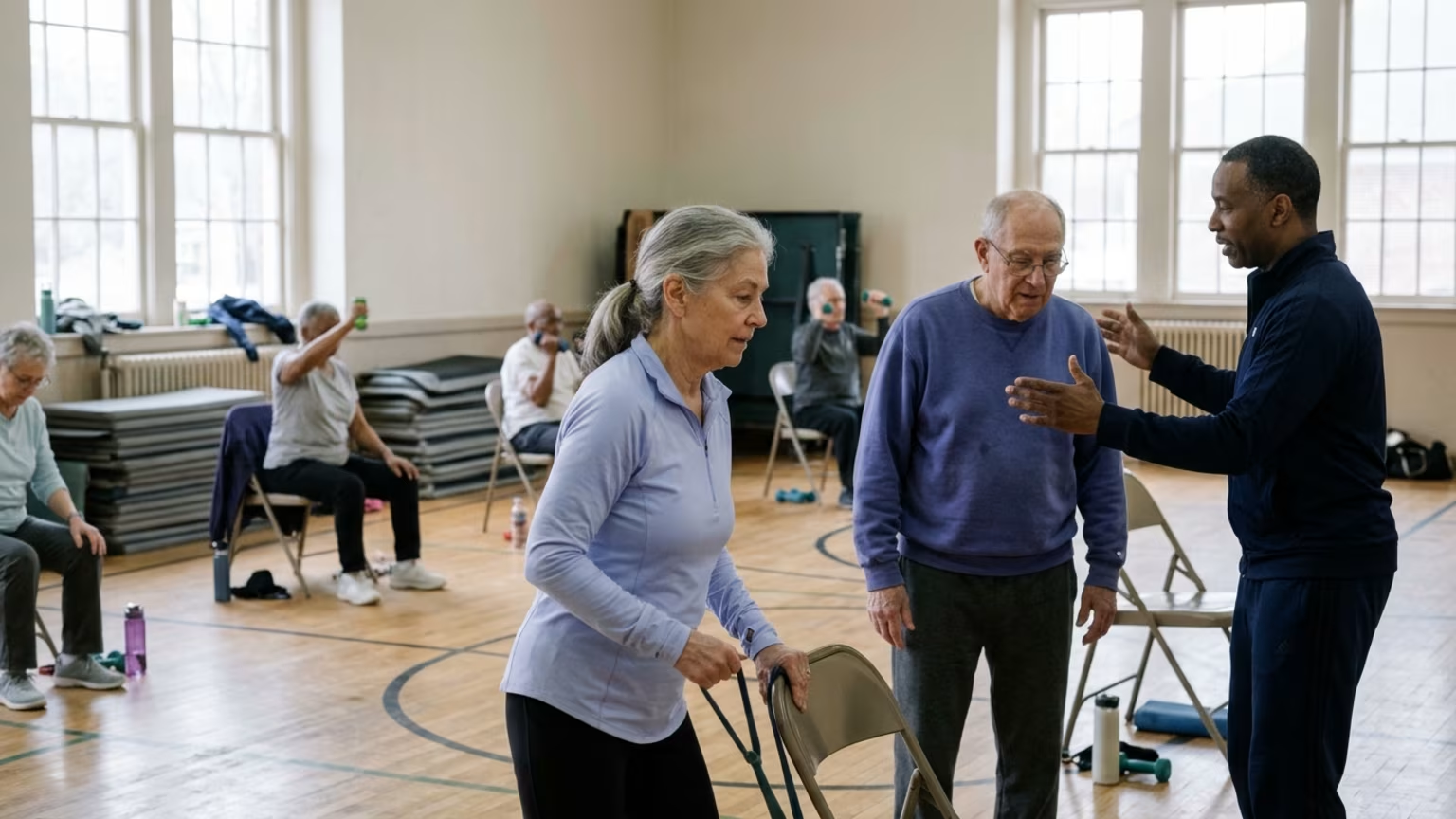

A yearlong study in adults ages 70 to 85 found varied strength and walking gains without a significant overall lean-mass change.





On 2026-10-24, the European Journal of Applied Physiology published an analysis reporting average gains in strength and walking performance after a year-long exercise program in older adults. Overall lean mass did not change significantly. Individual responses also varied substantially across the measures researchers tracked.
The report puts several forms of progress side by side rather than letting one result stand for the whole program. For adults trying to understand changes in physical capacity, that is the useful update: strength, walking performance and body composition gave different views of the same training period.
The findings came from an exploratory secondary analysis of the PASSWORD randomized trial. That trial was conducted from 2017 to 2019. A secondary analysis returns to existing trial data to examine another research question. Here, the researchers looked closely at how responses differed between participants and across physical outcomes.
The original trial compared physical training alone with physical training plus cognitive training. Because the researchers found no difference between those groups in physical outcomes, they pooled the groups for this analysis.
According to the paper, participants received a structured and progressive program that included:
The broader program also included flexibility work. This was a study of several forms of activity together, not a test of resistance exercise alone.
That background matters when reading the results. The findings describe what happened within a supported program that addressed several physical abilities. They do not identify which single exercise component accounted for each measured change.
The update also concerns how the existing evidence was examined. Rather than stopping at the group's average result, the researchers asked how often individual participants showed a high response on different tests. Those are related questions, but they describe different aspects of a trial.
The researchers reported statistically significant average improvements in four outcomes:
Appendicular lean mass did not change significantly overall. In other words, the strength and walking findings were not accompanied by a significant average increase in the study's lean-mass measure. That result describes this program and this group. It does not establish that older adults cannot gain lean mass through exercise.
The researchers then classified individual responses using thresholds that accounted for measurement error and biological variability. Under those definitions, the shares classified as high responders were:
The lean-mass result illustrates why an average and an individual response are not interchangeable. The group had no significant overall change in that measure, yet some participants crossed the paper's high-response threshold.
Across all the measures, 46% had a high response in two to five outcomes. Meanwhile, 22% had no high response in any outcome. Only 8% had high responses in four or five outcomes.
These categories need careful reading. They are research definitions, not universal cutoffs for a clinically important benefit. The 22% with no high response should not be read as 22% who gained nothing. It means none of their measured changes crossed the study's high-response thresholds.
The central finding is therefore broader than a single success rate. A participant's pattern could look different depending on which outcome was being considered. Group averages and individual response categories each added information that the other did not provide.
The paper included 314 community-dwelling adults ages 70 to 85 at enrollment. Participants reported that they were not meeting physical-activity recommendations. Of that group, 288 completed both baseline and 12-month measurements and were included in the responder analyses.
Eligibility also required being able to walk 500 meters without assistance other than a cane. People with severe conditions that could prevent safe participation were excluded.
Those details define the population behind the findings. The results should not be assumed to predict outcomes for every older adult. They also should not be treated as direct evidence about adults recovering from orthopedic surgery or an injury.
For ReboundBody readers, this distinction separates relevant context from a personal forecast. Research in community-dwelling older adults can inform a discussion about physical progress. It does not supply a recovery timeline or an exercise plan for a different clinical situation.
The practical value of this analysis is its use of more than one outcome. A body-composition measure answered a different question from a strength test or a walking test. Judging the entire program by lean mass alone would have left out the reported strength and walking improvements.
For someone rebuilding physical capacity, the study supports a discussion about which functional measures fit their goals. It does not make every test equally relevant to every person. Choosing useful measures is part of the conversation with a qualified clinician or rehabilitation professional.
Questions that follow directly from this evidence include:
The point is not to collect as many numbers as possible. It is to avoid asking one number to describe every part of progress. A strength result and a walking result may each deserve attention even when they do not change in the same way.
That distinction also helps frame how functional milestones relate to healing timelines. In orthopedic recovery, interpreting progress involves the person's condition and treatment context as well as the outcome being measured.
The researchers tracked supervised attendance and used participant diaries for home exercise and aerobic activity. Average adherence to supervised physical training was 67%. Reported adherence was 73% for resistance training and 60% for walking training. These figures describe participation in this particular program, not expected attendance in another setting.
Greater adherence to supervised resistance training was associated with high responses across multiple outcomes. That association does not establish that attendance itself caused those responses.
The useful clinical discussion is about a suitable strength routine that is realistic to maintain. It is not about copying the study's schedule or training loads. Personal exercise choices require consideration of health, symptoms and qualified clinical guidance.
For readers recovering from an orthopedic setback, readiness beyond symptom relief is a related but separate topic. This study examined changes in selected physical outcomes. Those findings belong within a broader recovery discussion rather than replacing it.
A major limitation concerns the comparison group. The authors did not have a non-exercise control group for evaluating individual responses. Without that comparison, they could not cleanly separate training effects from random variation in an individual's measured changes.
The original trial's randomization does not resolve that issue because both pooled groups received physical training. Comparing exercise with exercise plus cognitive training is different from comparing individual changes with changes in people who did not receive the exercise program.
That distinction matters most when interpreting a participant's response category. The analysis describes patterns of measured change, but it cannot assign every individual change to training. The authors identify this as a reason for care when studying who responds and why.
Predicting response also remains unsettled. Along with resistance-training adherence, the paper linked younger age and lower body mass index with high responses across multiple outcomes. It also found an association with multimorbidity, or having multiple health conditions.
Yet the authors found no consistent health-related predictor across all physical outcomes. They called for individualized approaches and further research into why responses differ. The analysis did not produce a simple health profile that explains every pattern of progress.
The broader lesson is measured rather than dramatic. In this study, progress did not take the same shape in every test. A fuller picture emerged when strength and walking results were read alongside the lean-mass result.
Interpreting strength and walking changes for an individual belongs to the treating clinician or rehabilitation professional; ReboundBody brings research context to that conversation. The site covers strength rebuilding and mobility for people returning from injury, surgery or a recurring physical problem. It separates established findings from unresolved questions without offering a personal treatment plan.

Follow ReboundBody for practical articles on injury recovery, rehabilitation, mobility and rebuilding strength. New posts turn research into clear ideas for the road back to activity after injury or surgery.






Read practical guidance on injury recovery, rehabilitation, mobility and rebuilding strength as you work your way back to activity.
Explore Resources