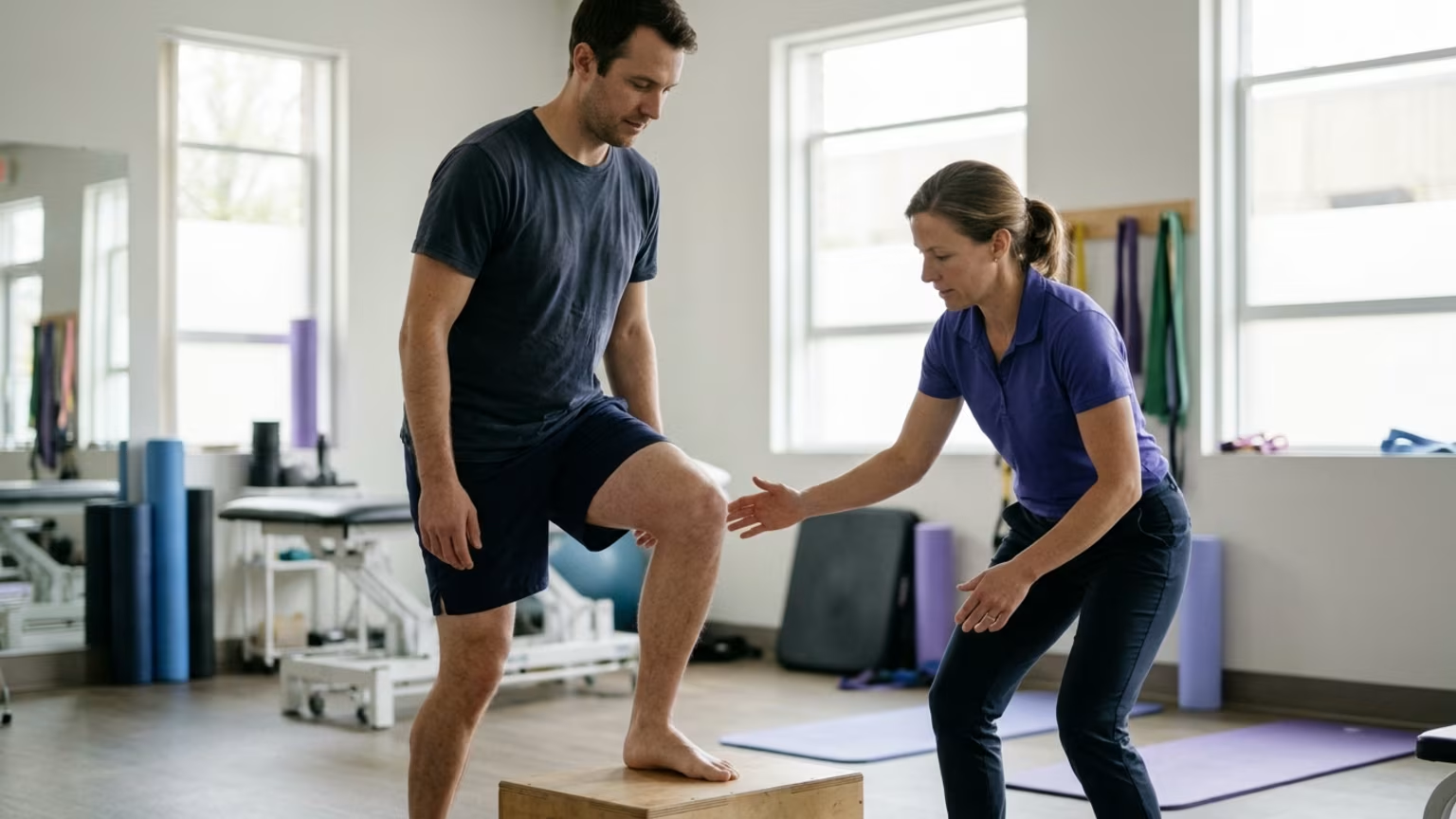

A five-year ACL trial found similar reported outcomes with or without routine bracing. Learn who was studied and why rehabilitation remained central.





On November 15, 2026, a five-year follow-up published in Archives of Orthopaedic and Trauma Surgery reported no significant differences in final outcomes between braced and brace-free rehabilitation after isolated anterior cruciate ligament reconstruction. Both groups received the same supervised rehabilitation. The difference was whether they used a routine postoperative functional knee brace.
The randomized trial follow-up adds longer-term evidence to a question that earlier research had already raised: does routine bracing add a lasting benefit after this type of ACL surgery?
The central distinction is important. This was a comparison of rehabilitation with or without a brace. It was not a comparison of rehabilitation against no rehabilitation.
According to the article, earlier randomized trials and systematic reviews had questioned the clinical benefit of routine postoperative bracing. Most of those studies followed patients for less than two years. That left less evidence about whether differences might become apparent further into recovery.
The five-year follow-up was designed to address that gap. Rather than introducing a different exercise approach, it returned to patients who had originally been assigned to different brace plans within the same rehabilitation program.
That makes this an extension of the evidence rather than a sudden reversal of established knowledge. The earlier question concerned whether routinely adding a brace improved outcomes. The longer follow-up asked whether a meaningful difference was apparent years later.
It was also a research finding rather than a new clinical guideline. Its contribution is a longer view of a defined comparison, not a replacement for the details of an individual surgical and rehabilitation plan.
The researchers originally randomized 139 patients. Of those, 71 were assigned to brace-free rehabilitation and 68 to rehabilitation with a functional knee brace.
In the braced group, patients wore the brace while walking for six weeks. The brace-free group received the same physiotherapy without external knee stabilization. Both groups had supervised physiotherapy and progressive exercises. They also followed the same return-to-sport criteria.
Those shared elements help define the question being tested. The researchers were examining the added role of the brace within that program. They were not testing whether a brace could replace exercise or whether patients could skip supervised rehabilitation.
At the final assessment, the reported five-year comparison found no significant between-group differences in subjective knee function or activity level. Quality of life also did not differ significantly.
The researchers likewise reported no significant differences in graft rerupture or revision surgery. Persistent knee-related complaints did not differ significantly between groups either. The assessments included IKDC and Lysholm scores alongside Tegner, ACL-RSI and SF-36 measures.
There was one additional finding about how knee function scores changed over time. Between the one-year and five-year assessments, IKDC scores stayed stable or improved slightly in the brace-free group. The braced group showed a statistically significant decline.
The authors cautioned that these absolute changes were modest. That finding should not be turned into a claim that avoiding a brace improves long-term knee function.
The broader result also needs precise wording. Finding no statistically significant difference does not prove that the approaches are identical in every respect. It means that this follow-up did not detect significant differences in the final outcomes reported.
The trial involved a selected surgical population. Participants were aged 18 to 55 and had isolated ACL tears. All received a semitendinosus tendon autograft, a type of hamstring tendon graft.
The study excluded certain injuries that would complicate the comparison. These included additional ligament injuries requiring surgery. Meniscal injuries requiring modified rehabilitation were also excluded.
Those details define where the findings fit most directly: isolated primary ACL reconstruction with this graft under the study's rehabilitation approach. The results should not automatically be extended to other graft choices or combined injuries. More complex meniscal procedures may also involve a different rehabilitation situation.
The age range matters as well. Adults older than 55 were outside the population studied. For readers in later life, this is useful background evidence rather than a direct answer about their own postoperative care.
The practical distinction is between a routine brace used within a standard study protocol and a brace prescribed for a particular surgical reason. The trial addressed the former. Understanding why a brace was prescribed is therefore part of understanding whether this evidence is relevant to a personal recovery plan.
For someone recovering from ACL reconstruction, the study supports a more specific conversation about brace use. The useful question is not simply whether braces are good or bad. It is what the brace is intended to do in that person's surgical and rehabilitation plan.
Questions supported by this research include:
These are discussion points for the surgeon and physical therapist. The findings do not establish a reason to change prescribed postoperative care independently.
The distinction between equipment and rehabilitation is especially relevant during the move back toward normal activity. In this trial, going without a brace did not mean going without a structured program. The brace-free group still received supervised therapy and progressive exercises.
Likewise, the study did not test an earlier return to sport for the brace-free group. Both groups had the same return-to-sport criteria. The finding concerns brace use within that shared approach, not permission to shorten the recovery process.
This belongs within the wider path from ACL surgery through rehabilitation. A brace decision is one part of that path rather than a summary of how much rehabilitation remains.
For readers comparing their care with someone else's, the study offers a way to frame the difference. Two people may have different brace plans without having different levels of commitment to rehabilitation. The relevant comparison is the purpose of the brace and the rehabilitation plan around it.
Loss to follow-up is an important limitation. Researchers assessed 97 of the 139 originally randomized patients after a mean of 5.2 years. That included 45 people from the brace-free group and 52 from the braced group. The follow-up rate was 69.8%.
The authors identified this loss as a possible source of attrition bias. In plain language, people who did not return for assessment might have had different outcomes from those who did. The available results cannot establish how their participation would have affected the comparison.
The long-term assessment also relied mainly on patient-reported measures and telephone interviews. Researchers did not perform objective clinical examinations at that time point. They also did not collect instrumented knee laxity measurements or strength testing.
Patient reports describe an important part of recovery: how people experience their knee and their activity. But those reports are not a direct measurement of strength or mechanical knee stability. The study therefore provides a longer view of reported outcomes without providing a complete physical assessment at five years.
The authors called for confirmation in larger multicenter research. Such work could test whether this pattern holds in a broader research setting and add objective measurements to the patient-reported results.
These limits leave a focused conclusion. Within the rehabilitation program studied, the researchers found no significant final outcome advantage from adding a routine functional brace. That is useful evidence for discussing brace plans without treating a single trial as the final answer.
There is also a difference between reaching a research follow-up date and understanding a person's long-term recovery picture. A five-year questionnaire describes part of that picture. It does not reconstruct every stage of the recovery that came before it.
The lasting observation is quieter than a verdict for or against braces. In this study, the brace differed while the rehabilitation remained. The longer recovery story was still built around that shared work.
Deciding how a postoperative brace fits into rehabilitation raises questions that ReboundBody addresses through evidence-aware recovery information. For adults uncertain about moving beyond formal therapy, its independent articles explain recovery milestones and the rebuilding of movement with realistic expectations, without making personal treatment decisions or medical promises.

Follow ReboundBody for practical articles on injury recovery, rehabilitation, mobility and rebuilding strength. New posts turn research into clear ideas for the road back to activity after injury or surgery.






Read practical guidance on injury recovery, rehabilitation, mobility and rebuilding strength as you work your way back to activity.
Explore Resources