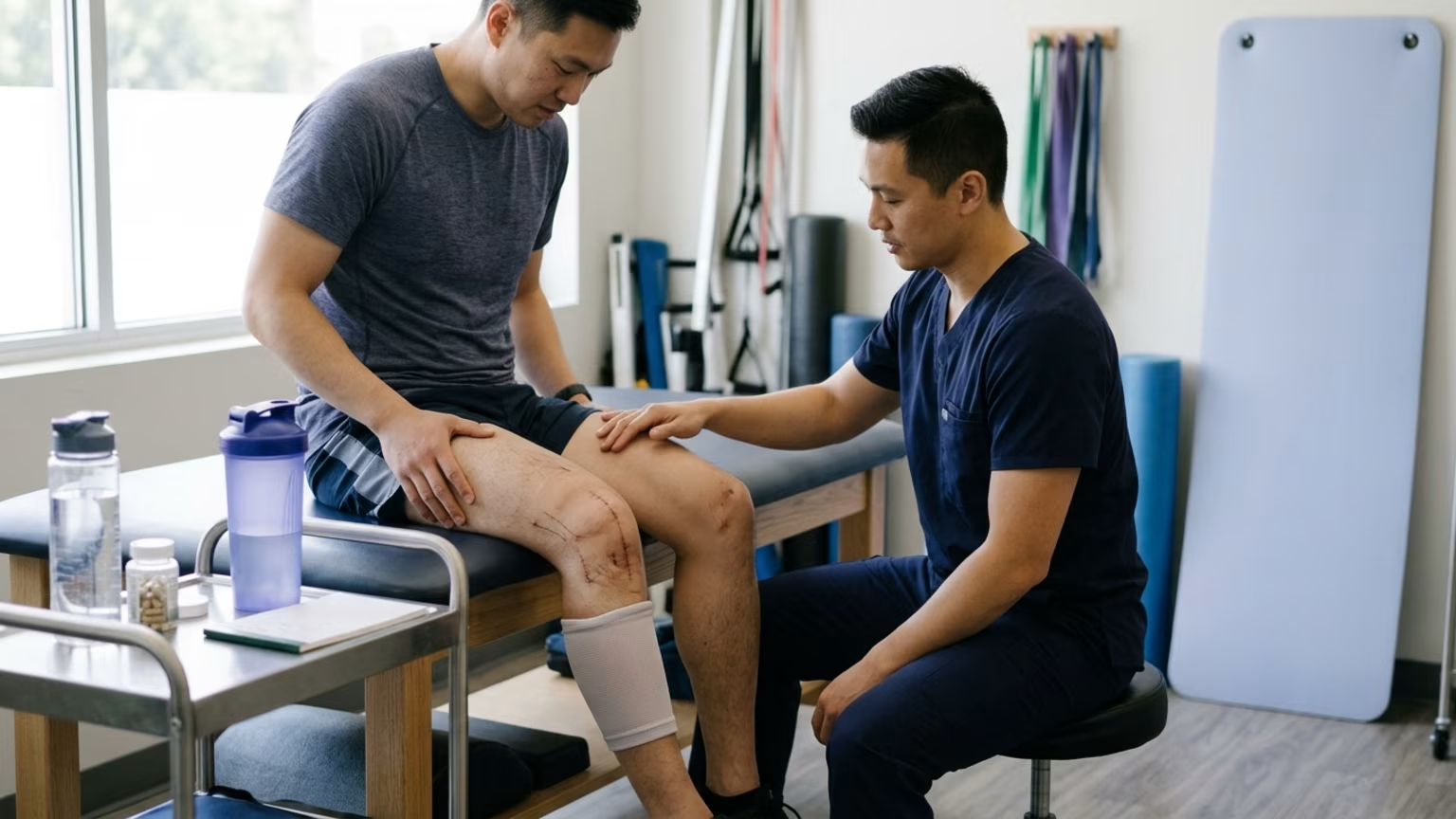

A small ACL reconstruction study linked a nutrition protocol with less measured thigh-muscle loss. Read the findings, practical context and limits.





On November 16, 2026, Orthopedic Reviews published a study linking perioperative nutritional supplementation with less measured thigh-muscle loss after primary anterior cruciate ligament reconstruction (ACLR). The authors reported smaller average declines in rectus femoris cross-sectional area among patients using a nutrition protocol than among those receiving standard care.
The report also described higher quadriceps strength limb-symmetry values in the protocol group at three and six months. Together, these findings bring attention to nutrition used around the time of surgery.
For readers following recovery research, the central issue is how much weight to place on those measurements. Understanding the finding starts with the care the protocol was compared with and the question the researchers examined.
The starting point for this report was standard perioperative care, which served as the comparison. The authors examined an added nutrition protocol around ACL reconstruction. This frames the research as a question about an addition to care.
Before reading the results as a change in advice, it helps to separate a research report from a guideline. This publication presents an observational comparison. It does not establish a standard supplement protocol or announce a change in clinical guidance.
It is also important not to read more into the comparison group's label than the evidence supports. “Standard care” does not mean “poor nutrition.” The reported differences do not establish that the comparison patients were eating inadequately.
The question was about a particular added protocol. It was not a test of whether ordinary food could support recovery or whether everyone undergoing ACL reconstruction needs a nutrition product.
The authors used ultrasound to measure rectus femoris cross-sectional area, or CSA. This was the muscle-size measurement tracked in the report. The results describe average decreases from the starting measurement.
The study reported these changes:
At each follow-up, the protocol group had the smaller average decline. Both groups still had average values below their starting measurements at six months. The finding is therefore best described as less measured loss rather than complete preservation of muscle size.
The strength results pointed in the same direction. Limb symmetry compares strength between the legs. The authors reported the following quadriceps strength limb-symmetry values:
Both strength comparisons were reported as p<0.01. Muscle size and strength were separate outcomes, even though their group differences followed a similar pattern.
These values describe group averages at scheduled follow-ups. They are not an expected timetable for an individual patient. Their value is in showing the pattern the researchers observed rather than setting a personal recovery target.
The full Orthopedic Reviews report included 50 people undergoing primary ACL reconstruction. There were 25 patients in the nutrition-protocol group and 25 receiving standard perioperative care.
That is the population directly represented by these findings. Applying the results to other injuries or operations would go beyond the study. A shared interest in rebuilding muscle does not make every recovery situation equivalent to the one examined here.
The protocol began 14 days before surgery and continued for 28 days afterward. It combined collagen peptides and amino acids with HMB, vitamins and other supplements. The postoperative formulation also included whey protein and creatine.
This was a defined perioperative intervention. It was not a general comparison of all supplement users with all nonusers. The timing and composition belong to the research question being tested.
Those details help identify what the investigators studied. They describe the intervention rather than provide a supplement schedule for readers to copy.
The practical relevance is a reason to discuss nutrition with the treating clinician, not a reason to purchase the studied kit. Decisions about adding supplements remain part of an individual's care. The report provides no basis for replacing prescribed rehabilitation.
A useful discussion can separate the research question from the personal decision. Questions for a qualified healthcare professional might include:
These questions do not assume that supplementation is needed. They keep the study in its proper role: information to consider alongside the rest of care.
It may also help to distinguish between reviewing daily eating and deciding about a specific product. Those are different conversations. A study of a supplement bundle does not, by itself, answer every question about nutrition during a less active period.
For related reading, ReboundBody discusses food intake when activity is reduced. That broader topic gives readers another way to frame nutrition questions without making a research kit the center of the discussion.
Nutrition questions can also sit alongside questions about the activities a person hopes to regain. ReboundBody's article on connecting recovery goals with real-life tasks offers context for that conversation. These are topics to discuss with qualified care rather than separate routes to changing a treatment plan.
Several features of the report determine how confidently the findings can be interpreted.
Patients in the protocol group chose to purchase the supplement kit. Assignment was not randomized. That choice may have been linked with other differences between the groups that affected their outcomes, so the comparison cannot establish that supplementation caused the measured differences.
Both the journal report and its PubMed record note that baseline comparability remains unverified. In other words, it has not been established that the groups were sufficiently comparable at the start. The report also lacks dispersion estimates and adjusted confidence intervals, leaving less information about variation around the reported averages and the uncertainty of the comparisons.
The authors caution that ultrasound measurement of rectus femoris CSA is not equivalent to whole-quadriceps muscle volume. A finding in this measured region should not be presented as a complete account of the entire quadriceps.
The small cohort also matters when judging how broadly to apply the results. The findings are a research signal that needs testing in larger and more rigorous comparisons.
Because the intervention bundled multiple ingredients, the report cannot identify which ingredient contributed to the differences. It also cannot establish that any single component would produce the same result on its own.
That distinction matters when interpreting claims about collagen or creatine. Their presence in the protocol is not evidence that either one was responsible for the observed pattern.
The report did not include patient-reported outcomes or evaluate return to sport. It also did not assess return to work or duty, or reinjury. The measured differences therefore leave important questions about everyday recovery unanswered.
The authors reported no supplement-related adverse events. That observation in a small study does not establish safety for every patient or clinical situation.
Future research could make the findings more useful by addressing these design and measurement gaps. It would also need to connect the measured changes with outcomes that matter to patients. That is the step between an interesting comparison and evidence strong enough to shape routine care.
Stay thoughtful about the evidence, and grounded in qualified care.
The gap between a smaller muscle-size decline and a personal supplement decision calls for careful interpretation. ReboundBody explains rehabilitation and recovery habits through independent, evidence-aware articles. Its focus is helping adults understand the path back to activity with realistic limits rather than turning a research result into a medical promise.

Follow ReboundBody for practical articles on injury recovery, rehabilitation, mobility and rebuilding strength. New posts turn research into clear ideas for the road back to activity after injury or surgery.






Read practical guidance on injury recovery, rehabilitation, mobility and rebuilding strength as you work your way back to activity.
Explore Resources