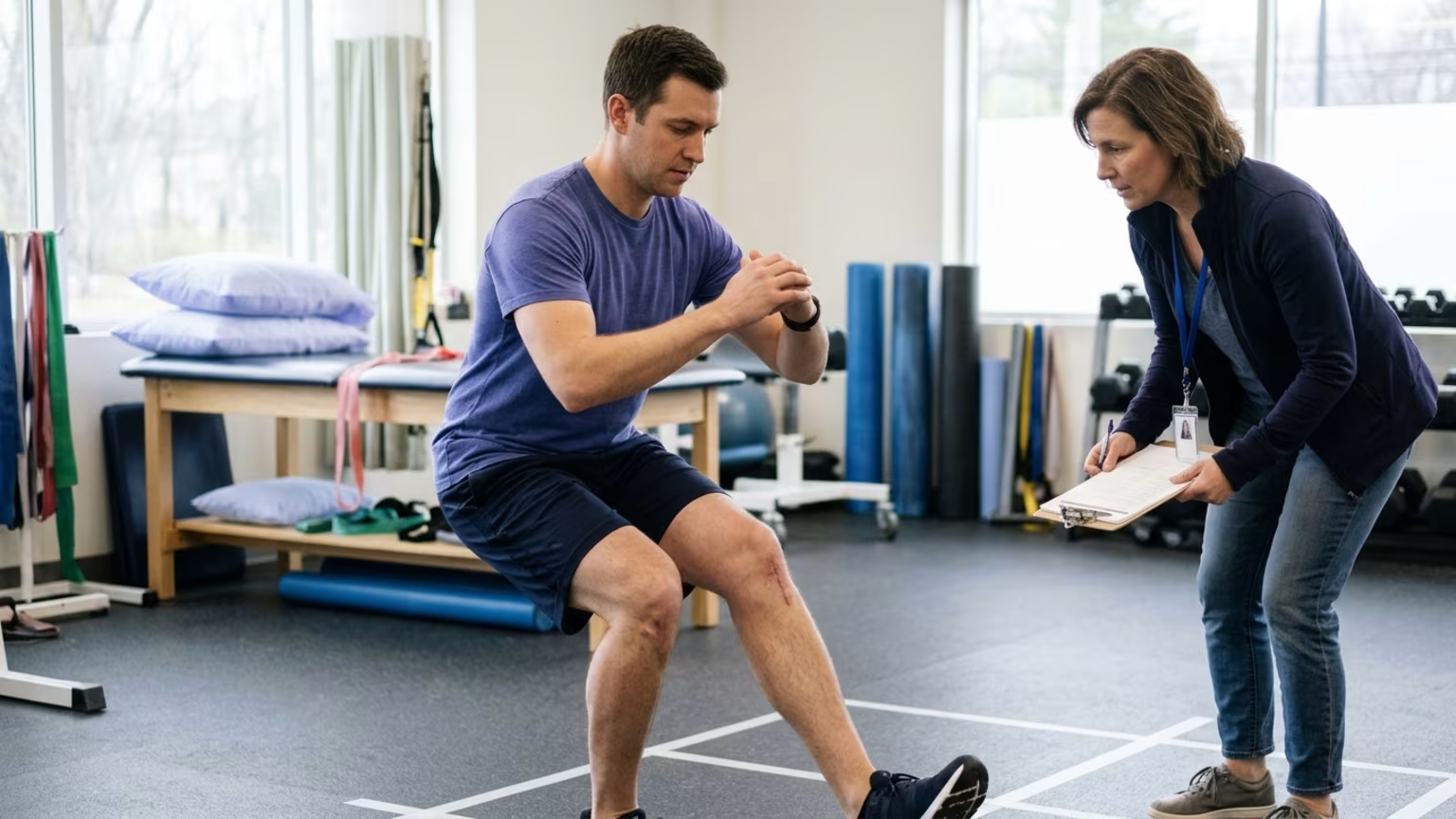

Readiness after injury or surgery involves more than confidence. Learn how task demands, physical function and clinical assessment fit together.





Feeling ready is not a clearance test.
Being ready to return means discussing with a qualified clinician whether current physical capacity and confidence match the activity someone wants to resume. Feeling better is part of that picture, not the whole answer.
What counts as enough depends on the injury and the intended activity. A return decision brings together symptoms, physical function, timing and psychological readiness rather than relying on a single feeling or result.
The first useful question is not simply whether someone is ready. It is what they are ready to do.
Walking farther, lifting and running are different goals. Changing direction adds another kind of demand. The research supports considering the specific activity rather than assuming that performance on one task establishes capacity for everything else.
A 2026 review in Current Reviews in Musculoskeletal Medicine describes return-to-play decisions after ACL reconstruction as combining time after surgery, functional criteria and psychological readiness. Its assessment examples include strength testing, hop tests and movement-quality assessment. Patient-reported psychological readiness is another component.
The evidence discussed here comes mainly from return-to-sport research after ACL reconstruction. One supporting review focuses specifically on youth athletes. These sources do not establish a universal clearance formula for every operation, age or everyday activity.
For an adult returning to ordinary movement, the useful lesson is the structure of the discussion. The goal gives the assessment a purpose. A clinician can consider which findings matter for that person and that activity.
Any existing limits also belong in that conversation. Understanding what activity restrictions mean is a separate issue from judging how confident someone feels about doing more.
Because confidence and demonstrated physical capacity answer different questions. The ACL review treats psychological readiness and physical testing as separate parts of the return decision.
Confidence describes how someone feels about performing an activity. Physical assessment examines selected abilities involved in performing it. Neither should be used as a substitute for the other.
The review describes the ACL-RSI as one measure used after ACL injury to assess emotion, confidence in performance and risk appraisal. It is a psychological-readiness measure. It is not a strength test or a direct test of physical capacity.
That distinction also changes how a result should be discussed. A confidence score is information about one part of readiness, not a summary of the whole recovery. Likewise, a physical test does not describe every concern someone has about returning.
A 2026 scoping review in the International Journal of Sports Physical Therapy identifies limitations in available psychological assessment tools. No single instrument captures the full psychological complexity of return-to-sport readiness.
The practical implication is to discuss confidence alongside physical findings. Questions about worry or trust in movement belong in the assessment rather than outside it. Our explanation of how clinicians assess activity readiness provides more context for that broader conversation.
The research supports looking at several areas rather than searching for one decisive result. Symptoms, mobility and strength help organize the discussion. Endurance or task tolerance and movement quality add context, while confidence remains a separate part of the overall picture.
These are areas for clinical discussion, not boxes a person can mark to clear themselves.
In this framework, symptom information includes what happens during an activity and afterward. How someone feels at rest is only part of the account.
A useful description connects symptoms to the activity being considered. The question is not just whether symptoms exist. It is how they relate to the task and how the treating professional interprets that response.
Mobility includes range of motion, meaning how far a joint moves. The youth ACL review identifies range of motion among the quantitative measures discussed in return-to-sport assessment.
Its relevance belongs in the context of the intended activity. A measurement provides information for the clinician to interpret. It does not answer the entire return question on its own.
Strength testing appears in the assessment batteries described by the ACL reconstruction review. The review discusses quadriceps and hamstring strength testing alongside other measures.
For readers, the important distinction is between a general impression of strength and an assessment of strength. Feeling stronger is meaningful personal information. The return discussion also asks what has been measured and how that finding relates to the planned activity.
Endurance adds a practical question: does the intended goal involve sustaining movement or repeating an effort? Walking farther and lifting repeatedly make that question more specific than simply wanting to return to normal.
These examples help describe the goal rather than prescribe a test. The treating professional can decide what assessment is relevant to the task. Being able to perform an action once and discussing tolerance for the intended activity are different questions.
This also gives context to why activity is often reintroduced gradually. The focus is the demand being resumed, not simply the name of the exercise or activity.
Movement quality concerns how a task is performed, not only whether it is completed. The youth ACL review discusses qualitative movement assessment alongside strength, hopping and range-of-motion measures.
That review also reports insufficient evidence to define specific movement-quality assessments or reference values based on age or maturation. A visual impression should therefore not be presented as a definitive readiness test.
The useful distinction is between observing movement and claiming that one observation settles the decision. Movement quality contributes information within an assessment. It is not a stand-alone verdict.
No. Passing a test battery is not a promise that another injury will not occur.
The 2026 review in Current Reviews in Musculoskeletal Medicine reports findings from a cited systematic review and meta-analysis. In that ACL evidence base, 42.7% of patients passed return-to-sport criteria. Of those who passed, 14.4% sustained a second ACL injury.
The review reports no statistically significant association between passing the criteria and reduced second-injury risk. It also notes that some people sustain another injury despite passing criteria and observing recommended timeframes.
This finding requires a distinction between two questions. One asks whether someone meets the criteria being assessed. The other asks whether those criteria reliably predict a future injury. A passing result answers the first question more directly than the second.
The practical interpretation is not that assessment is pointless. It is that a test result should be discussed for what it measures rather than treated as certainty about the future.
A more informative conversation asks what the results show about current function and what remains unresolved. Timing, task demands and psychological readiness still belong in that discussion. A single pass or fail label leaves much of that context out.
The research supports discussing the next activity with the clinician or rehabilitation professional. A concrete goal gives both physical findings and confidence a clearer context. Longer walks or returning to lifting describe different questions from returning to running or direction changes.
Useful questions include:
These questions seek an explanation rather than a score to earn. They can help clarify the role of postoperative rehabilitation appointments when the next stage of activity is being discussed.
The decision itself remains personal to the injury, procedure and goal. The framework helps organize that conversation without taking the place of it.
Ready to return is best understood as a discussion about the match between current capacity and the next activity. Symptoms and physical findings contribute to that discussion. Confidence matters too, but it does not replace demonstrated function.
The ACL research favors considering timing, functional criteria and psychological readiness together. Its findings support a broader view of assessment rather than a universal test or calendar date.
Sometimes progress is not a return to everything. It is a clearer understanding of the next thing.
Returning to activity involves personal decisions that a general research framework cannot settle on its own. ReboundBody explains rehabilitation and return to activity for adults after orthopedic setbacks through independent, evidence-aware writing with realistic limits and no medical promises, helping readers understand recovery discussions with qualified healthcare professionals.

Follow ReboundBody for practical articles on injury recovery, rehabilitation, mobility and rebuilding strength. New posts turn research into clear ideas for the road back to activity after injury or surgery.




Read practical guidance on injury recovery, rehabilitation, mobility and rebuilding strength as you work your way back to activity.
Explore Resources