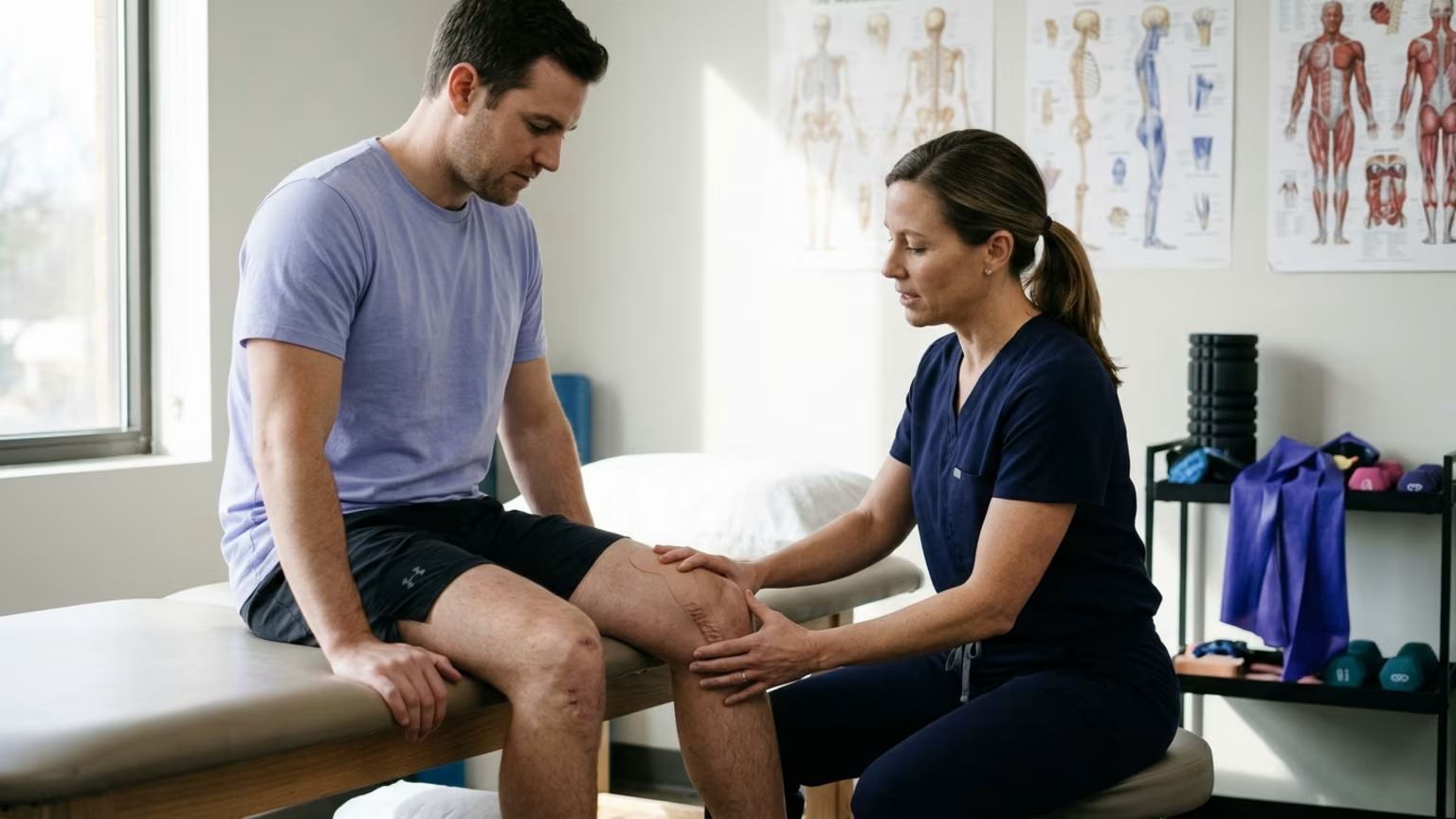

Learn why symptoms, strength and imaging can change at different rates, and why tissue-specific recovery needs more than a single countdown.





A participant in a 2026 hamstring-strain study could meet return-to-sport criteria while injury-related MRI changes remained. Published in Scientific Reports, the study captures a familiar recovery tension: reaching one milestone does not mean every measure has caught up.
Recovery is the process of regaining health and useful function after an injury or surgery. It includes symptoms, movement, strength and the ability to handle particular activities. Tissue repair is part of that process, but it is not another name for every outcome that matters.
This article explains why recovery measures can differ and how findings about particular tissues help put progress in context. It does not diagnose an injury, recommend treatment or establish a personal return date. The useful question is not simply which tissue heals fastest, but which part of recovery is being measured.
When movement is working as intended, comfort is only part of the picture. Strength and movement control also matter, along with the ability to perform the intended task. These are related questions rather than interchangeable measurements.
The hamstring study's authors emphasized strength, neuromuscular control and activity-specific function when discussing recovery. Neuromuscular control means how the nervous system and muscles coordinate movement. A return date alone does not describe all those abilities.
It helps to separate several questions:
A result in one category does not automatically answer the others. For example, the absence of pain is not the same measurement as strength. A scan is also not a direct test of every task someone wants to resume.
ReboundBody's explanation of why symptom relief is only one measure of progress provides additional context for this distinction. The point is not to discount feeling better. It is to understand which question that improvement answers.
The tissue involved matters, but its name does not describe the entire injury. Severity and location are relevant context. Treatment and the demands of the intended activity also belong in the discussion.
The available findings are most useful when kept attached to the condition studied, rather than turned into a ranking of tissue healing speeds.
The 2026 hamstring-strain study reported that some participants met clinical return criteria even though MRI findings had not fully resolved. Clinical criteria could include no pain and full strength.
This finding separates two outcomes that can sound identical in everyday conversation: meeting return criteria and having no remaining injury-related changes on a scan. The authors cautioned against treating return-to-sport timing as a measure of complete recovery.
That does not make the remaining MRI findings proof of treatment failure. It means the clinical assessment and the scan describe different aspects of the injury.
A 2026 review of blood-flow-restriction training for tendinopathy reported improvements in some pain, strength and functional outcomes. Changes in tendon structure were inconsistent.
This is relevant to interpreting recovery claims. A statement that people felt or functioned better is not automatically evidence that tendon structure changed in the same way. Likewise, an imaging result should not replace the assessment of symptoms and function.
A summary of Einhorn and Gerstenfeld's 2015 narrative review describes fracture repair through callus formation followed by prolonged remodeling. It also identifies injury extent, stability and blood supply as factors affecting healing.
Those contributing factors help explain why the word “fracture” is not a complete recovery forecast. The condition of the injury matters as well as the tissue category.
A hamstring return date should not become a forecast for a ligament injury. Findings from a tendon-rehabilitation review should not become a cartilage recovery schedule either.
The same principle applies within a tissue category. A diagnosis-specific discussion is more useful than assuming that every injury involving the same tissue follows the same course.
Broad phases describe a biological process. They are not dates by which every person should reach the same result.
The clearest physiological sequence in this research comes from the fracture review: callus formation followed by a prolonged remodeling phase. The soft-tissue studies add a different perspective by showing how clinical outcomes and imaging findings can diverge.
In the fracture review's account, callus formation is part of the repair process before prolonged remodeling. This gives recovery a sequence rather than a single finishing point.
The review also places repair in the context of injury extent and the conditions affecting healing. A calendar alone does not contain that information.
Remodeling names the later phase described in the fracture review. Its prolonged nature matters because a recovery process can continue beyond an earlier milestone.
This does not mean that a person must wait for every biological change to end before any activity is possible. Activity decisions require the clinical team's interpretation of the particular injury and its restrictions.
The hamstring study adds an important distinction: a return-to-sport milestone is a clinical decision point, not a declaration that every recovery measure is identical. The authors noted that strength and movement control may need continued attention, along with activity-specific function.
Functional recovery therefore belongs alongside tissue repair in the discussion. It should not be treated as a separate countdown that always starts or ends on a fixed date.
The evidence has clear boundaries. The muscle findings concern hamstring strains rather than every muscle injury. The tendon review's small and varied evidence base did not establish treatment effectiveness. These sources do not provide reliable week-by-week ranges across all five tissue categories.
Individual timelines vary. A meaningful range needs to be tied to the diagnosis and the clinical plan rather than supplied as a universal tissue deadline. For postoperative recovery, understanding how biological healing relates to rehabilitation milestones helps keep that distinction clear.
Research often uses words that sound more conclusive than they are. Knowing what each term describes makes a result easier to interpret.
The key distinction is between what was measured and what a reader might assume it means. “Improved function” and “changed tissue appearance” are different findings. Neither phrase should silently substitute for the other.
The core takeaway is that recovery has several related checkpoints. Symptoms, movement, strength and tissue findings do not have to change together for progress to be meaningful. At the same time, improvement in one measure does not establish readiness for every previous activity.
Useful questions for a clinical conversation include:
These questions keep the discussion tied to a diagnosis rather than an online countdown. They also help distinguish a research finding from a personal clearance rule.
For someone following restrictions after surgery or a substantial injury, the treating team's progression remains the relevant plan. Persistent symptoms or uncertainty about increasing activity call for individualized guidance, not a conclusion drawn from another tissue's timetable.
ReboundBody's broader injury recovery reading offers further context. Diagnosis and activity clearance still require a qualified clinician who can assess the individual situation.
Tissue-specific recovery decisions are the treating clinician's responsibility; ReboundBody supplies clear editorial context for understanding them. For active adults facing competing claims about exercises and recovery treatments, its evidence-aware explanations help separate symptom improvement from broader recovery questions and support more informed conversations about progress with qualified healthcare professionals.

Follow ReboundBody for practical articles on injury recovery, rehabilitation, mobility and rebuilding strength. New posts turn research into clear ideas for the road back to activity after injury or surgery.




Read practical guidance on injury recovery, rehabilitation, mobility and rebuilding strength as you work your way back to activity.
Explore Resources