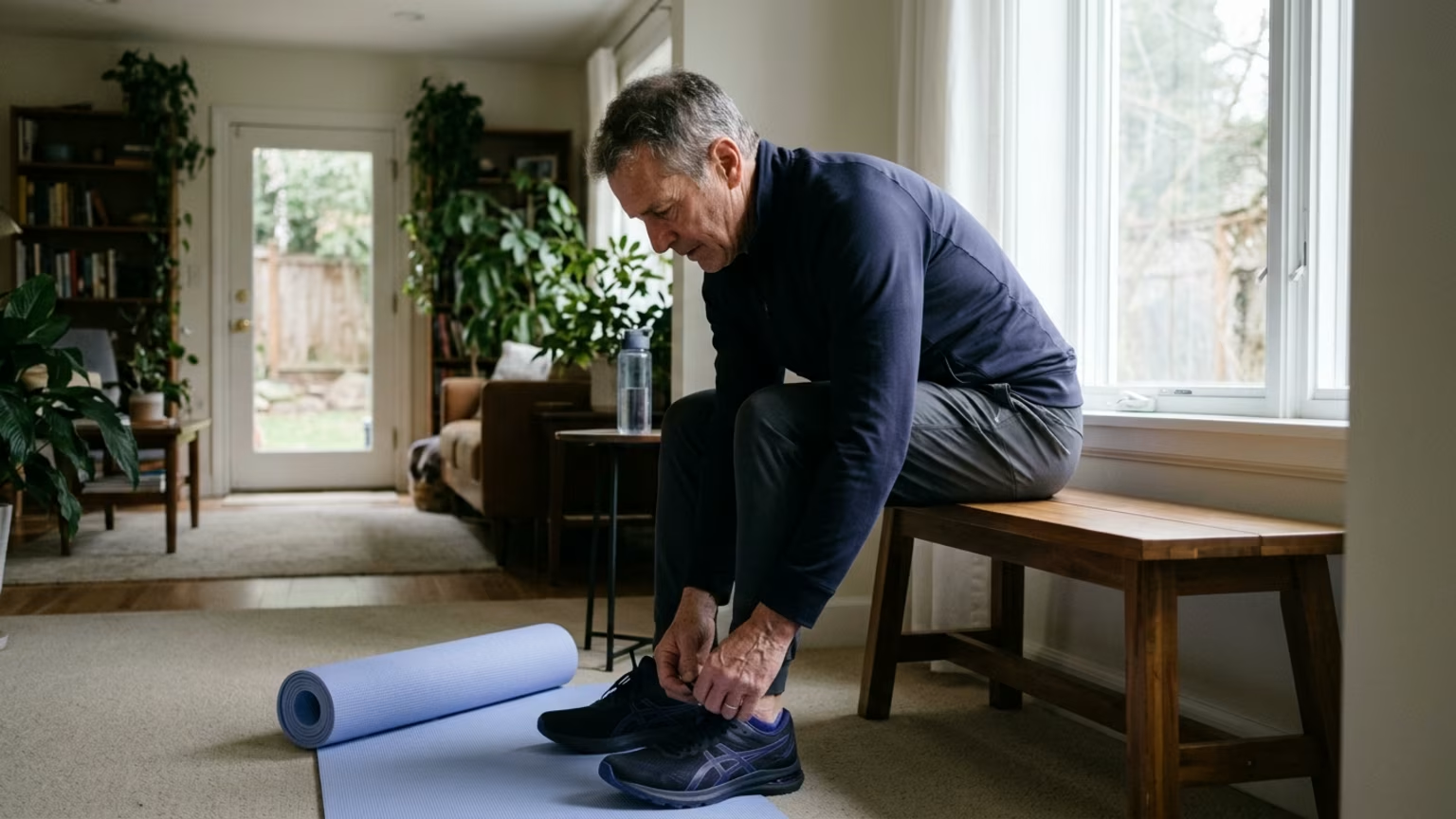

A five-cohort study linked becoming active after 50 with better daily function. Learn what recovery meant and why the findings need careful interpretation.





On October 22, 2026, BMC Public Health published a study linking changes in physical activity with later changes in everyday independence among adults aged 50 or older. Across five aging cohorts, people who became active after inactivity generally had less functional deterioration and greater recovery than those who remained inactive.
The peer-reviewed study followed changes between levels of daily function. Its primary analysis included 112,855 adults. Remaining active had the most favorable overall pattern of transitions.
Coverage described the finding as less disability and greater recovery after becoming active. Understanding what “recovery” means in this paper is important: the researchers measured changes in everyday functional ability. That gives the findings a specific meaning for readers thinking about movement after a setback.
The study adds a change-over-time perspective to research on activity and aging. Rather than considering activity at only one assessment, the researchers examined whether people changed their activity status. They then studied how those changes related to later movement between levels of functional ability.
That distinction puts a different question at the center of the research. It asks not only how active someone was at a particular point, but whether becoming active after inactivity was associated with a different course afterward.
Participants were placed into four groups based on two activity assessments:
The median time between these assessments was two years in four cohorts. It was three years in the Mexican cohort.
These comparisons allowed the researchers to examine changes in both directions. Becoming active was compared with remaining inactive. Becoming inactive was compared with remaining active.
This is the evidence context behind the update. The study’s contribution is a comparison of changing and stable activity patterns across several populations. It focuses attention on what followed a change in activity status, rather than treating activity as a fixed description of a person.
The researchers grouped functional ability into three states:
These categories describe levels of everyday function. The analysis examined transitions between them, including deterioration and recovery toward independence. Researchers used statistical models within each cohort and then combined the estimates.
Among participants who were initially inactive, becoming active was associated with more favorable transitions than remaining inactive. Two reported estimates help show the pattern:
The first estimate points toward less deterioration. The second points toward greater recovery to independence. Together, they show why the authors considered both directions of change rather than focusing only on the development of disability.
The reverse pattern appeared when participants became inactive. Compared with people who remained active, they had a higher transition intensity from independence to IADL disability. The hazard ratio was 1.28.
They also had a lower recovery intensity from BADL disability to independence. That hazard ratio was 0.66.
These are hazard ratios for transitions between functional states. They are not the percentage of participants who recovered or avoided disability. A hazard ratio of 1.73 does not mean that 1.73 times as many people recovered.
The overall finding was consistent in direction: becoming active and remaining active were generally associated with more favorable functional transitions than remaining inactive. Continued activity had the most favorable overall pattern.
The study drew on five population-based aging cohorts:
All participants met the age criterion of 50 or older. Of 266,204 people who met that criterion, 115,140 contributed eligible paired activity and functional-status data. The primary analysis included 112,855 participants.
The outcomes concerned everyday independence. In this study, recovery meant moving from a disability state toward a more independent functional state. It was a measured change in daily function rather than a general description of feeling better.
That definition matters when reading a headline about recovery. The central outcome was the ability to function independently in daily life. The paper tracked movement between functional categories over time.
For readers considering how age fits into orthopedic recovery, this provides background about aging and daily function. It also gives a useful distinction to bring into discussions about progress: recovery needs an outcome attached to it. In this paper, that outcome was greater everyday independence.
The encouraging point is that the study did not place everyone with a history of inactivity in the same group. It distinguished people who remained inactive from those who became active. Those groups had different subsequent patterns of daily function.
For someone sidelined by a physical setback, that finding can offer a more hopeful way to frame a conversation about movement. A period of inactivity is a past state. The study examined what happened when that state changed.
The practical relevance is clearest when attention stays on meaningful function. Instead of treating “recovery” as a single finish line, a discussion with a qualified healthcare professional can focus on the abilities that matter in that person’s situation.
Useful questions include:
These questions connect a population-level finding with a personal discussion without turning the study into a treatment plan. They also keep the outcome clear. Improving daily independence and returning to a particular activity are different questions to discuss.
Readers thinking about returning to activity after a setback can use the finding as background for that conversation. For questions that extend beyond the early stages, understanding longer-term recovery offers a related editorial perspective.
Several limits determine how much weight to give the results. The authors specifically urged caution because the study was observational and the findings varied substantially between cohorts.
The study establishes an association, not cause and effect. Researchers observed activity changes rather than assigning participants to an activity program. The results therefore do not prove that becoming active caused less disability or greater recovery.
The strength of the associations varied across cohorts. The authors reported that 12 of 18 prediction intervals included 1. Their caution is important: a combined estimate does not mean that every cohort showed the same strength of association.
The primary analysis used complete cases. A sensitivity analysis using multiple imputation produced results that pointed in the same direction. This additional analysis supported the direction of the findings while leaving the study’s other limits in place.
Death was not included as an outcome state. Observation ended at the last valid functional-status assessment. The analysis therefore did not describe every possible later outcome.
The population was not defined by orthopedic injury or surgery. The study did not test return to sport or recovery from a particular musculoskeletal condition. It also did not specify an exercise dose, intensity or rehabilitation protocol.
Questions remain about how the observed associations relate to those settings. The paper also does not establish how quickly an individual might regain function after becoming active.
Personal decisions about resuming exercise belong with qualified healthcare professionals who know the recovery situation. The appropriate use of this study is to inform expectations and questions, not to set a schedule or change an existing treatment plan.
Keep the encouragement. Leave room for your own recovery.
Deciding whether a study about daily independence changes expectations after a setback calls for context, which ReboundBody supplies through recovery-focused writing. Its explanations help adults in midlife and later life make sense of uncertain timelines and normal variation while keeping personal recovery decisions with their treating professionals.

Follow ReboundBody for practical articles on injury recovery, rehabilitation, mobility and rebuilding strength. New posts turn research into clear ideas for the road back to activity after injury or surgery.



Read practical guidance on injury recovery, rehabilitation, mobility and rebuilding strength as you work your way back to activity.
Explore Resources