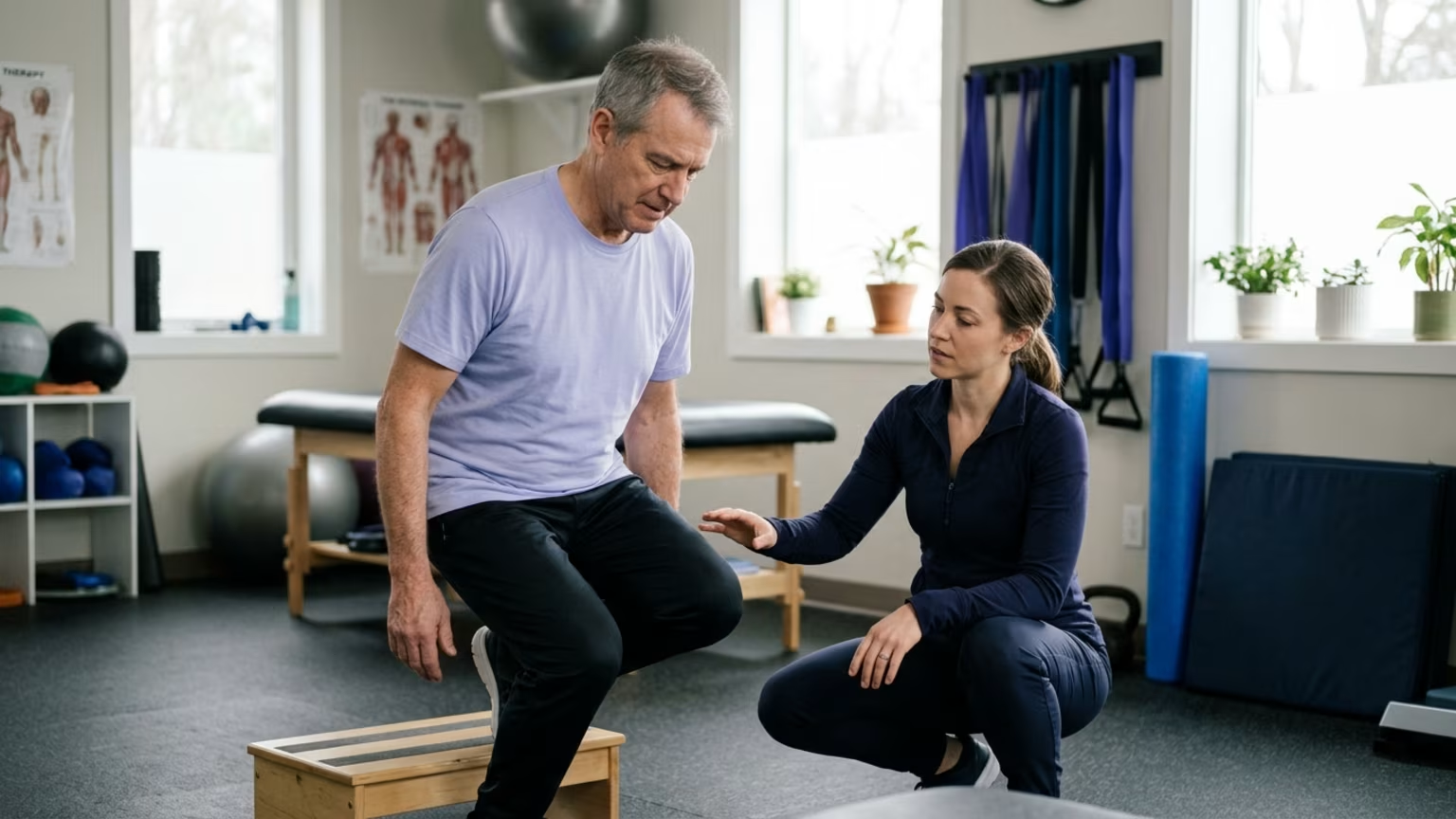

Learn how to describe restricted reach, extra effort, unsteadiness and hesitation without mistaking everyday observations for a diagnosis.





Standing up from a chair is not just a strength task.
Strength and conditioning specialist Dana Santas told CNN that it draws on ankle and hip mobility, lower-body and core strength, and balance.
If that movement feels difficult, the answer may involve several abilities rather than one.
Self-observation can help describe a movement problem, but it cannot identify its medical cause or replace an individualized evaluation. The useful goal is to explain the task and your experience clearly. That gives a doctor or physical therapist a specific concern to discuss.
Everyday tasks can combine several movement demands. Santas told CNN that standing up and lowering down with control challenge strength, mobility and coordination. Calling the whole task a “strength problem” leaves out some of those demands.
The answer also varies with what a person means by “difficult.” A movement that feels restricted is a different experience from one that feels effortful. Feeling unsteady is different from being unsure how to coordinate a turn.
For a conversation about movement, it helps to separate these descriptions:
These are ways to organize observations rather than assign a diagnosis. More than one description may fit the same experience. There is no need to choose a single category before discussing a concern.
The practical distinction is between reporting an experience and explaining it. “Standing takes more effort” reports an experience. “My legs are weak” proposes an explanation that needs interpretation.
Start with the specific task, then describe what happens during it. “Reaching overhead feels restricted” gives a clearer starting point than “my mobility is bad.” It names both the activity and the concern.
A simple description can follow this order:
Use what you have already noticed during ordinary activity. This communication approach does not require setting up a demanding movement challenge or forcing a restricted movement.
For reaching, possible wording includes “I cannot reach as far as I expect” or “reaching overhead feels effortful.” Those statements communicate different concerns without requiring medical terminology. If both fit, both belong in the description.
It is also reasonable to say that the experience is hard to describe. For example: “Reaching feels different, but I am not sure whether it is restricted or just difficult to control.” That uncertainty is useful information for the conversation.
For background on the terms, our guide to how movement capacities differ explains mobility alongside strength and stability. The purpose is to make the language more familiar before discussing your own situation.
Not necessarily. The chair-rise example in CNN’s report shows why one familiar task should not be reduced to a single ability. It brings together movement at the ankle and hip with strength and balance.
It can be useful to describe standing up separately from lowering down. Santas’s comments about controlled movement include both directions. Possible wording might be “standing takes extra effort” or “lowering into the chair feels difficult to coordinate.”
Notice that these descriptions stay close to the task. They do not jump from a difficult chair rise to a claim about a particular muscle or joint. That keeps the discussion focused on what actually needs explaining.
CNN reports that clinicians use chair rises when assessing functional limitations. It also identifies the CDC’s 30-second chair stand as part of its fall-risk assessment.
The word “assessment” matters. That chair stand is a defined procedure, not simply an ordinary chair rise turned into a score. The communication framework here does not require timing yourself or comparing your performance with an online target.
For an appointment, a plain account of the difficulty remains useful: which part feels challenging and what you notice during it. The clinician can then discuss whether a formal assessment is relevant to the question you are asking.
Describe both the movement and the hesitation. “I feel unsteady when I turn” and “I hesitate because I do not feel secure” communicate different parts of an experience. If both are present, there is no need to leave one out.
The same applies to coordination. “The turn feels awkward to organize” is different wording from “I am worried about turning.” Keeping those descriptions separate makes the concern easier to discuss without deciding in advance what explains it.
Confidence belongs in the conversation. It should not be dismissed simply because it is harder to describe than how far an arm reaches. At the same time, hesitation should not be treated as proof of a balance problem.
A useful account might connect the task and the uncertainty: “When I turn, I feel unsure whether I am steady, so I hesitate.” This is an example of wording, not a report about a particular patient.
The goal is not to prove that a movement is safe by attempting a harder version. It is to bring an honest description of the familiar task to someone qualified to interpret it. Ordinary language is enough to begin that discussion.
Ask how the difficulty will be evaluated and what it means for your recovery decisions. CNN recommends consulting a doctor or physical therapist before starting an exercise program. A clear task description can give that conversation a specific focus.
Useful questions include:
These questions keep observation and decision-making connected without treating them as the same thing. The description is what you bring to the appointment. Evaluation and recovery planning are what you ask the healthcare professional to help interpret.
If the concern arose after formal rehabilitation ended, say that too. It makes the question about the next stage of activity explicit. Our resource on planning beyond the end of physical therapy provides broader editorial context for that transition.
You do not need to arrive with the correct label. A specific account of reaching, turning or standing is a reasonable starting point for asking what comes next.
Bring a clear account of the task and your experience to a qualified clinician. Everyday movements can draw on several abilities at once, so reduced reach, extra effort and unsteadiness deserve their own descriptions rather than one assumed explanation.
Clear observations first. Personal recovery decisions with qualified care.
How far someone reaches and how much effort standing takes are concrete aspects of movement to discuss during recovery. ReboundBody publishes independent explanations of mobility and strength rebuilding for active adults navigating orthopedic setbacks, using evidence-aware language with realistic limits rather than presenting general information as an individual treatment plan.

Follow ReboundBody for practical articles on injury recovery, rehabilitation, mobility and rebuilding strength. New posts turn research into clear ideas for the road back to activity after injury or surgery.





Read practical guidance on injury recovery, rehabilitation, mobility and rebuilding strength as you work your way back to activity.
Explore Resources