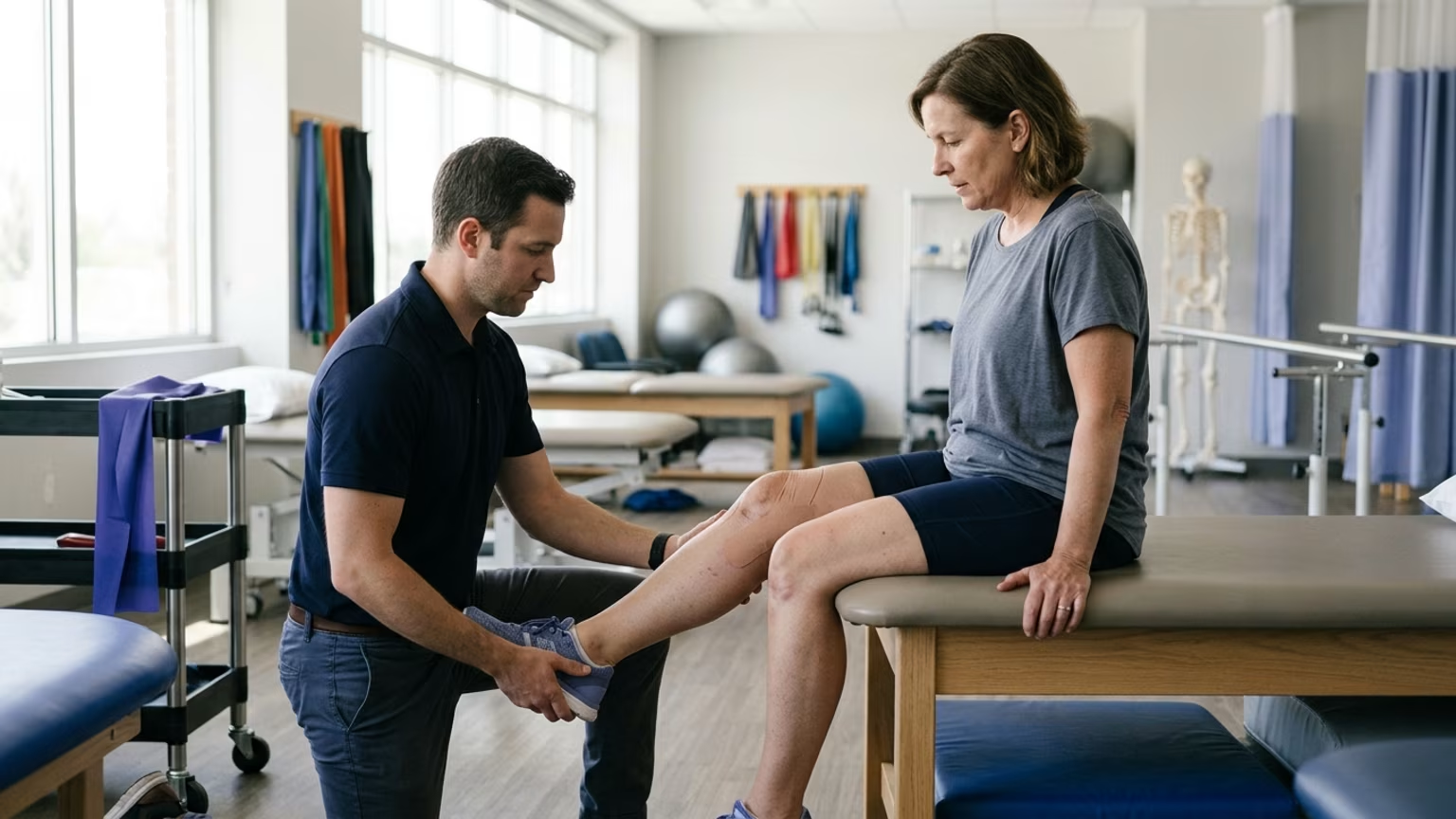

Learn what mobility, strengthening, balance and walking practice mean after orthopedic surgery, and why therapy varies with restrictions and goals.





Physical therapy after orthopedic surgery may involve practicing a permitted movement, working on walking or rebuilding muscle strength.
An everyday task, such as a transfer, may also become part of a session.
The mix and timing depend on the operation, healing restrictions and the person's goals.
A clinic's overview of postoperative rehabilitation lists mobility, strengthening and balance among possible components. It also includes walking practice, functional tasks and gradual return to more demanding activity. These are categories that help explain a plan rather than a universal checklist.
The most useful way to understand therapy is to connect each activity with its purpose. Some work may focus on permitted movement and managing daily tasks. Other work may focus on rebuilding physical capacity as healing progresses.
The procedure and its restrictions shape what therapy can include at a given point. A person's everyday goals help explain what the work is intended to support.
The clinic overview notes that some procedures allow simple movement, walking or muscle-activation exercises soon after surgery. Others require protection or restrictions before certain activities begin.
This distinction matters when comparing experiences. Someone else's early walking practice does not establish when another person should begin the same activity. The relevant question is how the treating team has connected the plan to the specific operation.
A restriction sets a boundary around what is permitted. Therapy needs to be understood within those boundaries rather than as a separate route around them.
For example, a discussion about mobility should include which movements are currently allowed. A discussion about strengthening should include whether any loads remain restricted. Those details belong with the treating team.
This is also useful context when planning for the early recovery period.
Walking more comfortably and returning to a chosen activity are examples of functional aims described in the research. They help explain why a particular therapy task matters.
A useful plan discussion connects the current work with a goal rather than treating the exercise list as the goal itself.
Mobility work concerns movement. Strengthening concerns muscle capacity. Both may appear in rehabilitation, but the words describe different purposes.
In plain language, mobility work means practicing comfortable movement within the limits set for that stage of recovery. The clinic overview calls this movement restoration.
The practical question is what movement the activity is intended to address. Knowing that purpose gives more meaning to the task than simply knowing its name.
Mobility should not be read as permission to seek the largest possible movement. The relevant boundary is the movement allowed under the care team's current restrictions.
Strengthening focuses on rebuilding the muscles' capacity to do work. Progressive strengthening means that the work can become more demanding as appropriate rather than remaining at the same level throughout rehabilitation.
The clinic overview describes a possible shift from protecting the surgical area toward rebuilding strength, mobility and activity tolerance. Here, activity tolerance means the capacity to manage activity.
The word “progressive” does not supply a personal schedule. A useful question for the therapist is what a proposed change is intended to achieve and how it fits the current restrictions.
APTA's public summary of its October 2026 feature says updated total-knee-replacement guidance places greater emphasis on progressive exercise and digital care. It also frames questions about which interventions improve function and whether commonly used treatments are worthwhile.
The evidence has a defined scope. The clinic overview is practitioner guidance rather than comparative outcome research. APTA's public page concerns knee replacement and does not provide the detailed recommendations or outcome data. Neither source supplies a dependable recovery timetable across orthopedic operations.
The practical takeaway is to ask how a strengthening activity serves the current goal. A broad emphasis on exercise or digital care does not select a particular approach for an individual reader.
Balance work focuses on steadiness. Gait training means working on walking. The clinic overview lists both among the possible elements of orthopedic rehabilitation.
These terms can sound more technical than the activities they describe. Understanding the intended purpose makes it easier to discuss why either appears in a plan.
Balance is a useful heading for activities intended to practice being steady. The category identifies the aim without telling the reader which specific task is appropriate.
For a person whose plan includes balance work, a useful question is how that activity connects with an everyday goal. That keeps the conversation focused on function rather than on completing an unfamiliar exercise.
Gait is the clinical term for walking. Gait training therefore means practicing walking as part of rehabilitation.
Its place in a plan depends on the operation and permitted activity described earlier. A therapist can explain what the walking work is intended to address and how it connects with the person's broader goals.
Balance and walking are related topics, but they are not interchangeable labels. Asking which purpose a task serves can make the plan easier to follow in conversation.
Functional practice means rehearsing tasks that matter in daily life. The clinic overview includes everyday functional exercises and a gradual return to more demanding activities among possible rehabilitation components.
A transfer is one example of a functional task. In plain language, it means moving from one position or place to another. The important point is that rehabilitation may include practicing an activity itself rather than discussing movement and strength only in isolation.
An everyday goal gives a therapy activity context. Walking practice has a clear connection with a walking goal. Functional practice makes the link between rehabilitation and daily tasks more explicit.
A useful explanation from the therapist might identify:
These are ways to understand the plan rather than instructions for choosing exercises independently.
The clinic overview describes rehabilitation as potentially shifting toward greater strength, mobility and activity as healing progresses. That makes the transition back to familiar activity a useful subject for progress discussions.
Finishing scheduled therapy and deciding how to resume a chosen activity are topics to discuss together. A reader can ask how the current goals connect with life outside appointments and what remains to be clarified.
For broader context, ReboundBody's guide to planning beyond formal therapy addresses that transition.
Start with the purpose of the current stage. Then ask about its boundaries and its connection with the activities that matter to you.
The following prompts can support that discussion:
These questions do not require knowing clinical terms. For more context on those conversations, read about how therapy goals and progress are reviewed.
Postoperative physical therapy may combine movement practice, strengthening and work on everyday function. Balance and walking practice may also have a place. The operation, healing restrictions and personal goals shape which components belong in the plan.
The central question is what the current work is intended to support and how it connects with the next goal.
Clear goals. Informed conversations. Realistic expectations.
Interpreting how a postoperative therapy goal relates to normal activity is an information task ReboundBody supports with evidence-aware explanations. For active adults unsure about the transition out of scheduled rehabilitation, its independent recovery coverage puts clinical terms and strength rebuilding in context for more informed discussions with their healthcare team.

Follow ReboundBody for practical articles on injury recovery, rehabilitation, mobility and rebuilding strength. New posts turn research into clear ideas for the road back to activity after injury or surgery.




Read practical guidance on injury recovery, rehabilitation, mobility and rebuilding strength as you work your way back to activity.
Explore Resources