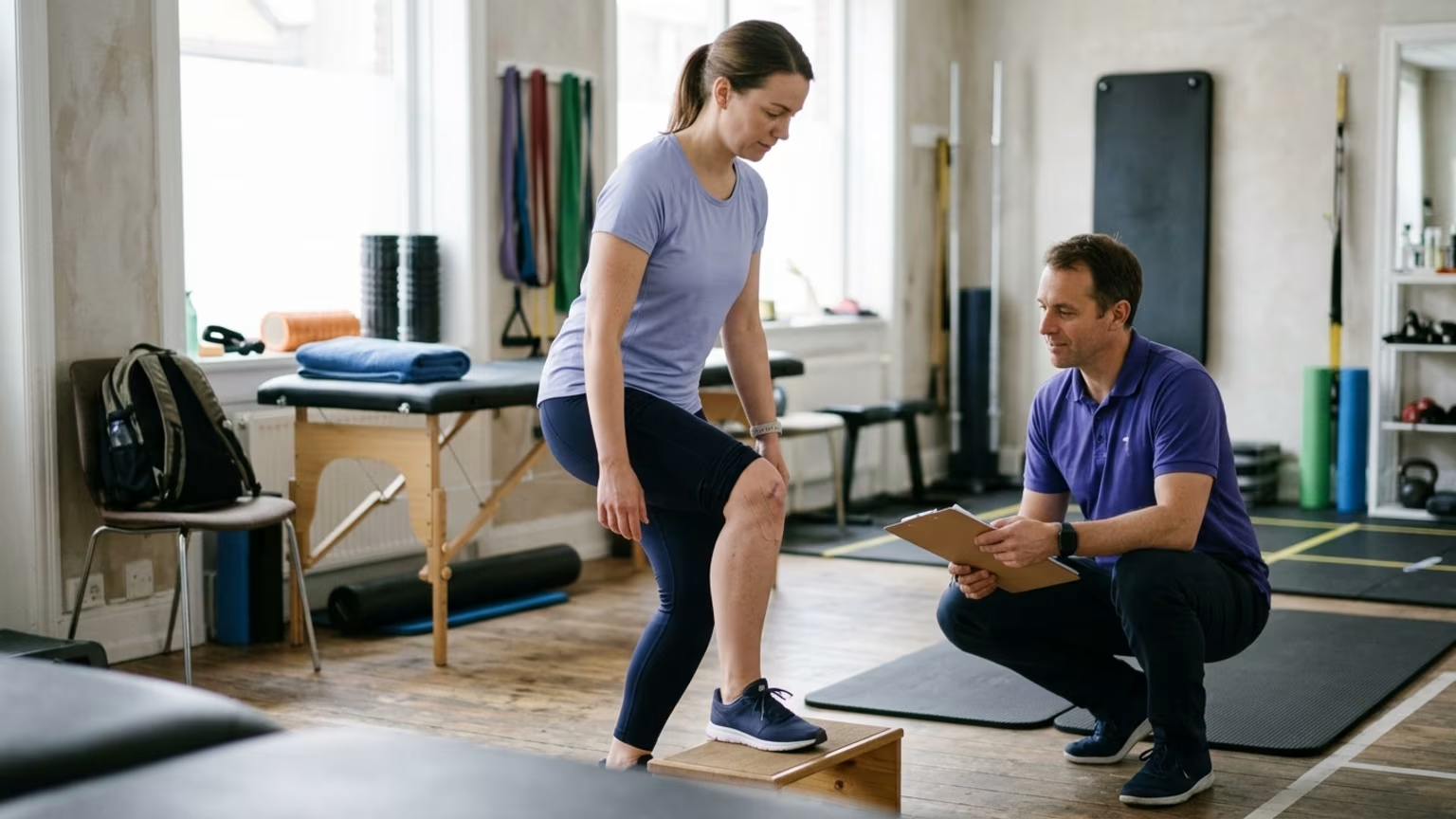

How ACL research frames readiness for activity through time, strength, movement and confidence, with questions to discuss with a clinician.





A 2026 clinical review in Current Reviews in Musculoskeletal Medicine describes approximately nine months as a lower time boundary for return to play after anterior cruciate ligament (ACL) reconstruction. It recommends assessing readiness through elapsed time, functional criteria and psychological readiness together. That matters because a date alone does not describe strength, movement quality or confidence.
The evidence discussed here centers on ACL return to sport, not a timetable for all orthopedic recovery. A clinical explainer summarizing a 2024 review says that review found no universally validated lower-limb return-to-sport test battery. The explainer also notes that the evidence is weighted toward knee and ACL research, with less research on hip and ankle.
In plain terms, functional criteria are findings about what someone can do. Readiness is therefore a discussion about the intended activity and the assessment findings, not just a date circled on a calendar.
Readiness varies with the injury or procedure and the activity being considered. Return to modified activity and return to demanding sport are different goals. A discussion about one should not be mistaken for a decision about the other.
That is why it helps to make “back to exercise” more concrete. Is the goal modified participation, recreational activity or demanding sport? Naming the intended activity gives the clinician a clearer question than asking whether recovery is finished.
Recreational goals deserve to be named just as clearly as sport goals. A general request to “be active again” may leave important questions unanswered. Naming the activity helps keep a discussion about daily life from turning into an abstract conversation about sport clearance.
Within the ACL review’s approach, time and testing address different parts of that question. Time describes how long it has been since surgery. Strength tests and functional assessments add information about current capacity. Psychological measures bring in the person’s own experience of returning.
These are not competing ways of judging recovery. The review recommends bringing them together. For a broader explanation of how results fit a decision, see how clinical assessments inform the next activity stage.
The ACL-focused review describes assessments that may include quadriceps and hamstring strength tests, hop tests, movement-quality assessment and a patient-reported psychological-readiness measure. A test battery means several assessments considered together. The point is to gather different kinds of information rather than let a calendar date answer every question.
These descriptions explain the clinical approach. They are not instructions for choosing or performing tests independently.
Strength testing is one part of the review’s proposed assessment. It names both quadriceps and hamstring testing rather than describing readiness with a single general statement such as “the leg feels strong.”
A useful question for the treating clinician is what the measured strength result means for the intended activity. This keeps the discussion connected to the goal rather than to a score without context.
Hop tests appear in the review as possible measures of functional performance. They sit within a broader assessment that also considers strength and movement quality.
Ask what the chosen test is intended to assess. A result is more useful to the conversation when its purpose is clear.
Movement-quality assessment is another domain listed in the review. This concerns how a movement is performed, not just the result recorded.
The practical question is how the clinician interprets that observation alongside the other findings. No self-testing routine is needed to begin that conversation.
Yes. Psychological readiness belongs in the discussion alongside physical assessment, according to the clinical review. Confidence is part of that picture rather than a replacement for strength or functional testing.
A 2026 scoping review focused on female football players after ACL injury describes the ACL Return to Sport after Injury (ACL-RSI) scale. It assesses confidence, emotions and appraisal of risk. Higher scores indicate greater psychological readiness within that measure.
That population is specific, so the findings should not be transferred automatically to every adult returning to recreation. The useful broader discussion is about the person’s concerns, not whether everyone needs the same questionnaire.
In practical terms, someone can ask what confidence concerns mean in relation to the physical findings. There is no need to wait until every worry has disappeared before raising the subject with a clinician.
Reporting confidence is not a test of character. It is a way to explain the experience of returning to activity. The aim is to include that experience in the conversation rather than make it compete with physical results.
ReboundBody’s explanation of worry about movement after injury offers more context for that conversation. Describing concern gives the care team a topic to discuss rather than leaving it outside the readiness assessment.
No single comparison should carry the whole discussion. The clinical review says that estimated preinjury capacity may be preferable to relying only on limb symmetry when preoperative testing of the other limb is available.
Limb symmetry refers to how closely the two sides compare. Estimated preinjury capacity asks a different question: how does current capacity compare with an estimate of capacity before the injury? Preoperative testing means testing done before surgery.
The distinction matters when interpreting a result. Similarity between sides and similarity to an earlier level are not identical comparisons. The review presents this as an approach to interpretation, not proof that one comparison method is best for everyone.
A useful follow-up is: “What are we comparing this result with?” The next question is why that comparison fits the intended activity. This moves the conversation away from treating one number as a complete answer.
This is also why asking only whether a score is “good” can miss the point. Ask what the reference represents and how it relates to the goal. The same conversation can cover what earlier measurements are available to the clinician.
Questions are most useful when they connect assessment findings to a specific next step. For personal decisions, the treating clinician is the right person to explain how the injury or procedure affects that discussion.
Possible questions include:
These questions do not create a progression plan. They help clarify the plan being discussed with qualified care. It is especially useful to distinguish approval for modified participation from a decision about demanding sport.
If an answer uses a broad term such as “ready,” ask for it to be tied to an activity. A useful discussion ends with a clearer description of the decision under consideration, not simply a more reassuring label.
For more context on that distinction, read about different meanings of returning to activity. The important outcome is a shared understanding of the proposed activity and what the current assessment says about it.
The clinical review’s central message is to combine time with functional and psychological information when evaluating ACL return to play. Strength, movement quality and confidence contribute different information. A decision makes more sense when those findings are linked to the activity the person actually wants to resume.
Return to the opening figure of approximately nine months. In the review, that date sits beside assessments of function and psychological readiness. The calendar supplies the date; the clinical conversation gives it meaning for the return-to-play decision.
Choosing which activity a readiness discussion should address is the starting point; ReboundBody adds editorial context for the shift from rehabilitation into everyday movement. For readers sidelined by an orthopedic problem, its articles explain mobility and strength rebuilding so uncertainty about life after rehabilitation can become clearer questions for the treating team.

Follow ReboundBody for practical articles on injury recovery, rehabilitation, mobility and rebuilding strength. New posts turn research into clear ideas for the road back to activity after injury or surgery.




Read practical guidance on injury recovery, rehabilitation, mobility and rebuilding strength as you work your way back to activity.
Explore Resources