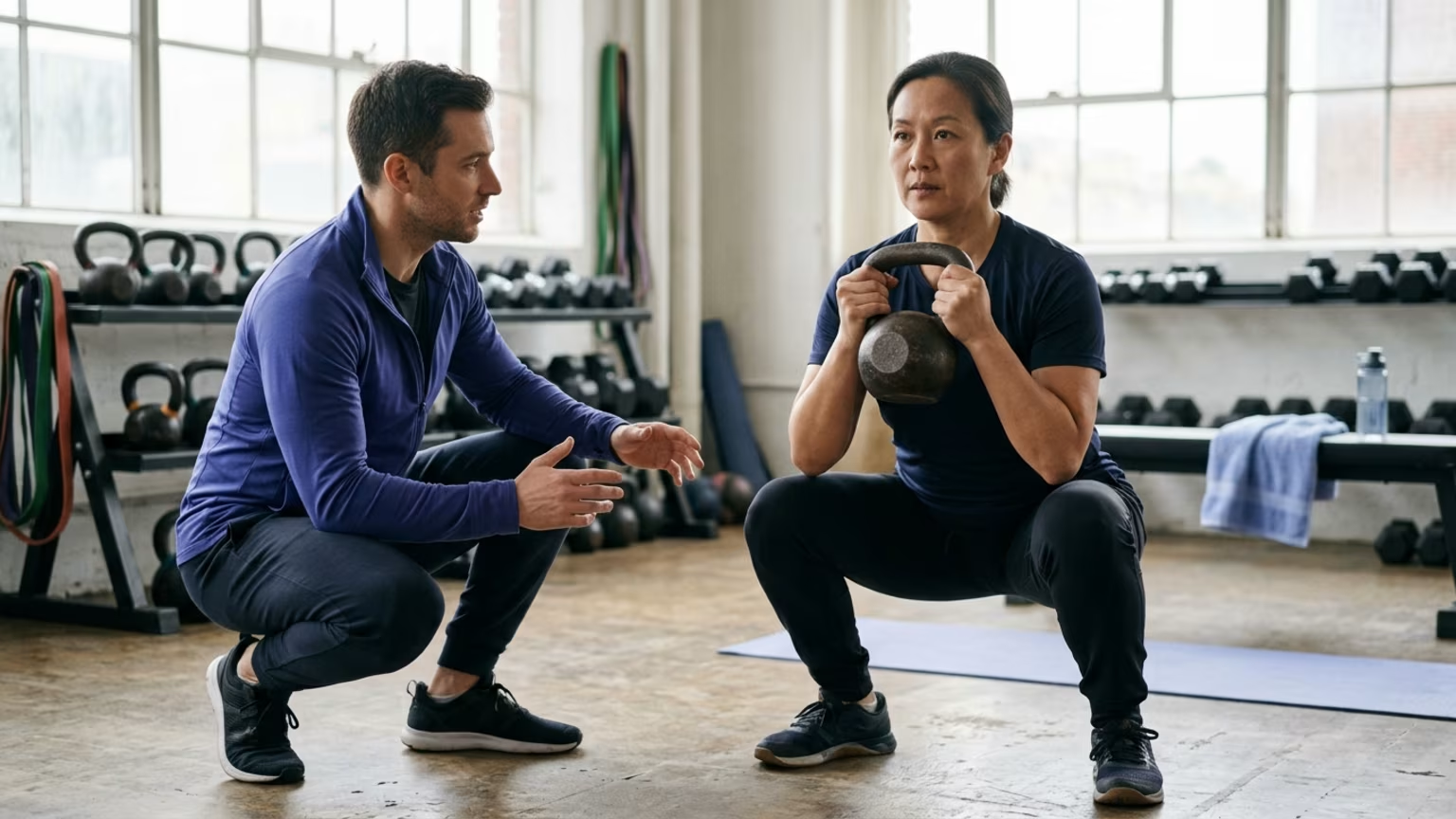

A recovery-focused look at Health’s four-exercise list, the fall-prevention evidence and why general fitness suggestions need individual context.





In its October 16, 2026 article, Health presented a trainer-informed list of four exercises intended to support strength and function with age. The movements are squats, deadlifts, side planks and dead hangs. Health recommends them as options adults can incorporate into workouts.
For someone returning from an orthopedic injury or surgery, the important question is how to interpret that recommendation. A general fitness article and a personal rehabilitation plan serve different purposes. Reading them as though they offer the same kind of direction can give an exercise headline more authority than it deserves.
The list offers a concrete starting point for discussing movement. Its practical value lies in bringing exercise choices into focus rather than creating another standard that every recovering adult must meet. That distinction matters more than whether a particular movement appears on a popular list.
The federal guidance context remains the current second edition of the Physical Activity Guidelines for Americans. The U.S. Department of Health and Human Services says it plans to release a 2027 supplement addressing steps and muscle-strengthening activity. It is seeking public comments to inform that work.
This is a guidance-development process. It is not an announcement that federal recommendations have already changed to endorse Health’s four exercises. A planned supplement also should not be read as proof that one media list represents the preferred approach to strength training.
These sources answer different questions. Federal guidance provides a broader reference point for physical activity. Health’s article offers a particular selection of exercises within the much larger subject of staying active with age.
For readers comparing advice online, the source’s role is worth noticing before its recommendations are applied. An exercise suggestion, a research review and a government guidance document carry different kinds of information. Their appearance in the same news cycle does not make them interchangeable or show that one endorses another.
A 2026 review published in BMC Geriatrics reports that exercise-based interventions have their most consistently supported downstream clinical evidence in fall prevention. The reported outcomes include reductions in fall rate, risk of falling and fall-related fractures.
Those are meaningful outcomes for a recovery-focused audience. They concern events that affect everyday life rather than simply whether an exercise looks demanding. Still, the review’s finding belongs to the broader evidence on exercise-based interventions.
The distinction between the sources is straightforward:
The review does not establish that Health’s specific four-move combination produces those fall-related benefits. Assigning that finding to the list would turn evidence about exercise interventions into a claim about a particular routine.
A useful reading keeps the finding attached to the intervention it actually describes. The broader evidence can provide context without becoming a stamp of approval for every exercise recommendation published alongside it.
Health’s recommendation addresses adults broadly. It is general fitness coverage rather than advice directed at a defined group recovering from a particular orthopedic condition.
The approved account of the BMC Geriatrics review does not provide participant ages, diagnoses or stages of recovery. It therefore does not establish how closely the reviewed populations resemble a reader recovering from surgery or managing recurring musculoskeletal symptoms.
For ReboundBody’s audience, the useful distinction is between an adult fitness goal and an individual recovery situation. Wanting to maintain strength with age does not describe someone’s current symptoms, restrictions or physical capacity. Those details belong in a discussion with qualified healthcare professionals.
Being in the broad age group addressed by an exercise article is not the same as being in the population for which a specific recovery decision has been studied. Readers do not need to reject general fitness information. They need to keep its intended audience in view.
The practical decision is not whether these movements deserve a place on a universal list. It is whether the ideas in the article are relevant to an existing recovery plan. That is a question for the treating healthcare team when personal restrictions or treatment decisions are involved.
A productive discussion can begin with the goal behind the interest. A reader may be trying to understand strength rebuilding, everyday movement or the transition back to recreation. Naming that goal gives the conversation a clearer focus than asking whether a headline is right or wrong.
Questions raised by the article could include:
These are questions for shared understanding, not a checklist for granting personal clearance. The article itself is not a reason to replace prescribed rehabilitation exercises or change treatment.
It also helps to separate the exercise name from the broader activity goal. ReboundBody’s discussion of daily activity and structured exercise offers related context for thinking about those categories. The point is to clarify what kind of activity is being discussed before treating a short list as the whole plan.
For someone whose main question is the transition out of formal rehabilitation, the discussion may center on returning to meaningful hobbies. That keeps the focus on the reader’s activity goals rather than on completing every item in a media recommendation.
Several limits should shape how much weight this particular list receives. Health describes the recommendation as trainer-informed, but the available article material does not identify the trainer or provide credentials. No attributable expert quotation is available in that material.
The article also does not establish that the four exercises were tested together as a program. It provides no general weekly schedule in the available information. The list therefore should not be presented as a complete fitness program or a validated rehabilitation routine.
For injury recovery, the unanswered questions are more specific. The source material does not provide condition-specific screening criteria, contraindications or a post-surgical progression. It also does not demonstrate that the four exercises accelerate recovery or prevent injury.
Those gaps set a clear boundary for practical use: treat the list as a set of discussion options rather than a prescription. Personal decisions about suitability and progression remain with qualified care. The planned HHS supplement may add broader guidance on muscle-strengthening activity, but its final content is still being developed.
There is room to find an exercise idea interesting without accepting the headline as a requirement. Clear questions belong in recovery. Pressure to match a list does not.
Choosing how much weight to give an exercise headline is an information decision, which ReboundBody supports through evidence-aware recovery writing. For active adults in midlife and later life facing conflicting exercise claims, its independent coverage clarifies rehabilitation and return-to-activity topics without offering personal treatment plans or medical promises.

Follow ReboundBody for practical articles on injury recovery, rehabilitation, mobility and rebuilding strength. New posts turn research into clear ideas for the road back to activity after injury or surgery.






Read practical guidance on injury recovery, rehabilitation, mobility and rebuilding strength as you work your way back to activity.
Explore Resources