
The FAST-2 trial improved chair-stand and balance scores in older adults. Learn why coaching, modifications and study limits matter.





On March 12, 2026, PLOS One published a randomized trial of FAST-2 that reported better chair-stand and balance test results in older adults with walking difficulty. The 12-week study tested a brief daily home routine alongside coaching and adjustable exercises.
Looking back at the finding, the short duration is only part of the story. Later coverage of the four-minute workout emphasized its small time commitment. The study also included reminders, feedback and movement modifications.
For people rebuilding everyday movement, the useful finding is that a short but supported program improved specific measures of physical performance. Understanding how researchers reached that result matters more than copying the exercise list.
This update concerns a trial result rather than a new rehabilitation guideline. The researchers were studying older adults who were inactive and already had trouble walking. Their question was whether a brief daily functional-strength program could improve performance in that setting.
The comparison was delayed treatment. Researchers randomly assigned participants either to FAST-2 or to a group that waited for treatment during the study period. That allowed them to compare changes between groups over the same 12 weeks.
This distinction matters when interpreting the results. The finding was not simply that people performed better after practicing a routine. The exercise group improved more than the comparison group on the reported tests.
The starting point was also specific: existing walking difficulty combined with little reported activity. That context should stay attached to the headline. The trial addressed a focused question about physical performance rather than settling how long an exercise session should be for every recovery goal.
The study added evidence that a short daily program could improve several functional test results in the population studied. It also documented how often participants completed the routine and how much adjustment the exercises required.
FAST-2 was a home program intended for daily use. The study routine included:
The program included 30 seconds of rest between exercises. This describes the study intervention, not a set of exercise instructions for someone with an injury or surgical restriction.
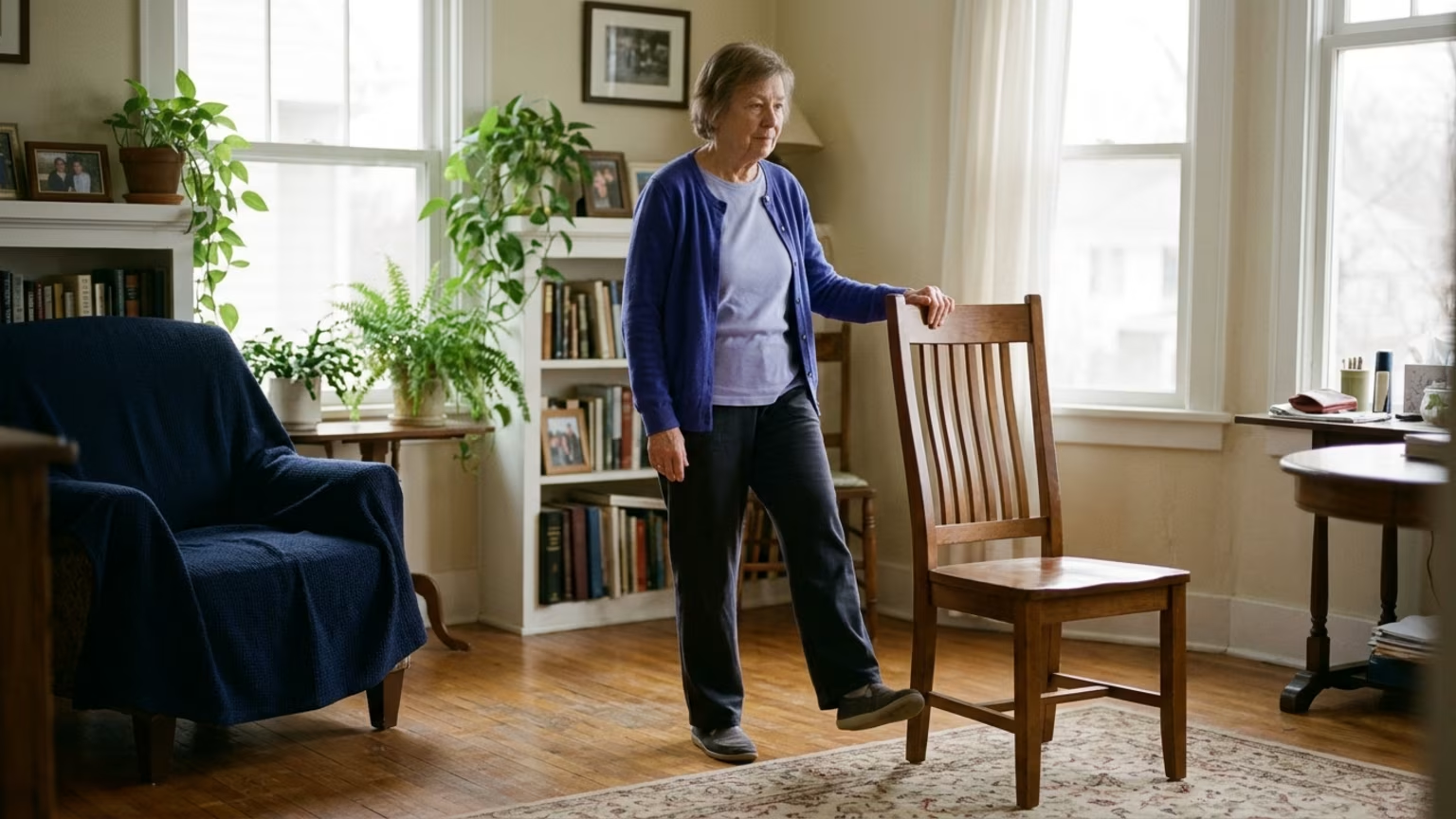
Researchers also built adjustments into the program. These included easier versions of push-ups and chair stands. The safety setup included a stepper positioned in a corner so participants could touch a wall if they felt unsteady.
According to the trial report, the FAST-2 group outperformed the delayed-treatment group on three tests over 12 weeks:
These figures describe differences in change between the groups. They are not personal targets or predictions for an individual reader.
The tests also capture different aspects of performance. One counted repeated chair stands within a set time. Another measured how long participants could stand on one leg. The third timed a fixed number of sit-to-stands.
Keeping those test names visible makes the result easier to interpret than a broad statement that the routine improved “mobility.” It shows exactly what researchers assessed and where they found a benefit.
Participants received video-based coaching at baseline and at weeks 2, 4 and 8. They also received daily email reminders and regular feedback about performance and completion.
The researchers reported that participants completed the routine on 81% of days on average. Modifications were used in 40.6% of exercise sessions.
Those details belong beside the exercise duration. The tested program combined brief movement with repeated contact and opportunities to adjust the movements. The study’s encouraging result came from that package.
The trial randomized 97 adults aged 65 or older. Of these, 44 were assigned to FAST-2 and 53 to delayed treatment. Their average age was 74, and 68% were women.
Participants were inactive and reported difficulty walking a quarter-mile without special equipment. At baseline, they reported an average of about 18 minutes of physical activity per week.
Age was therefore only one part of the study population. These were older adults with an existing walking limitation and a low activity level. The result is most directly relevant to understanding that combination of circumstances.
The trial was not designed around people recovering from a recent orthopedic operation. It also was not a return-to-sport study. Applying its findings to those situations requires a separate clinical judgment rather than an assumption based on age alone.
For a reader in rehabilitation, the useful distinction is between recognizing a promising training format and knowing whether its movements fit a particular recovery stage. The study offers evidence for the format in its participants. It does not establish the right exercises or progression for a specific injury or operation.
The practical value is a focused question: could brief functional exercise have a place within an existing recovery plan?
That question keeps the discussion grounded in the evidence. It does not assume that longer sessions are unnecessary. It asks whether a shorter format could be adapted to a person’s current ability and restrictions with appropriate professional input.
For someone working with a clinician or physical therapist, several parts of the study may be worth discussing:
These are questions about adapting care, not reasons to add the study routine independently. The clinician or physical therapist can connect the discussion to the person’s condition and existing plan.
It may also help to separate the idea of a brief session from the broader goal of rebuilding physical capacity. A study can show improvement on selected tests without answering every question about daily movement. ReboundBody’s overview of strength, mobility and everyday function provides background for understanding those different goals.
The language used to describe progress matters too. Readers sorting out strength and mobility claims can find context in how movement-related terms differ. Clear terms make it easier to connect a research finding with a question for the healthcare team.
For those nearing the end of supervised care, the broader issue may be understanding the transition beyond formal physical therapy. FAST-2 offers a reason to discuss brief exercise within that conversation rather than treating the study as a complete long-term plan.
The authors identified several limits. The sample was relatively small, the intervention lasted three months and outcomes were assessed by video. Longer studies are needed to learn whether the performance benefits and participation levels persist.
The reported outcomes were chair-stand and balance tests. The trial did not report measuring falls or directly measuring changes in disability. Better test performance should therefore remain separate from claims about fewer falls or restored independence.
The authors also cautioned that the findings do not establish that four minutes of exercise is enough to improve cardiovascular health or body composition in the general population. Those broader health questions were not answered by this trial.
Safety deserves its own place in the interpretation. The paper reported seven adverse events considered possibly, probably or definitely related to the intervention among six participants. These occurred across 2,994 completed sessions. All were orthopedic in nature, with shoulder discomfort reported most often.
The support package leaves another question open: how much did the reminders, coaching and feedback contribute to the results? Because these were part of the tested intervention, the findings do not establish the same outcome from an exercise list alone.
Taken together, the trial offers a useful proof of concept. A brief and adaptable program improved specific functional tests in the older adults studied. The next step for a recovery reader is a focused care conversation rather than a new self-directed prescription.
Today, write down this question for your clinician or physical therapist: “Could a brief, adapted movement session fit within my current recovery plan?”
Reducing FAST-2 to a stopwatch result leaves out the coaching and adjustments that shaped the study. ReboundBody publishes independent recovery articles that put research findings in context for adults dealing with orthopedic setbacks. Its coverage explains rehabilitation and rebuilding movement without turning a study headline into an individual care plan.

Follow ReboundBody for practical articles on injury recovery, rehabilitation, mobility and rebuilding strength. New posts turn research into clear ideas for the road back to activity after injury or surgery.






Read practical guidance on injury recovery, rehabilitation, mobility and rebuilding strength as you work your way back to activity.
Explore Resources