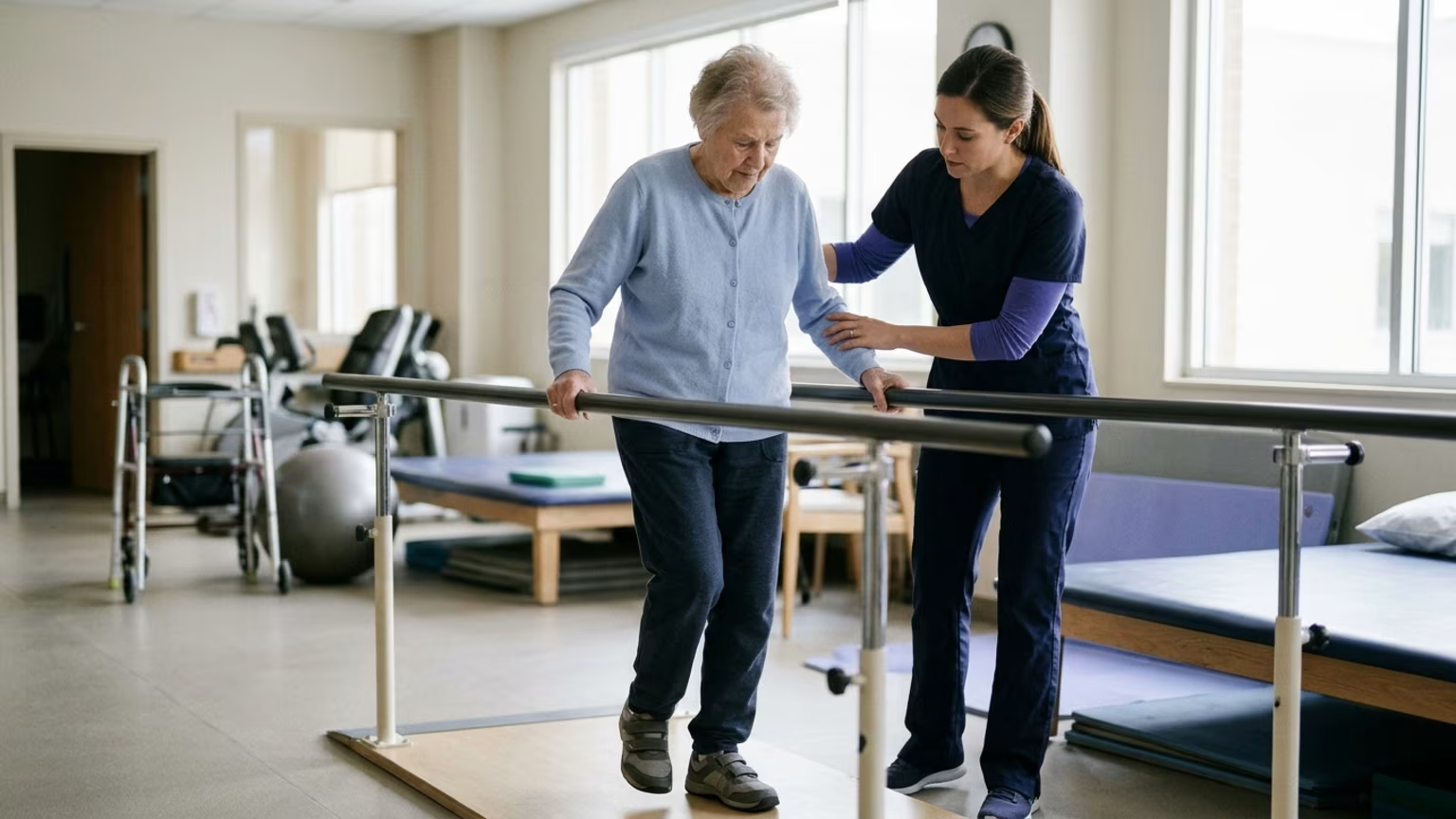

A study linked broader rehab to better three-month scores after hip fracture surgery. Learn who was studied, what changed and what remains uncertain.





A November 14, 2026 report on research published in Frontiers in Medicine described better average recovery scores among frail older adults after trochanteric femoral fracture surgery. Patients who received a progressive exercise program had better daily-function, hip-performance and frailty scores at three months than patients treated the year before.
The program combined resistance exercise, balance work, joint mobility and aerobic activity. It was added to standard postoperative care and included support from clinicians and family members. Activity progressed over three months rather than remaining at the same level throughout recovery.
The finding brings attention to the overall shape of rehabilitation after fracture fixation. The relevant question is not simply whether a person is doing mobility exercises. It is how different parts of a recovery plan fit together and change over time.
The researchers used conventional postoperative care delivered in 2023 as their comparison. In 2024 the hospital introduced the multicomponent exercise program alongside standard care. This created a comparison between patients treated during different periods.
That distinction matters when reading the headline. The study examined an addition to postoperative care. It did not compare exercise with receiving no care, and it should not be described as a test of surgery versus rehabilitation.
Both groups improved from their starting scores, according to the study report. The group receiving the added program had better average results at follow-up. Those findings do not support dismissing conventional care as ineffective.
The earlier-care group also should not be casually relabeled a “mobility-only” group. The reported comparison was conventional care versus conventional care with a broader exercise package. Keeping that comparison intact helps prevent a reasonable finding from becoming an unsupported claim about which single type of exercise is best.
The study’s added program addressed several aspects of movement rather than focusing on joint mobility alone. Its components included:
The researchers described a graded progression over three months. Earlier activity included bed-based mobility and strengthening. Later activity moved toward standing, balance and walking, with stairs and resistance training also included.
This was a progression within a clinician-supported program. The different activities were not presented as equal starting options for every participant. The study also included multidisciplinary support and family involvement, so its approach extended beyond an exercise list.
At three months, the intervention group had better average scores on several measures described in the study report:
Each of these between-group comparisons had a reported P value below 0.001. The study also reported higher Functional Independence Measure and SF-36 health-related quality-of-life scores in the intervention group at follow-up.
Taken together, the reported differences covered more than joint movement. They included daily function, hip performance, frailty and health-related quality of life. That wider set of outcomes is the main addition this study brings to the discussion of postoperative rehabilitation.
The study included 120 frail adults aged 60 or older at Xi’an Honghui Hospital in China. All had undergone surgical fixation for trochanteric femoral fractures. Of these participants, 60 received conventional care and 60 received the added exercise program.
Frailty was part of the population selected for the study, not simply an outcome measured afterward. The findings therefore concern older adults with a specific fracture and recovery setting. This was not a general exercise study involving everyone returning to activity after an orthopedic problem.
For readers whose situation closely matches that profile, the study offers a relevant subject to discuss with their treating team. For younger adults or people recovering from another injury, its relevance is the question about coordinated rehabilitation rather than an expectation of matching the reported scores.
Keeping the patient group attached to the headline is important. “Better recovery scores after fracture surgery” is a much broader statement than the population the researchers actually studied.
The practical value of this research is a more informed conversation about the plan already being managed by qualified healthcare professionals. It is not a reason to add resistance work or change walking demands independently.
According to the study report, the program was tailored and advanced according to tolerance. For readers comparing different forms of lower-impact movement, this places the focus on what an activity contributes to the whole plan rather than its label alone.
Useful questions for a rehabilitation discussion include:
These questions do not require assuming that every person needs the study’s exact program. They help distinguish the purpose of rehabilitation from the details of a particular research protocol. They also keep personal decisions with the professionals who know the patient’s situation.
The study described reducing or pausing exercise when it aggravated pain or when heart or lung warning signs arose. Reassessment involved the physical therapist and treating physician. That clinical response was part of the program, not a home screening rule for readers to reproduce.
Questions about readiness beyond pain relief fit into this wider discussion. For this study, the useful focus is how activity selection, progression and review worked together. The practical takeaway is a topic for care conversations rather than a schedule to copy.
The study was quasi-experimental, meaning its groups were not assigned at random. Because patients were treated in consecutive calendar years, changes in staffing or patient mix could have contributed to the differences. The authors therefore described the findings as preliminary associations rather than proof that the program caused better recovery.
The exercise intervention was also a package. It combined progression with multidisciplinary support and family involvement. The study cannot separate the contribution of resistance exercise from the contribution of balance work or the additional support surrounding the program.
Follow-up lasted three months. The results do not establish whether the differences continued beyond that point or affected later falls, rehospitalization or long-term independence. Those later outcomes remain open questions.
The authors called for randomized controlled trials and research across more diverse, multicenter settings. That work would help test whether the findings hold beyond the single hospital involved here. It would also help clarify how the approach might transfer to other care settings.
Finally, the reported averages and statistical significance do not establish a particular benefit for an individual patient. The scores are findings across groups, not a forecast of someone’s recovery. Their appropriate role is to inform the evidence discussion rather than define a personal milestone.
For now, the study gives a clearer view of one coordinated approach to recovery. Its most useful contribution may be the attention it gives to how the parts fit together, not simply how many exercises appear on a page.
Day-to-day rehabilitation after fracture surgery belongs with the treating team; ReboundBody adds context to the information surrounding those decisions. For adults in midlife and later life facing conflicting exercise or treatment claims, the site explains recovery research in plain language with attention to the difference between a study finding and a personal care decision.

Follow ReboundBody for practical articles on injury recovery, rehabilitation, mobility and rebuilding strength. New posts turn research into clear ideas for the road back to activity after injury or surgery.






Read practical guidance on injury recovery, rehabilitation, mobility and rebuilding strength as you work your way back to activity.
Explore Resources