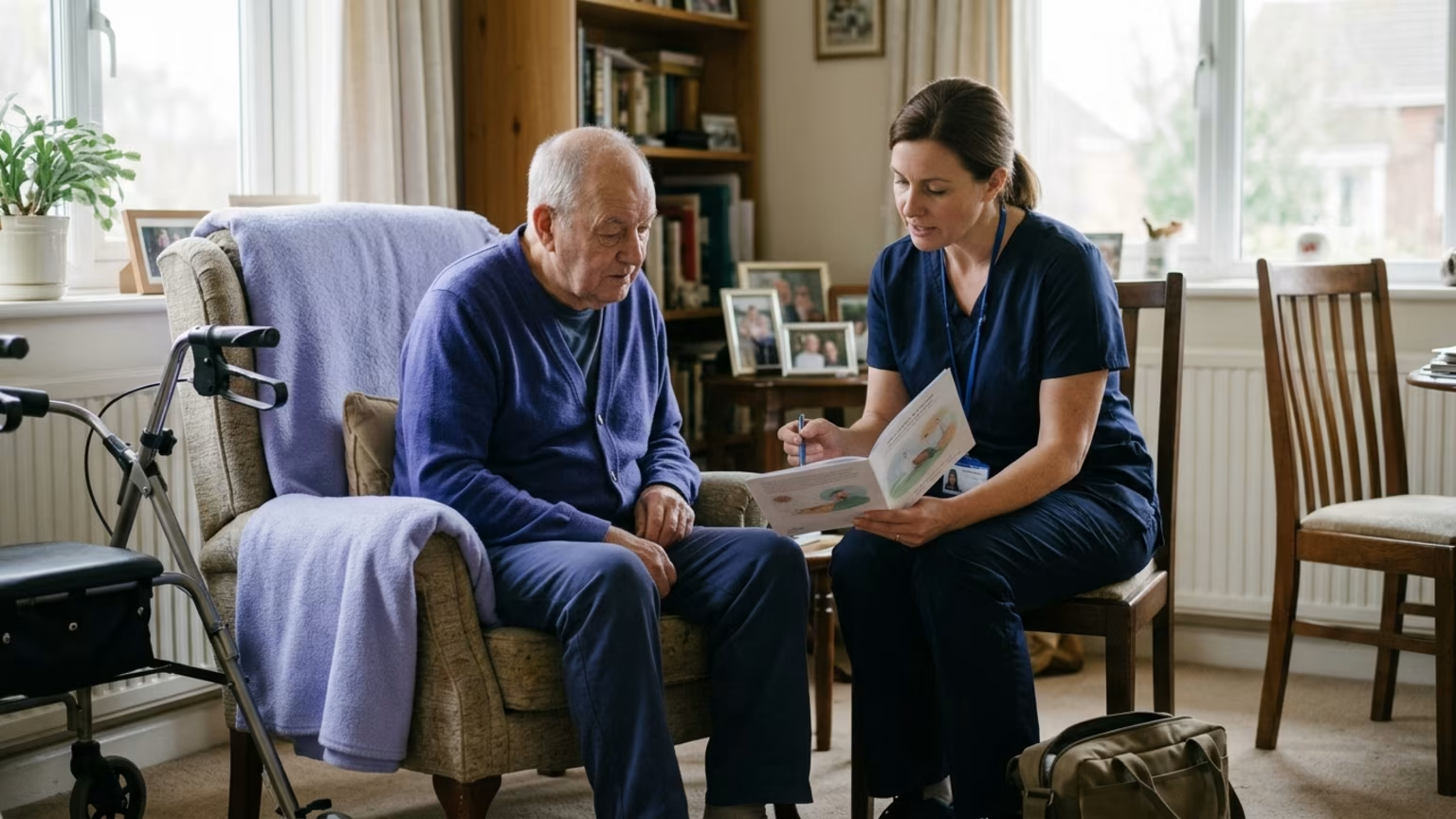

Augusta Health’s new guide explains possible home support after joint replacement, symptoms to report and Medicare coverage conditions.





On November 12, 2026, Augusta Health published “Home Health After Joint Replacement Surgery.” The patient guide describes how home-health professionals may support mobility, wound observation and daily activities while following the surgeon’s care plan. It also explains the role of home physical therapy and lists changes to report to the care team.
The development is a clearer description of possible support at home, not a new national treatment guideline. Its practical value is in naming tasks that may be part of recovery outside the hospital. For people preparing to return home, it offers a starting point for questions about services and communication.
Augusta Health’s October 2026 recovery guide had already placed individual surgical instructions at the center of recovery. It said activity levels, weight-bearing limits and wound-care instructions should come from the patient’s surgeon and therapy team. Those instructions remain the reference point when home-health support is added.
That earlier guide also described temporary changes around the home. Examples included removing loose rugs and keeping frequently used items within reach. These were practical home-preparation measures rather than a standard exercise schedule or a replacement for the surgical team’s directions.
A separate policy development also preceded the November patient guide. A Federal Register notice published November 9, 2026, discussed the 2027 Medicare home-health payment system. It stated that the payment model did not change home-health eligibility or coverage criteria.
These sources address different questions. The recovery guide concerns daily recovery planning. The federal notice concerns payment policy, while the newer Augusta guide explains the kinds of support that home-health professionals may provide.
Augusta Health presents home health as care delivered alongside the surgeon’s plan. The guide groups that support around everyday needs and rehabilitation. For readers, the useful distinction is between what a service may involve and what their own care plan actually includes.
The guide says home-health professionals may help patients move safely around the home. It also describes home physical therapy aimed at rebuilding strength, improving range of motion and supporting safe movement in that setting. Range of motion refers to how far a joint moves.
These are treatment goals rather than a shared schedule for every patient. The specific activity instructions still come from the surgical and therapy teams, as Augusta’s earlier recovery guide explains. A description of home therapy should therefore be read together with those instructions.
For broader context on care settings, ReboundBody explains how home-based rehabilitation fits among other options.
Augusta Health says home-health professionals may help establish medication routines and monitor the surgical wound. These are distinct parts of support that readers can ask about when reviewing the proposed care plan.
The practical question is who is responsible for each task. A patient may need to clarify who handles questions about medication instructions and who should receive updates about the incision. The guide’s emphasis on working alongside the surgeon’s plan makes that coordination important to the discussion.
The guide also describes possible help with bathing and dressing when appropriate. This places ordinary daily tasks within the recovery conversation rather than treating rehabilitation as exercise alone.
Still, a description of possible assistance is not a confirmed service arrangement. The discharge or home-health team can explain which tasks are included in the individual plan and who will provide that help.
Augusta Health’s guide addresses people recovering after joint-replacement surgery. It does not say that everyone in that group needs home health or will receive every service described. Surgery type alone is not enough to determine the exact package of support.
For readers asking about Medicare, federal eligibility rules add another layer. The rules require certification by a physician or allowed practitioner. They also generally require homebound status, a need for qualifying skilled services and a plan of care.
Federal coverage rules describe skilled care that can include intermittent skilled nursing or physical therapy. Separate skilled-service requirements tie therapy goals and treatment to the person’s condition and functional assessment. That means the care plan is connected to the individual’s assessed needs.
The amount, frequency and duration of therapy must also be reasonable and necessary for that person. Readers should therefore ask the referring clinician and home-health agency to explain how the coverage requirements apply to the proposed services. A general patient guide cannot settle that eligibility decision.
The related rehabilitation research has a narrower population. A 2026 review in BMC Musculoskeletal Disorders reported improved knee function associated with exercise-based rehabilitation. Its randomized trials involved people after total knee arthroplasty, or total knee replacement, rather than everyone who has had joint surgery.
The guide’s most useful application is a clearer conversation with the surgical or discharge team. Instead of treating “home health” as a complete description, readers can ask what that term means in the plan being proposed.
Questions supported by Augusta Health’s guidance and the federal coverage rules include:
These questions concern coordination and understanding. They do not require a reader to select exercises, change medication or decide how much weight to place through the operated leg. Those decisions belong with the treating professionals and the individual care plan.
For readers organizing written directions, ReboundBody’s guide to keeping postoperative medication instructions clear provides related background.
Augusta Health advises contacting the care team about:
The guide presents these as changes to report to the care team. Follow that team’s instructions about urgency because the guide does not set a universal response timeframe.
Having home-health visits planned does not answer the separate question of whom to contact between those visits. Augusta’s advice to report concerning changes makes that contact information a useful part of the care-planning discussion. Readers can ask whether their written instructions identify the appropriate contact.
ReboundBody also offers background on understanding incision-care instructions and warning signs. That reading supports questions about the surgical team’s directions rather than replacing them.
The Augusta guide is institutional patient education rather than a clinical trial. It supplies no comparative outcome data, cost figures or staffing details. It also offers no evidence that home services reduce complications or make recovery faster.
The knee-replacement review provides a separate evidence limit. It rated the exercise-rehabilitation evidence low certainty and reported substantial differences among the trials. Its findings do not establish that home health itself caused the improvements or that one rehabilitation setting is best for everyone.
Those gaps matter when interpreting claims about results. A guide can explain the purpose of a service without showing how it compares with other arrangements. Similarly, a favorable rehabilitation finding does not establish which services a particular person needs at home.
For planning purposes, the clearest distinction is between the service description and the individual plan. Augusta Health describes possible forms of support. The treating team supplies the activity instructions, while the referring clinician and home-health agency can explain the services and coverage being proposed.
Today, add this question to your care-team notes: “Which home-health services are actually included in my plan?”
Deciding what to ask about home-health services requires clear explanations, which is the editorial role ReboundBody fills. For active adults sorting through unfamiliar clinical terms and research findings, the site explains rehabilitation and physical recovery with realistic limits to support better-informed discussions with their healthcare professionals.

Follow ReboundBody for practical articles on injury recovery, rehabilitation, mobility and rebuilding strength. New posts turn research into clear ideas for the road back to activity after injury or surgery.






Read practical guidance on injury recovery, rehabilitation, mobility and rebuilding strength as you work your way back to activity.
Explore Resources