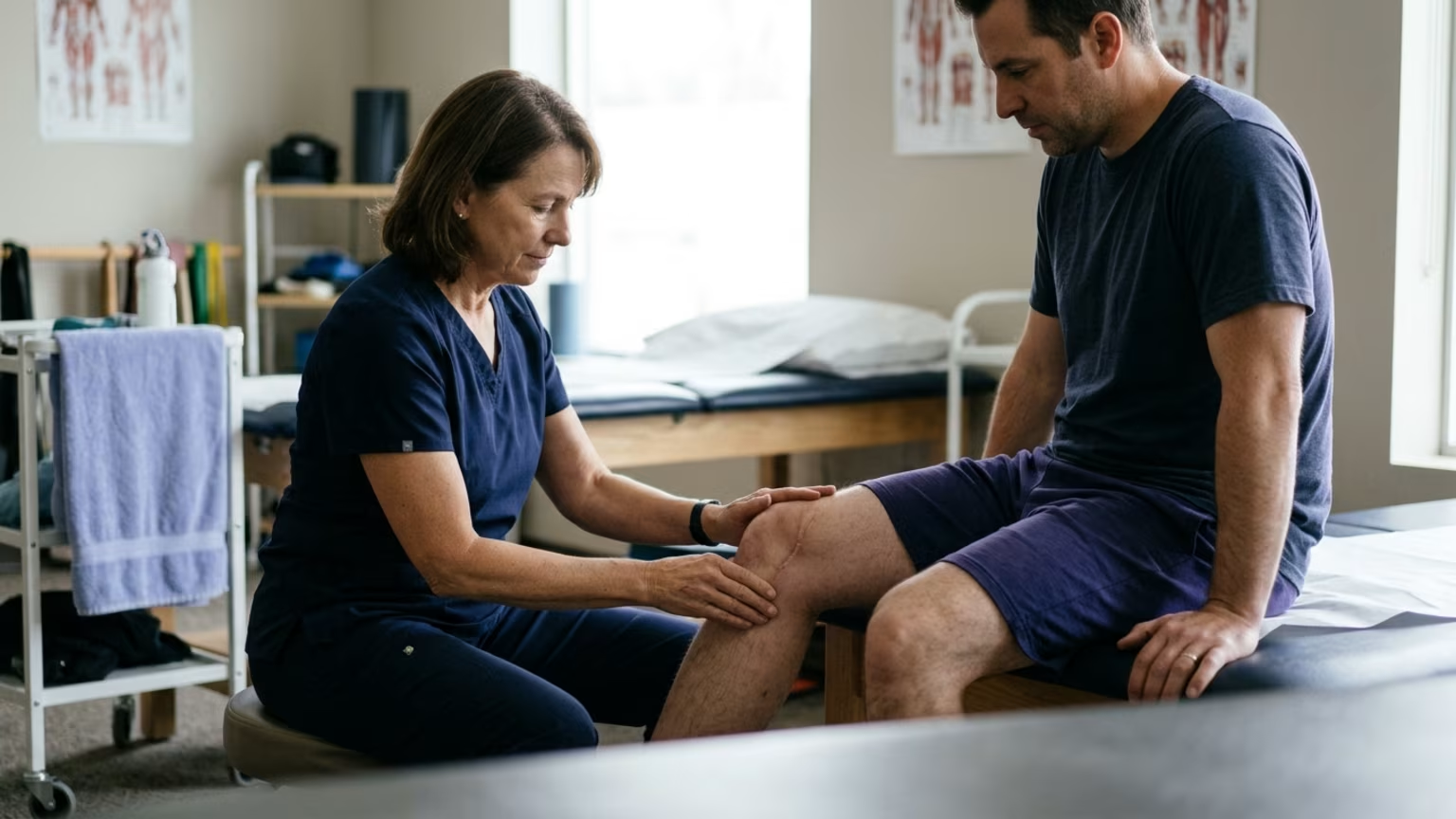

Understand overlapping tissue-healing phases, why strength can lag behind symptom relief, and how rehabilitation goals differ from calendar deadlines.





Symptoms may ease after hip-preservation surgery.
Function may improve too.
Hip strength measures can still lag behind.
An international society article in the Journal of Hip Preservation Surgery describes this pattern.
Tissue healing is the repair process that follows an injury. Inflammation, tissue rebuilding and remodeling describe different parts of that process. They are useful ideas for understanding recovery, but they are not separate calendar boxes that close on fixed dates.
Physical recovery also includes regaining the abilities needed for normal activity. Repairing tissue and rebuilding those abilities are related, but they are not interchangeable.
This article explains overlapping healing activity and why comfort can improve before physical capacity. The evidence discussed concerns specific tendon, wrist and hip conditions. It does not establish one schedule for every injury or provide a way to diagnose symptoms or clear someone for activity.
Normal function means more than having little or no pain. It also involves meeting the demands of an activity through movement, strength and control.
A proposed rehabilitation framework for triangular fibrocartilage complex injuries illustrates these different demands. The triangular fibrocartilage complex, usually shortened to TFCC, is a structure in the wrist. In their review, Liu and Zhou describe rehabilitation goals involving range of motion, controlled loading and neuromuscular control.
Those terms describe different abilities:
These abilities help explain why recovery is not a single result. A person’s symptom report and strength measurement answer different questions. Neither should be treated as a complete description of recovery.
The distinction matters when discussing a return to lifting, recreation or sport. Naming the intended activity gives the treating clinician a clearer goal than simply asking when recovery will be finished.
For broader context, ReboundBody explains the different physical abilities involved in rebuilding function.
One possible contributor to differences in healing is anatomy. The tendon review summarized in the research describes variation related to blood supply and anatomical location.
Liu and Zhou provide a wrist-specific example. Their TFCC review describes a blood-supplied peripheral region and a central portion made largely of avascular fibrocartilaginous tissue. Avascular means lacking blood vessels.
The important point is not a percentage to apply elsewhere. It is that different regions within the same structure can have different biological features. A general injury label does not capture every feature relevant to recovery.
Another source of difficulty is that recovery measures can change at different rates. The hip-preservation article reports that strength can lag behind improvements in symptoms and function. That creates a possible gap between feeling better and being prepared for a demanding activity.
Reduced discomfort is encouraging. The mistake is treating it as proof that every other part of recovery has caught up.
This is why symptoms alone should not be used to identify the injured structure or judge its readiness. The research supports considering the affected tissue and the abilities required for the intended activity, rather than relying on one reassuring sign.
A tendon review describes inflammation, proliferation and remodeling as overlapping phases. In plain language, these refer to the injury response, tissue rebuilding and continued reshaping of repair tissue.
The overlap is central to understanding them. The names describe kinds of healing activity, not proof that one process has completely stopped before another begins.
Inflammation names the response associated with injury and repair. It is part of the healing picture rather than a complete measure of recovery.
The phase name does not function as a symptom-based diagnosis. A person cannot use a general description of inflammation to determine exactly what is happening inside a particular injured structure.
Proliferation is the clinical term used for the rebuilding phase. It helps distinguish the work of repair from the initial injury response.
Because the phases overlap, rebuilding should not be pictured as something that waits for every sign of the earlier response to disappear. Nor does the word establish how much strength or activity tolerance has returned.
Remodeling describes the continued reshaping of repaired tissue. It is another reason that “repair has started” and “recovery is complete” are different statements.
The phase model explains the broad process. Functional assessment addresses a different question: what the person can currently do in relation to the demands they want to resume.
That distinction is discussed further in ReboundBody’s explanation of biological repair and the return of useful capacity.
Biological phases and rehabilitation stages are not identical labels. One describes healing activity. The other organizes the goals of rehabilitation.
Liu and Zhou’s TFCC review proposes stages focused on:
Here, symptom modulation means managing symptoms. Functional reintegration means bringing physical abilities back into relevant activities.
The authors recommend progression according to clinical objectives and functional recovery rather than rigid time criteria. They also state that their framework is conceptual, not a validated or prescriptive protocol. They describe the TFCC-specific evidence as limited and varied.
The practical value is a way to understand the purpose of rehabilitation. It is not a set of instructions for choosing exercises or advancing activity independently. A useful discussion with a treating clinician is which objective is currently being addressed and how progress toward it is assessed.
The hip-preservation article gives a concrete example of different recovery measures following different time courses. It reports that symptoms, function and satisfaction may improve as early as 14 weeks. Hip strength may continue improving for up to a year after surgery.
These findings describe separate outcomes. They should not be combined into a start-to-finish range for tissue healing.
Instead, they illustrate a broad recovery window in which some improvements can occur while strength is still developing. Individual timelines vary. A calendar date can provide context without describing every part of recovery.
This helps make sense of progress that feels uneven: improvement in one area does not require all other measures to improve at the same pace.
Clinical terms can sound like firm milestones even when they describe different questions. Three distinctions are especially useful when discussing the move back toward normal activity.
These are the goals being addressed in care. In the TFCC framework, examples include controlled movement and functional reintegration. Understanding the current objective helps connect a rehabilitation activity with its purpose.
This refers to the return of useful physical abilities. It is broader than symptom relief alone and should be discussed in relation to the activities a person hopes to resume.
A measurement of movement is one part of that picture. ReboundBody’s article on how joint movement measurements relate to everyday tasks provides related context.
Readiness is a decision about the demands of returning to sport. A review of patellar tendinopathy reports that validated return-to-sport readiness criteria for that condition are lacking.
Rather than relying on a single sign, that review discusses several domains. These include response to progressive loading, strength and sport-specific tolerance.
For a clinical conversation, the useful questions are specific: Which abilities matter for the intended activity? How are those abilities being assessed? What remains to be addressed before the next transition?
Healing involves overlapping work rather than a sequence of fixed calendar stages. Rehabilitation also addresses movement, strength and control. Those aspects of recovery may not progress together.
The central takeaway is simple: feeling better is meaningful progress, but it is not a complete readiness test. The hip-surgery evidence illustrates that gap, while the wrist framework emphasizes clinical goals and functional recovery.
A qualified clinician is needed to interpret the injury and assess readiness for personal activity demands. General healing information is most useful when it helps make that conversation more specific.
Overlapping healing phases do not supply a personal return date, so ReboundBody keeps its recovery explanations grounded in realistic limits. For adults unsure about moving beyond formal rehabilitation, its coverage of mobility and strength rebuilding helps put the transition toward normal activity into perspective before discussions with a qualified healthcare professional.

Follow ReboundBody for practical articles on injury recovery, rehabilitation, mobility and rebuilding strength. New posts turn research into clear ideas for the road back to activity after injury or surgery.





Read practical guidance on injury recovery, rehabilitation, mobility and rebuilding strength as you work your way back to activity.
Explore Resources