
A physiotherapist's advice puts daily function at the center of stiffness assessment, with personal goals and clear limits to the evidence.





In a GuelphToday Spotlight article with a search listing dated November 5, 2026, physiotherapist Peter Laidlaw of Body In Tune Guelph recommends assessment when stiffness disrupts daily life or keeps returning. His emphasis is on the activities a person needs or wants to do.
The article describes changes such as taking longer to rise from a chair or choosing an elevator instead of stairs. These examples bring the issue into everyday life. The question is not simply whether someone feels older. It is whether a change in movement is getting in the way.
An umbrella review published in BMC Geriatrics on October 13, 2026, examined exercise, nutrition and combined interventions in older adults. It reported the most consistent evidence for exercise-containing interventions on fall-related outcomes.
That finding gives the advice a broader research setting. Movement is part of the evidence base for active aging. Yet the outcome measured matters: a finding about falls addresses a different question from deciding why a particular task has become uncomfortable.
The distinction is useful when reading health coverage. Evidence supporting an intervention for a defined outcome is one kind of information. A practitioner's advice about when to arrange an assessment is another. Laidlaw's contribution is a description of the changes that can bring someone into a clinical conversation.
Laidlaw describes mobility as the ability to move comfortably and confidently through activities that matter to the person. That includes more than how far an individual joint moves. It brings strength and everyday function into the discussion.
Laidlaw says maintaining mobility can support strength, balance, independence and quality of life. That gives the discussion a purpose beyond joint flexibility. The useful outcome is capacity for activities a person values.
His examples include morning stiffness and greater difficulty getting down to the floor. He also draws attention to changing how one moves to avoid discomfort. A movement that is still possible may nonetheless have become something a person works around.
That shift helps explain his suggested reason for seeking assessment. Laidlaw recommends having pain or stiffness assessed when it interferes with everyday activities, work, exercise or sleep. Symptoms that keep returning also belong in that conversation. He says persistent, worsening or unexplained pain should not simply be ignored.
This is a focus on impact and pattern. Stiffness that changes a needed activity gives a clinician something concrete to discuss. The person's experience of the problem matters alongside the movement itself.
Laidlaw also describes pain as being influenced by more than the condition of a single body part. He names activity and sleep among those influences. Stress, previous injuries and the nervous system are also part of his explanation. He says pain does not always mean tissue damage or serious injury.
For readers trying to interpret a symptom, the useful question becomes broader than whether a joint feels tight. It includes what has changed and how that change affects the day.
Laidlaw discusses people seeking help for stiffness or weakness, reduced activity, difficulty with a movement, or preparation for a return to sport. These are the situations addressed in his account.
For adults returning to activity after an orthopedic setback, the relevant connection is function. Walking comfortably or getting in and out of a car may be more meaningful than comparing current movement with an earlier stage of life. A goal might also be carrying groceries or returning to recreation.
The BMC Geriatrics review has a different population and purpose. It evaluates interventions in older adults and reports on fall-related outcomes. Its findings belong to that setting rather than serving as a description of the people discussed in the local feature.
Laidlaw's perspective leaves room for different goals. He says the aim need not be moving as someone did at age 25. The emphasis is on retaining the capacity for activities that matter now.
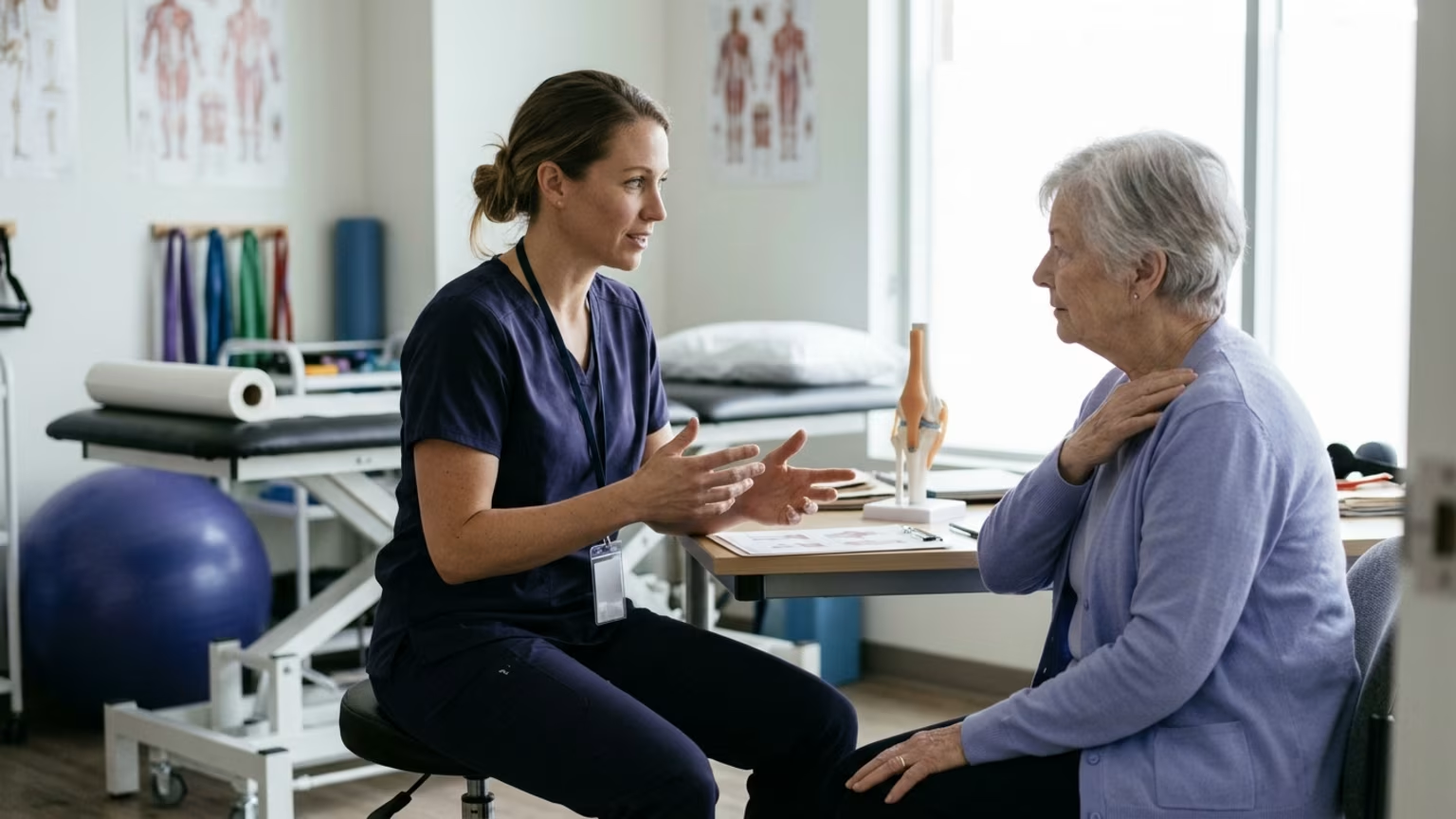
Laidlaw describes a first appointment as generally beginning with a discussion of health history and goals. He then describes assessment of relevant movement and strength along with mobility and function. That sequence connects the person's concerns with what the clinician examines.
The term function is doing practical work here. It connects an examination of movement with daily tasks and desired activities. In Laidlaw's account, a person's goals help identify which parts of movement are relevant to assess.
In practical terms, a goal gives the conversation a direction. Getting down to the floor is a more specific concern than wanting to feel younger. Returning to a recreational activity is a different goal from managing the movements needed at work. Each helps explain what the person wants to regain.
The account also gives readers a useful way to organize questions for a qualified healthcare professional:
These questions draw on the topics Laidlaw describes. They keep the discussion connected to the person's life rather than to a generic idea of good mobility. ReboundBody's guide to describing symptoms during rehabilitation offers a related reading resource.
Laidlaw's activity advice is individualized and consistent. He recommends identifying suitable activities and exercises rather than assuming everyone needs the same routine. When a movement becomes difficult or uncomfortable, he favors assessment to find an appropriate way to keep moving instead of automatically abandoning it.
For someone rebuilding activity after injury or surgery, that framing keeps the previous routine from becoming the only reference point. A clinician can consider the goal alongside current movement and function.
Readers thinking about that transition may also find context in ReboundBody's explanation of assessments used before returning to activity. Its article on connecting persistent stiffness with daily tasks addresses a related mobility question.
The GuelphToday feature reports one practitioner's clinical perspective. It supplies no numerical treatment outcomes or evidence about how common these problems are. It also provides no exercise prescription, loading schedule or return-to-sport timeline. Those gaps prevent treating the feature as a tested recovery program.
The first-appointment description is Laidlaw's account rather than a universal clinic process. His explanation of pain does not diagnose an individual reader. Personal decisions about symptoms and activity therefore belong with a qualified healthcare professional who can assess the situation.
The umbrella review also has important limits. Its authors note overlap between reviews and differences in the people and interventions studied. Review quality varied and credibility assessments were incomplete. Those issues leave uncertainty about how confidently the findings apply across different settings.
The practical takeaway is more specific than a promise that movement will resolve stiffness. Laidlaw's advice offers a reason to bring a functional change into an assessment and a way to discuss meaningful goals. What is causing the change and which approach fits the person remain questions for that assessment.
Return to the chair and staircase from the opening. They are not tests to pass or proof that age explains a problem. They are familiar parts of life that can make a change in movement easier to describe. In Laidlaw's account, that description is a starting point for understanding what deserves attention.
Treating stiffness advice as a ready-made recovery plan can blur the difference between a practitioner's perspective and tested findings. ReboundBody's independent articles help adults sidelined by orthopedic problems understand movement research and unfamiliar clinical terms, so they can bring better-informed questions about recovery to their healthcare team.

Follow ReboundBody for practical articles on injury recovery, rehabilitation, mobility and rebuilding strength. New posts turn research into clear ideas for the road back to activity after injury or surgery.






Read practical guidance on injury recovery, rehabilitation, mobility and rebuilding strength as you work your way back to activity.
Explore Resources