

A trial in younger women found added benefits from CFT plus Pilates for movement fear and selected endurance measures, but not pain or disability.





An October 19, 2026 report in Pain Medicine compared Pilates alone with Pilates combined with cognitive functional therapy (CFT) in women with chronic nonspecific low-back pain. Adding CFT led to better results for fear of movement and two trunk-endurance outcomes. It did not produce statistically different results for pain, disability, or postural sway.
That is a focused finding rather than a broad change in back-pain care. The trial adds a direct comparison between an exercise approach and that same approach paired with CFT. Its main contribution is showing that the added benefit depended on which outcome the researchers measured.
Pilates was already part of the research on exercise for chronic nonspecific low-back pain. A network meta-analysis summarized in PEDro brought together 89 studies involving 5,578 adults with this condition. This type of analysis compares results across studies of different approaches.
The analysis placed Pilates among the exercise approaches with a high probability of ranking well for pain compared with a true control. That provides a reason to consider Pilates within the range of movement-based options. It does not establish that Pilates is superior to every other suitable exercise choice.
The authors rated the overall evidence as low quality. They noted differences among studies and few studies at low risk of bias. Those concerns limit how much weight readers should place on the rankings.
Against that background, the Pain Medicine trial addressed a narrower question: does adding CFT produce better outcomes than Pilates alone? That question matters because evidence supporting an exercise approach does not automatically establish the value of every treatment added to it. The combined approach needs its own comparison.
Pain intensity was the trial's primary outcome. The researchers also examined disability, fear of movement, trunk endurance and postural-control measures. These outcomes describe different parts of the back-pain experience rather than interchangeable versions of the same result.
According to Pain Medicine, the main findings were:
The distinction between the comparisons is important. Improvement compared with a control condition supports a different conclusion from improvement compared with another active treatment. The first asks whether the Pilates-based approaches performed better than control. The second asks whether CFT added something beyond Pilates.
For the second question, the clearest positive findings involved movement fear and selected endurance measures. The study did not establish additional pain relief or disability reduction from adding CFT.
This is why a headline about a better combined treatment would be too broad. In this trial, the fear-of-movement result and the pain result did not follow the same pattern. The outcome needs to stay attached to the claim.
The trial studied younger women with mild to moderate chronic nonspecific low-back pain. That population is central to understanding the findings. It was not a study of all adults with back pain or every stage of physical recovery.
The results should not be directly extended to men, older adults, people with more severe symptoms or people recovering from surgery. The study also was not a test of rehabilitation for a particular orthopedic injury. A reader's own diagnosis and recovery stage therefore matter when discussing its relevance with a clinician.
For ReboundBody's audience in midlife and later life, the useful connection is the research question rather than an assumption of identical benefit. The trial separates pain relief from movement fear and endurance. Those are distinct topics that can be brought into a conversation about returning to everyday activity.
It is also important to keep the intervention specific. This trial examined the Pilates and CFT approaches used by its researchers. It did not compare every Pilates program or every way of delivering CFT.
The practical value is not a ready-made exercise prescription. It is a clearer way to ask what a proposed approach is intended to help. A conversation about resuming activity without rushing can start with the activity that matters to the reader rather than the name of a program.
A reader may be interested in less pain or fewer limits in daily life. Another concern may be fear around movement or difficulty sustaining a task. The trial suggests that these goals should be discussed separately rather than grouped under a general promise of improvement.
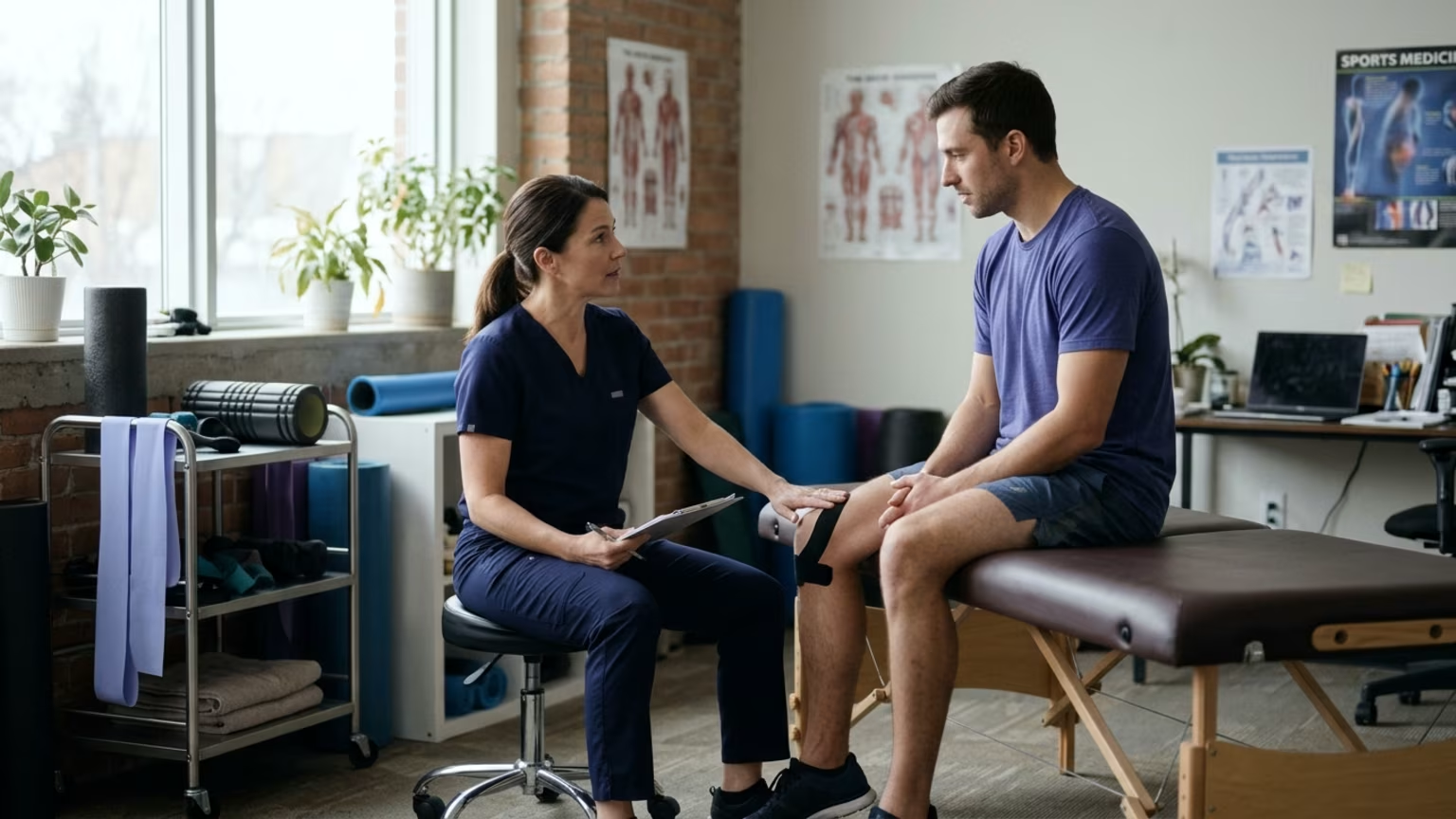
If the reason for considering CFT is additional pain relief, this trial did not establish that advantage over Pilates alone. If movement fear is the concern, the added CFT finding is more directly relevant to the discussion. A qualified clinician can consider how that research question fits the individual's situation.
This does not mean a reader should label their own symptoms or decide that fear is the cause of their pain. It means there is value in naming the concern clearly. That can make a treatment discussion more specific.
The study also offers a useful prompt about goals. A lower pain score and greater confidence with movement are different outcomes. A reader can ask which change a proposed treatment is meant to support and how that change connects with ordinary activities.
That discussion can stay grounded in the person's actual priorities. It might concern returning to a valued activity or understanding the next stage after rehabilitation. The trial supplies a distinction between outcomes, not a personal target for those activities.
For readers finding that uncertainty difficult, related reading on the emotional strain of recovery setbacks provides broader recovery context. It should remain separate from a claim that this particular treatment combination will resolve that uncertainty.
The research supports a conversation about a tolerable, individualized movement plan with qualified care. It does not require replacing an existing approach simply because another method appears in a trial headline.
Questions about balancing activity across the recovery process also remain personal. The useful role of this study is to sharpen the discussion about treatment goals. Decisions about an individual's exercises and progression belong with the professionals who understand their condition.
The accessible Pain Medicine page reports statistical significance but does not provide group means, change scores, confidence intervals or exact effect sizes. That prevents a clear judgment about how large the differences were or how noticeable they were to participants. Statistical significance alone does not answer the practical question of how much someone improved.
The accessible report also does not provide the detailed intervention content, treatment dose, adherence information or longer-term follow-up needed for stronger practical conclusions. Readers therefore cannot use it to identify an ideal home routine or minimum effective schedule. Nor does it establish whether the reported benefits lasted over time.
The next useful evidence would clarify the size of the added benefits and the details of how the treatments were delivered. It would also help connect the measured changes with outcomes that matter in daily life. Until those questions are clearer, the strongest takeaway remains specific: the added CFT findings concerned movement fear and selected endurance outcomes.
Today, write down one question for your next clinical visit: Which recovery goal would adding CFT to a movement plan be intended to address?
Deciding whether to discuss Pilates plus CFT starts with the recovery goal, while ReboundBody supplies research-led context for that decision. Its articles address uncertainty about the move from formal rehabilitation to ordinary activity through clear explanations that help adults understand rebuilding movement and prepare informed conversations with qualified healthcare professionals.

Follow ReboundBody for practical articles on injury recovery, rehabilitation, mobility and rebuilding strength. New posts turn research into clear ideas for the road back to activity after injury or surgery.



Read practical guidance on injury recovery, rehabilitation, mobility and rebuilding strength as you work your way back to activity.
Explore Resources