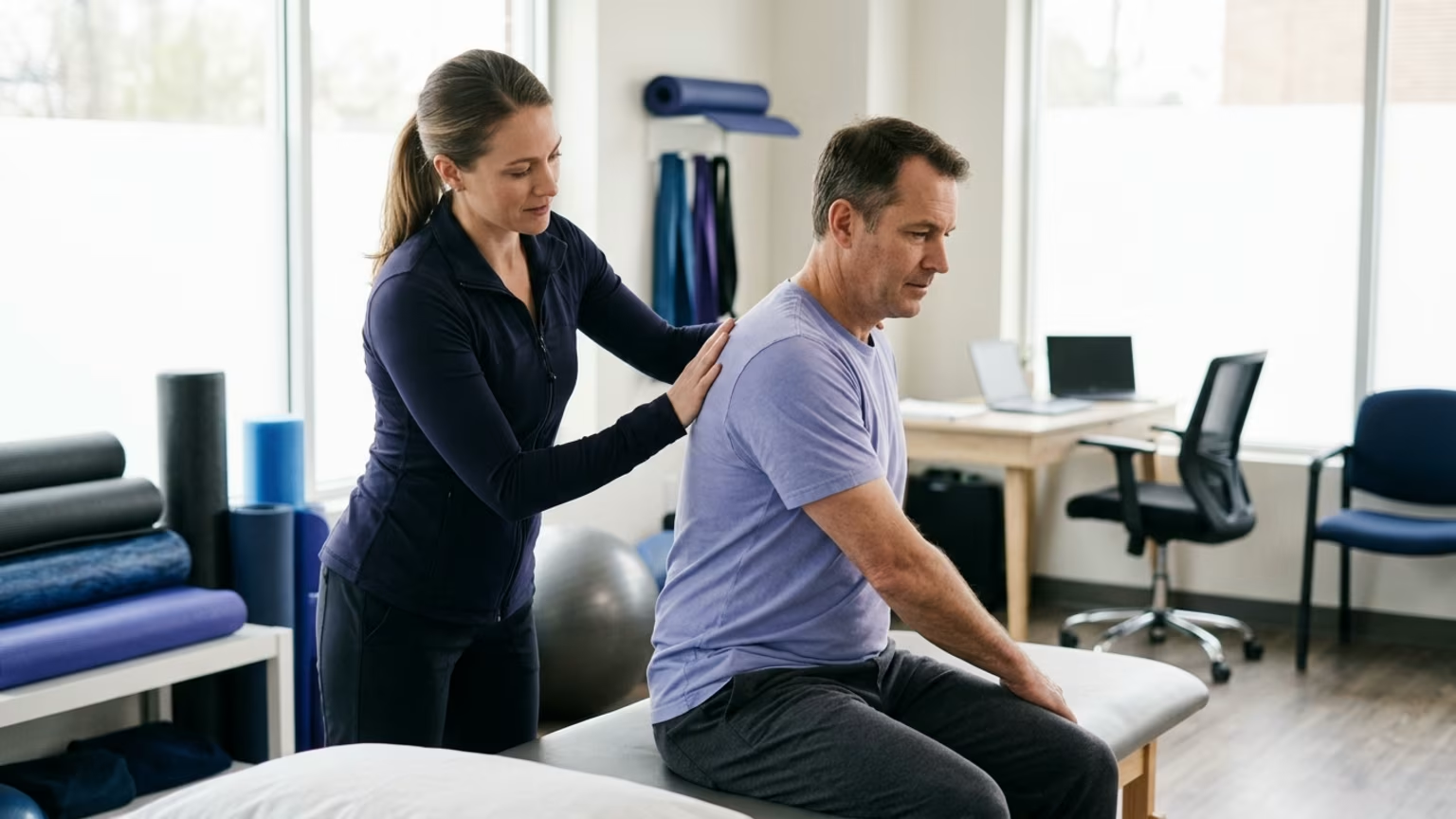

A new therapist-designed routine pairs mobility with strength after sitting. Learn its focus and how to discuss it in an orthopedic recovery context.





On October 10, 2026, The New York Times published a light mobility and strengthening routine designed with physical therapists David Jou and Katie Hillery. It lasts 20 to 25 minutes and focuses on the neck, back and hips. The page was updated October 11.
The routine’s defining feature is its combination of moving through different ranges of motion and engaging muscles. The therapists’ stated goal is to include movements that desk work may leave out. Hillery emphasizes opening the front of the body while working muscles along the back.
For adults navigating orthopedic recovery, the useful question is how that idea relates to everyday movement. A sitting-break routine and an individual rehabilitation plan have different purposes. Understanding that distinction helps put this report in context.
Before the Times story, a Health article dated 2026-10-08 covered physical therapists’ exercise choices for staying mobile with age. That earlier coverage addressed mobility through an active-aging lens. The Times report focuses on a particular daily setting: spending long periods sitting.
The change is an addition to general movement coverage, not an announced revision to a rehabilitation guideline. Its contribution is a therapist-designed option organized around movements that may be absent during desk work. That is different from evidence establishing a new standard of care.
This distinction matters when a practical exercise article reaches someone recovering from an injury or operation. General movement coverage asks what people might include in ordinary life. Rehabilitation discussions ask what fits a person’s current goals and circumstances.
The Times routine belongs in the first category. Readers can consider its theme without treating its publication as a reason to replace the work already planned with their healthcare team.
According to The New York Times, the routine combines mobility and strengthening exercises for the neck, back and hips. The emphasis is not simply on stretching after sitting. It also includes engaging muscles that Hillery identifies as part of the posterior chain.
That term can sound technical. In this report, the examples are the upper back and glutes. Hillery pairs work for those areas with movements that open the chest and hip flexors at the front of the body.
Her recommendation has two connected parts:
These are the routine’s reported design goals. They describe what the therapists want the movements to involve rather than a measured change in a reader’s symptoms.
Jou also emphasizes movement variety in the Times article. His explanation directs attention toward moving beyond a familiar seated position. The practical theme is variety across movements, not finding one exercise that answers every concern about sitting.
The article offers flexibility in how readers encounter that idea. The Times suggests doing the full routine during a break or in the evening. It also says readers can select a few movements to spread through the workday.
Those options are ways of organizing a general routine. The 20 to 25 minutes describes the full version presented by the publication. It is not a recovery milestone that readers need to meet.
The intended audience is people who sit for long periods and want a general movement option afterward. The Times does not define that audience by a particular injury or operation. It presents the routine as light intensity.
A reader in midlife or later life may recognize the everyday setting immediately. Desk work may be part of that person’s day alongside rehabilitation appointments or a return to usual activities. That overlap makes the subject relevant without making the routine specific to their recovery.
Two separate interests can therefore sit side by side. One is adding movement variety after time in a chair. The other is rebuilding the capacity needed for normal activity after a physical setback.
The report addresses the first interest. A treating clinician can help connect that general idea with the second. The distinction keeps a broadly appealing movement feature from becoming an assumed instruction for a particular stage of recovery.
The most useful takeaway is the routine’s theme: movement after desk work can involve both mobility and muscle engagement. For someone already in rehabilitation, that theme provides a focused subject to discuss with their treating clinician. There is no need to turn the article into a separate self-directed program.
Useful discussion questions include:
These questions keep attention on the purpose of movement rather than on copying a published routine. They also leave decisions about individual exercises with the professional who knows the person’s recovery situation. For related context, see ReboundBody’s guide to how therapy goals and progress are reviewed.
The report’s timing options are worth reading in the same way. A full session and a few movements across the day are different formats described by the Times. Readers do not need to interpret either format as a requirement or a test of how well recovery is going.
Likewise, the label “light” is a description of the published routine. It should not settle an individual question about whether particular movements belong in a current rehabilitation plan. That question is better brought to qualified care than answered from the label alone.
For adults approaching the end of formal therapy, the article may also prompt a broader discussion about ordinary activity. What role will general movement have alongside the work already established in rehabilitation? How does a new routine relate to the activities the person wants to return to?
That conversation is larger than one sitting-break feature. ReboundBody’s resource on the transition beyond scheduled therapy addresses this stage of the recovery journey. The useful focus remains understanding how everyday movement fits into the longer plan.
The Times article does not report clinical-trial results or quantified outcomes for this routine. It does not establish that the routine reduces stiffness or pain, or that it lowers injury risk. Therapist involvement explains who designed the routine; it does not by itself demonstrate those outcomes.
The accessible article text also does not expose the individual exercise names or full instructions. Its general design can be described accurately, but a precise exercise sequence cannot be reconstructed from that material. Filling in the missing movements would create a different routine rather than report the published one.
Recovery-specific questions remain separate. The article does not report testing the routine in people recovering from injury or surgery. It also provides no recovery-specific screening or modifications, so adaptation belongs in a discussion with the treating clinician.
The suggested duration leaves another question open. The source describes a light routine lasting 20 to 25 minutes, but it does not establish an optimal frequency. Its options for a full session or selected movements are presentation choices rather than evidence of an ideal schedule.
Jou uses the term “creep” to describe tissues coming to assume a familiar seated position. That is his explanation in the article, not a finding established there through a cited clinical study. It should be understood as attributed commentary rather than proof of a particular mechanism behind a reader’s symptoms.
More informative evidence would identify who was assessed and which outcomes changed. For orthopedic recovery, it would also need to address how the movements relate to specific recovery circumstances. Until then, the practical value is a clearly described movement idea that readers can bring into an informed conversation.
Stay curious about movement, and keep recovery decisions grounded in qualified care.
Comfortable neck, back and hip movement in daily life is a recovery goal that ReboundBody puts in context through evidence-aware information. For adults unsure how formal rehabilitation connects with ordinary activity, the site explains recovery milestones and supports more informed discussions with qualified healthcare professionals.

Follow ReboundBody for practical articles on injury recovery, rehabilitation, mobility and rebuilding strength. New posts turn research into clear ideas for the road back to activity after injury or surgery.




Read practical guidance on injury recovery, rehabilitation, mobility and rebuilding strength as you work your way back to activity.
Explore Resources