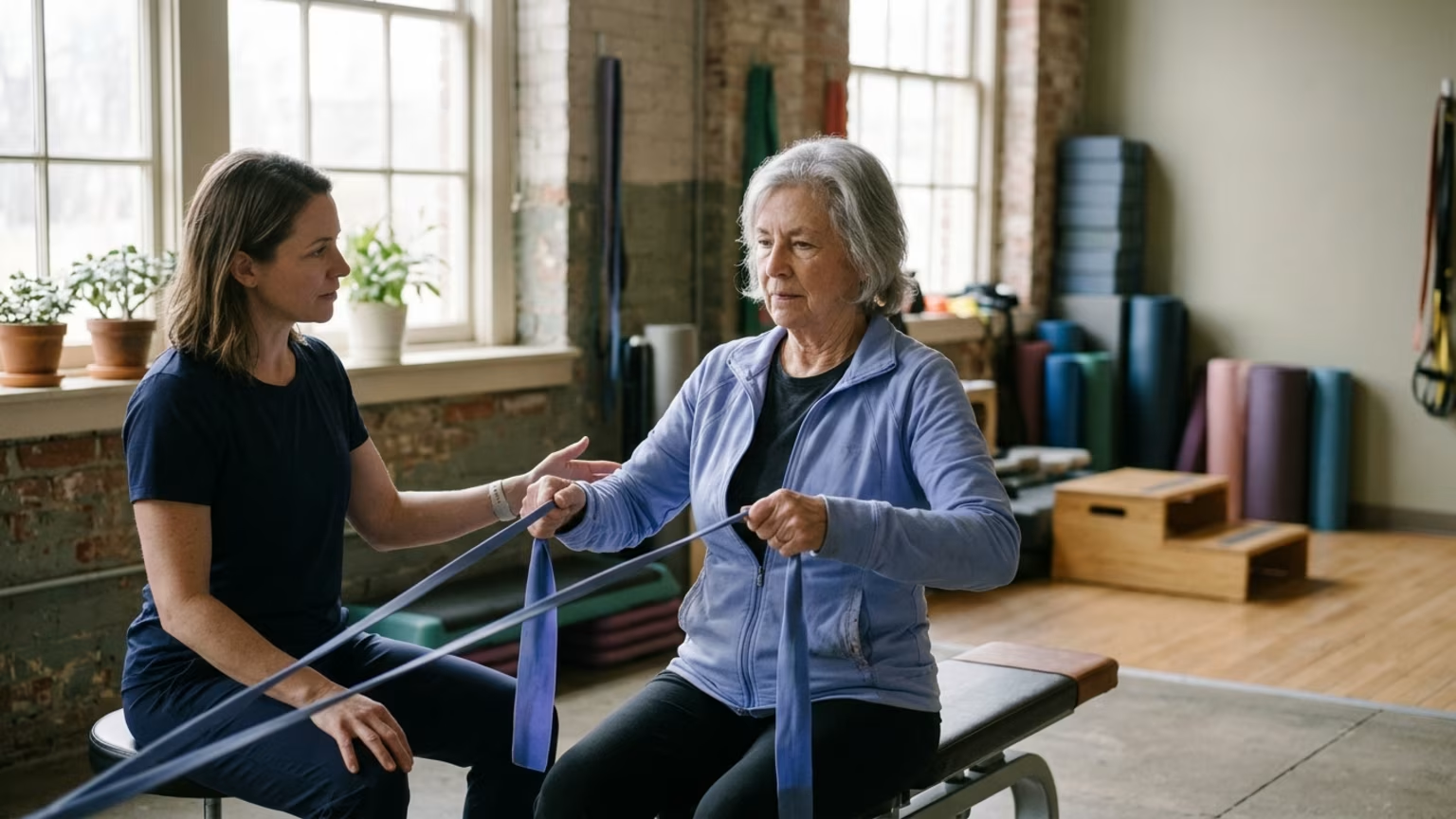

Older-adult studies report strength gains. Put those findings in context when discussing recovery progress after injury or surgery.





Older age does not make strength improvement impossible.
After a physical setback, it is understandable to question how much strength can return.
The belief that lost strength is simply permanent after midlife can make recovery feel like a closed door.
The common belief is straightforward: younger people can build strength, while older people can only try to preserve what remains. After an injury or operation, that idea can turn a difficult recovery into a judgment about age.
It is a concern worth taking seriously, not dismissing with motivational language. The meaningful question is whether older adults can show strength improvements in research, and what those findings mean for someone rebuilding movement after a setback.
The answer needs to leave room for both possibility and individual circumstances. Saying that improvement remains possible is different from saying that everyone will regain the same abilities.
A 2026 network meta-analysis in BMC Geriatrics reported strength improvements in older adults with sarcopenia or frailty after exercise interventions. That finding challenges the blanket claim that later life closes off the ability to get stronger.
The best-supported correction is modest but important: older age is compatible with measurable strength gains. The evidence is not equally certain for every outcome or exercise type.
For an adult returning from injury or surgery, this offers a reason to keep strength rebuilding in the conversation. It is an alternative to writing off progress before the person's situation has been assessed.
The 2026 network meta-analysis in BMC Geriatrics estimated a 1.95 kg mean difference in handgrip strength for elastic-band resistance training. The authors rated this evidence moderate certainty.
For machine-based resistance training, the analysis estimated a 2.96 kg mean difference in knee-extension strength. That evidence was rated low certainty.
These numbers refer to different strength measures. A grip-strength finding and a knee-extension finding are not interchangeable, so putting the figures side by side does not identify a winning exercise type.
The certainty ratings also deserve as much attention as the size of the estimates. The authors expressed more confidence in the handgrip estimate than in the knee-extension estimate.
Evidence certainty describes confidence in a research estimate. It is not a rating of an individual's ability or motivation. That distinction matters when interpreting a study during an already uncertain period of recovery.
The same analysis reported potential functional-mobility benefits from multicomponent training that included resistance exercise. The authors rated that evidence low certainty.
This matters because strength is one part of physical function. A question about getting stronger and a question about moving more easily are related, but they are not identical.
A separate 2026 article in European Geriatric Medicine examined multiple clinical outcomes after 12 weeks of resistance-based exercise training in healthy older adults. Its focus included identifying participants who did not respond across different outcome domains.
These studies mainly concern healthy older adults or people with sarcopenia or frailty. They are not direct studies of recovery after a particular orthopedic injury or operation.
The strength estimates are group-level findings rather than personal targets. The research does not establish a universal recovery timeline or how much strength someone should regain after a specific procedure.
The healthy-adult study's 12-week duration is a research period, not a deadline for recovery. Its reported focus also does not provide a specific numerical gain to expect.
Together, the findings support the possibility of improvement in older age. They do not establish that age never affects recovery or that every person will recover every lost ability.
For daily life, the useful shift is from asking whether someone is too old to improve to asking what progress means in their situation. That is a discussion for the person and the qualified healthcare professionals guiding recovery.
The following questions put the research into context. They are discussion prompts, not an exercise prescription.
A strength score is a measurement. Returning to an everyday task or hobby is a goal that may involve more than that measurement.
A productive conversation can hold both in view. What strength outcome is being assessed? How does it relate to the activity the person wants to resume? What other movement outcomes matter to the treating team?
This keeps the purpose of strengthening visible. The aim is not simply to reproduce a published number, but to understand how measured progress fits the broader recovery goal.
Everyday goals also give the discussion a clear subject. “Getting stronger” may be the broad aim, while returning to a valued activity is the reason that aim matters. Readers can describe those activities and ask how the goals relate to the measures being reviewed.
ReboundBody's overview of how rehabilitation progress is reviewed gives further context for that conversation.
The practical message from this research is that improvement can be gradual and can vary between people. That makes the meaning of a milestone a useful topic at a progress review.
Instead of treating time as a pass-or-fail test, a review can focus on what has changed and what the current findings mean. Useful questions include:
These questions allow a more precise conversation than “Should I be stronger by now?” They also leave room for the treating team to explain the person's own milestones.
A useful progress review also separates description from interpretation. Asking what changed calls for an account of the findings, while asking what that change means invites the treating professional to explain their context. Both questions are more focused than judging the whole recovery from the number of weeks that have passed.
For a broader discussion of the transition between stages, see how exercise progression is considered after a setback.
For a conversation about bands or machines, the starting point is the recovery goal. The treatment plan provides the setting for discussing which kind of strengthening is appropriate.
After surgery, procedure-specific guidance from the treating clinician remains the reference point for personal decisions.
Questions about progressive resistance work can therefore focus on its role in the current plan. What is the strengthening intended to address? How will the team review the response? What guidance applies before the plan changes?
The emphasis stays on the purpose of strengthening and the way progress will be reviewed. ReboundBody's explanation of the stages of postoperative physical therapy adds context for that process.
The healthy-adult study's interest in non-responders is a reminder to be precise about research language. For a reader, the useful question is what was measured and how response was assessed.
A broad label such as “not responding” is less informative than a clear explanation of the findings being reviewed. In a personal recovery discussion, it is reasonable to ask the treating team what a particular result means for the next review.
This approach makes room for realistic expectations without reducing someone to a research category. It also keeps attention on understanding the current stage rather than making a final judgment about future capacity.
The claim that strength improvement becomes impossible after midlife is not supported by the older-adult research described here. Measurable gains have been reported, including in groups with sarcopenia or frailty.
The sound takeaway is neither resignation nor certainty. Strength rebuilding remains a meaningful topic for an individualized recovery discussion, with progress understood through relevant measures and the activities that matter to the person.
Choosing how to interpret a strength milestone brings recovery timelines into focus, and ReboundBody supplies independent editorial context for that decision. Its coverage of rehabilitation and physical recovery helps adults in midlife and later life understand normal variation and prepare informed questions about progress for their healthcare team.

Follow ReboundBody for practical articles on injury recovery, rehabilitation, mobility and rebuilding strength. New posts turn research into clear ideas for the road back to activity after injury or surgery.






Read practical guidance on injury recovery, rehabilitation, mobility and rebuilding strength as you work your way back to activity.
Explore Resources