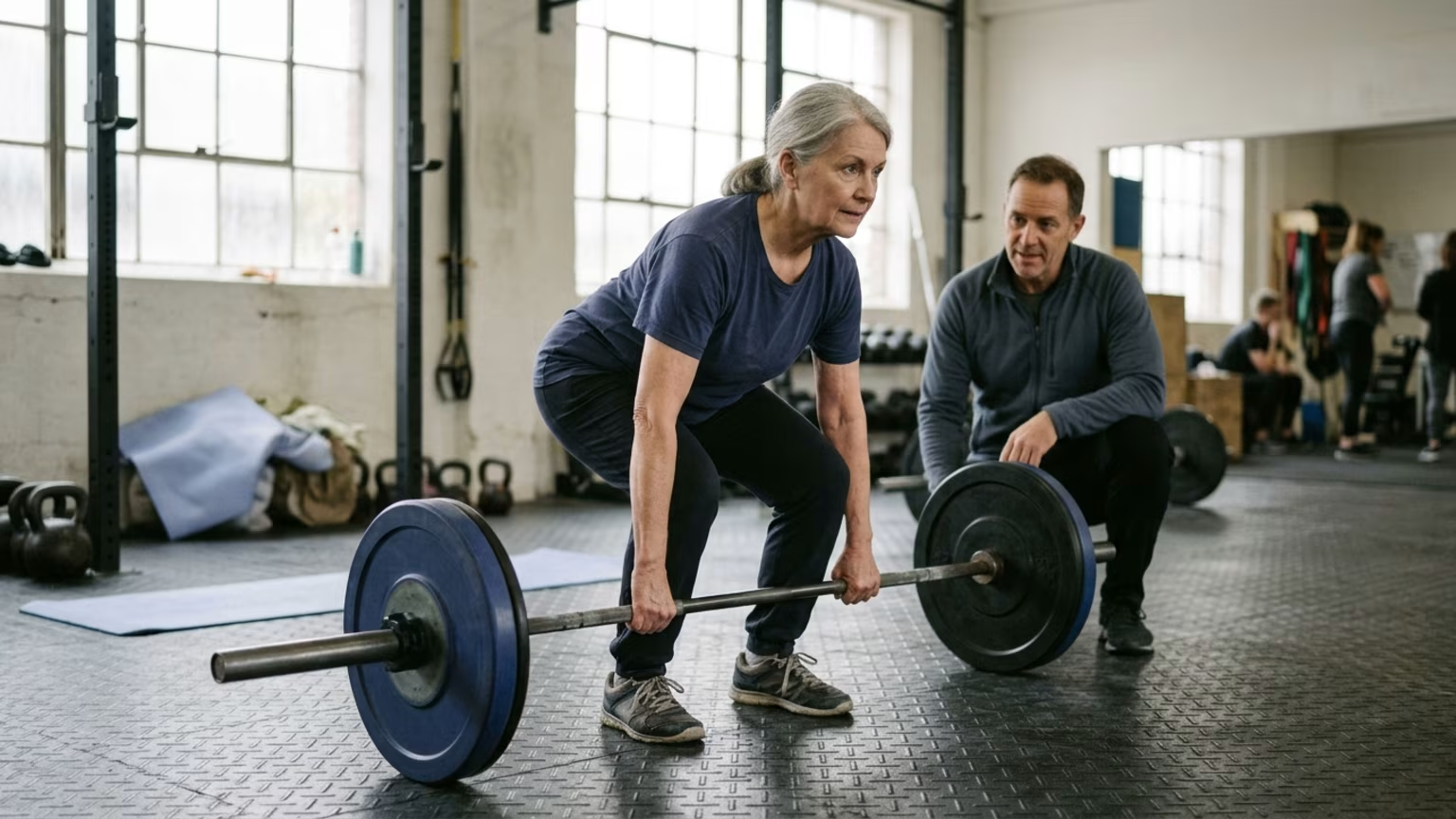

A Singapore report puts older adults' strength training in context, with a focus on everyday goals, gradual challenge and recovery-related limits.





On October 17, 2026, The Straits Times reported that three Singapore fitness businesses were seeing more older clients or a substantial share of new clients aged 50 and older. The report focused on strength training to support mobility, health and independence.
The businesses described different signs of interest:
The practical thread running through the story was everyday function. Getting up from a chair, carrying groceries and climbing stairs featured alongside the goal of travelling more comfortably. The report connected strength training with tasks people wanted to keep doing.
For someone rebuilding after a physical setback, that framing offers a useful way to read the headline. The central question is not simply how much weight an older person lifts. It is how the training relates to the movement they want to regain or maintain.
Strength training was already part of the U.S. physical activity guidance conversation before this newspaper report. In October 2026, the U.S. Department of Health and Human Services said it was seeking public comments on step counts and muscle-strengthening activity.
HHS said the supplementary guidance would build on the existing Physical Activity Guidelines for Americans. The department expected the supplement in 2027. That announcement concerned guidance still being developed, not new recommendations already issued.
There was also a separate evidence context for people with knee osteoarthritis. An American Academy of Family Physicians summary of a Cochrane review reported that exercise improved patient-reported treatment success over two years compared with control or placebo. It rated the evidence as inconsistent or limited-quality.
That review concerned exercise for knee osteoarthritis. It should not be read as evidence that heavy lifting is the preferred approach for every older adult.
These sources serve different purposes. The HHS announcement describes work on public guidance. The AAFP summary describes research on a particular condition. The Singapore report adds accounts of participation and expert views about matching training to ability and everyday goals.
Neville Koh, a senior physiotherapist at Parkway Rehab @ Royal Square, told The Straits Times that progressive overload is key to building strength. He warned that repeating the same weights and routine can bring diminishing returns.
In plain language, progressive loading means adjusting the challenge as ability improves. The idea is not to make every session harder regardless of circumstances. In the report, progression was tied to what a person could manage and how their strength developed.
Khor Seong King, a senior personal trainer at Surge Strength & Results, said age alone should not determine the weight someone uses. He described starting at a safely manageable level and increasing the challenge as strength and confidence improve.
That distinction matters when reading the word “heavy.” A weight mentioned in someone else's story does not explain where another person should begin. Khor's advice focused on the person's current ability rather than an age-based lifting target.
Khor offered a simple example: a trainer working with someone who struggles to rise from a chair might begin with a bodyweight sit-to-stand. Resistance could be introduced later.
The value of that example is the connection between the exercise and the task. Standing from a chair is the goal being addressed. Added weight is a possible way to change the challenge rather than the goal itself.
ReboundBody's explanation of movement skills used in daily life offers related context for thinking about function. It keeps the discussion connected to ordinary activities rather than treating a gym number as the only sign of progress.
The most direct population described in The Straits Times report was older gym clients in Singapore. This was reporting about fitness businesses and individual experiences, not a study with a defined clinical population.
The businesses also used different measures. An increase in an existing age group is different from a count of current clients. Both differ from the share of new clients above a certain age. These local observations do not establish a nationwide participation trend or show what is happening among U.S. adults.
The people featured also had varied health histories. The report described 73-year-old Philip Chia returning to training after a total knee replacement. It also discussed Ai Ling Lo's return after cancer treatment and her use of bodyweight squats rather than barbell squats.
Those details help explain why “older adults” is too broad a label for choosing an exercise approach. The report covered people pursuing similar goals from different circumstances. Returning after surgery is a different context from starting strength training without that recovery history.
For ReboundBody's readers in midlife and later life, the useful connection is the focus on rebuilding practical ability. The Singapore participation figures describe the setting of the story. They do not determine which movements or loads fit a particular recovery.
The report supports a discussion built around function, manageable challenge and modification. It does not require turning a news story into a personal training plan. The practical task is to identify which parts belong in a conversation with a qualified healthcare professional or an appropriately experienced trainer.
The article's examples offer concrete language for discussing goals: standing from a chair, managing stairs or carrying shopping. These are more specific than saying that the goal is simply to “get stronger.”
Useful questions for a recovery conversation include:
These questions keep the discussion grounded in the report's functional approach. They also leave exercise selection and progression with the people who know the individual's health and recovery circumstances.
Koh advised people with chronic conditions to speak with a doctor before strenuous physical activity. He also said an accredited physical therapist may conduct movement screening and recommend exercises or stretches before training.
That advice makes health context part of the decision rather than treating age as the only consideration. For someone recovering from surgery, exercise choices should follow the treating clinician's individualized restrictions.
ReboundBody's guide to making sense of training changes during an uneven recovery provides related reading. It is background for understanding the discussion rather than a replacement for personal care.
The Straits Times report also advised choosing trainers experienced in working with older adults. Its examples included modifying exercises rather than using the same version for everyone.
The fit between a trainer's experience and a person's goals is therefore a reasonable topic to discuss. Someone seeking help with ordinary movement after a setback may have different needs from someone pursuing a particular lift.
For terminology that may come up in those conversations, ReboundBody explains common strength-training variables. Understanding the terms can make a proposed plan easier to discuss without supplying the plan itself.
The report's training advice came from experts interviewed for the story. It was not a trial testing a specific progression plan. It does not establish a schedule for increasing resistance or a universal amount of weight for older adults to lift.
The featured recoveries were individual experiences. They are not estimates of typical strength gains or evidence that another person will recover in the same way. Their role is to illustrate different goals and circumstances rather than provide benchmarks for comparison.
Several practical questions therefore remain personal: how to choose the starting challenge, when to change it and which exercise version fits the current stage of recovery. Those decisions need information about the individual that a newspaper report cannot supply.
There is also an important distinction between participation and results. More older clients at a gym tells us about that business's clientele. Understanding whether training improved daily function would require evidence about those outcomes. The business figures and the personal stories answer different questions.
The report is useful when read at that scale. It brings everyday goals into a discussion often dominated by the amount of weight lifted. It also creates room for questions about progression and modification without settling each person's next step.
Stay informed, with room for recovery to be individual.
Judging when to add resistance during recovery calls for personal clinical input; ReboundBody's role is to clarify the evidence behind that discussion. Its independent articles explain strength rebuilding and return to activity for adults managing injury, surgery or recurring physical problems.

Follow ReboundBody for practical articles on injury recovery, rehabilitation, mobility and rebuilding strength. New posts turn research into clear ideas for the road back to activity after injury or surgery.




Read practical guidance on injury recovery, rehabilitation, mobility and rebuilding strength as you work your way back to activity.
Explore Resources