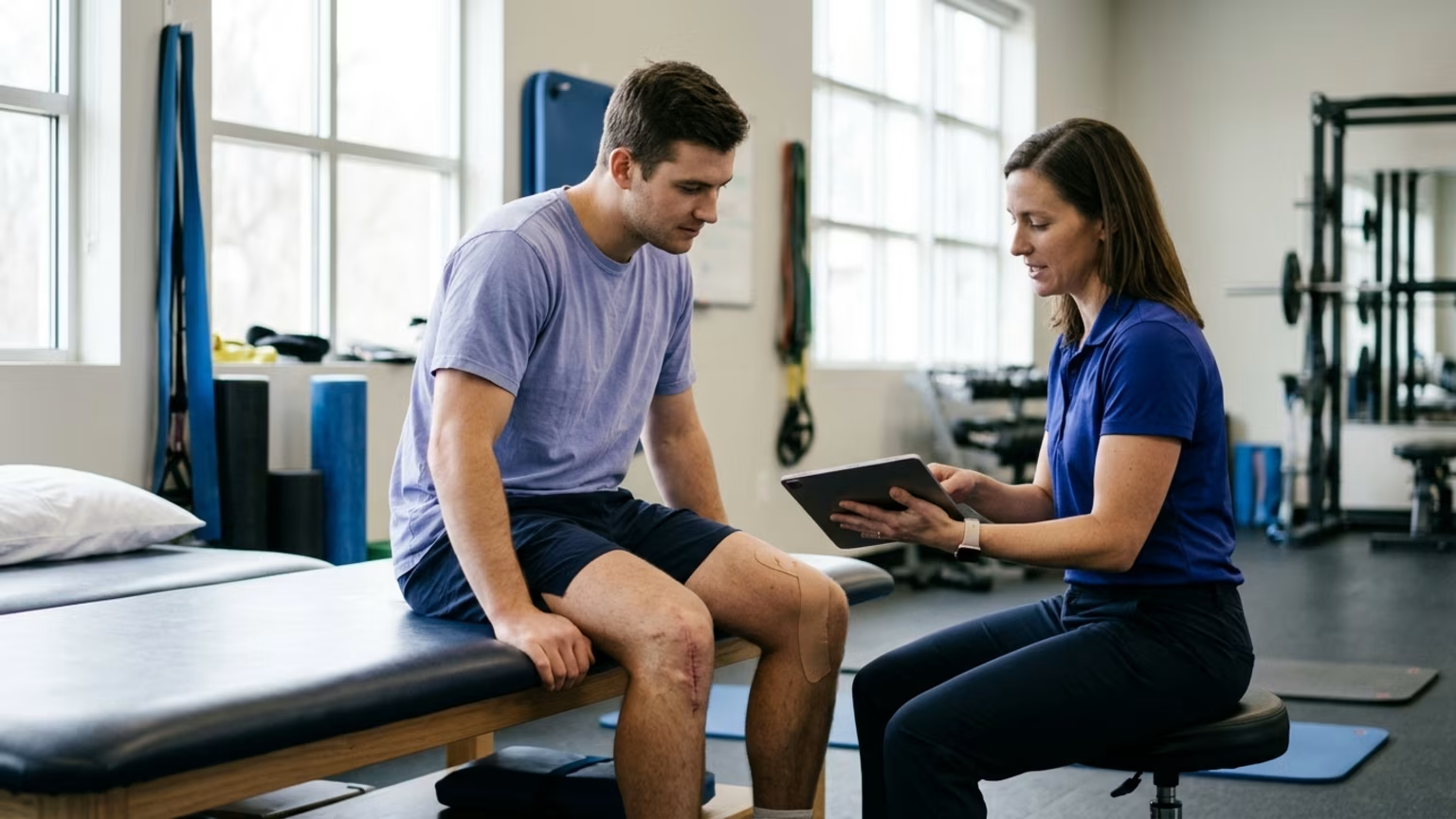

An October 2026 explainer maps staged loading after tendon surgery. Learn how it frames strength checks, activity demands and the limits of its guidance.





On October 26, 2026, Acibadem International published an explainer describing five stages of return to loading after tendon surgery. The article lists Dr. Şule Eren, MD, as its author. It moves from protecting the repair through motion and strength to power and a graded return to sport or work.
The central idea is that clearance involves a sequence of demonstrated abilities rather than a single date or signature. In the article's account, the question changes as recovery progresses: first whether the repair is protected, then whether the person can handle increasingly demanding activity.
For adults trying to understand the path back to recreation or physical work, that framing gives recovery milestones a clearer purpose. It connects each stage with the demands that come next.
The background to this update is the variation in tendon rehabilitation. Acibadem's explainer describes protocols that differ between surgeons and between tendons. It contrasts Achilles repair with rotator cuff repair, which may begin with a sling and passive motion before active lifting.
That context matters when comparing recovery stories. Two people may both have had tendon surgery without having the same early movement limits or later activity demands. The article therefore places the operation itself at the center of planning rather than treating tendon surgery as one uniform recovery process.
It also separates time spent healing from the capacity needed for activity. The article cautions that how a limb feels may improve before its ability to tolerate load has fully returned. This distinction underlies the broader difference between tissue repair and restored movement capacity.
The staged model builds on that context by asking what each part of rehabilitation is meant to establish.
Acibadem International organizes its explanation into five broad stages. The contribution is a way to follow the logic of progression: protection comes first, while later stages address strength and increasingly demanding tasks.
The opening stage centers on protecting the repaired tendon. The article includes a healed incision and a secure repair among its examples of progression gates. These are early repair-related considerations rather than measures of sporting ability.
The distinction helps explain why the first part of recovery has a different purpose from later training. Establishing that the repair is ready for the next stage is a separate question from establishing readiness to run or lift heavily.
The next stage focuses on motion and basic muscle activation. The article describes near-full motion and normal walking among possible signs of progress. These markers concern basic movement before the plan shifts toward greater physical demands.
In this framework, movement recovery is not simply a pause before strengthening. It is a stage with its own purpose and observations. The clinician's attention is on how the person moves as well as what activity they can complete.
The strength stage introduces measured comparisons with the uninjured side. Acibadem describes strength approaching the other side as one example of a progression check.
Its running examples include pain-free ankle motion, walking without a limp and single-leg heel raises approaching the other side in count and height. The comparison considers both how many repetitions are completed and how the movement performs. That makes the question more specific than whether someone can do a heel raise at all.
The next stage addresses power and reactivity before more demanding activity. For jumping, the explainer discusses measured strength comparisons and the limb's response the following morning. It describes delayed stiffness as a possible sign that the previous load exceeded current capacity.
This adds a second perspective to a successful test performance. The article considers not only the task completed during testing but also the response afterward. A single observation is therefore part of a wider picture of load tolerance.
The final stage brings sport or work tasks back through graded exposure. For sport, the article describes movement from bilateral to single-leg hopping and from straight-line running to cutting and direction changes. It also describes progression from non-contact drills to full training.
Importantly, it separates unrestricted training from competition. For manual work, the same task-focused approach involves identifying job demands and gradually reintroducing duties and, where relevant, working hours.
The explainer addresses athletes and manual workers after tendon surgery. It is not a study with an enrolled patient population. Achilles repair features in its running examples, while rotator cuff repair illustrates a different pathway for the upper limb.
Its relevance extends beyond the word “athlete” in the title. Someone returning to a physical job may need to discuss lifting or ladder use rather than running and hopping. The article also identifies kneeling, overhead reaching and walking conditions as job demands worth mapping.
For an adult returning to recreation, the useful connection is similarly task-specific. The activity being resumed gives the rehabilitation discussion a concrete focus. A general label such as “active again” leaves more unanswered than a description of the actual movement involved.
The article's distinction between training and competition also has a work-related parallel. Returning to selected duties is a different milestone from returning to unrestricted duties or a full workload. Those endpoints deserve separate names in a recovery conversation.
The practical use of this framework is to make the next conversation with the treating team more specific. The surgeon or physical therapist sets the medical limits. The explainer supplies a way to organize questions about the abilities being assessed within those limits.
Questions supported by its discussion include:
These questions direct attention toward the reason for a milestone rather than treating it as a box to check. They also create space to clarify unfamiliar language. In this article, “symmetry” refers to comparing performance between sides, while “graded exposure” describes reintroducing demands gradually.
For work planning, a description of actual duties is more useful than relying only on a phrase such as “light duty.” Acibadem emphasizes job-demand assessment, including the tasks and the hours involved. That gives the treating team a more concrete account of what returning to work would require.
The same task-based thinking can help organize discussions about recreation. ReboundBody's guide to starting with the activity someone wants to resume develops that editorial perspective.
The loading framework also provides context for understanding why rehabilitation demand often increases gradually. Here, progression means building toward a defined activity rather than simply doing more because a certain amount of time has passed.
The October explainer does not establish a new professional guideline. Its test examples use language such as “might want to see,” and it does not provide validated thresholds for every tendon or operation. It also does not supply supporting studies for its specific recommendations.
Its phases are a framework rather than a fixed calendar. The article says duration varies with the repair and the individual, while time still matters because tissue healing cannot be accelerated indefinitely. That leaves an important question open: which combination of elapsed time and functional findings best supports each progression decision?
For midlife and older readers, another unanswered question is how those broad examples should be adapted to different patient groups. The article does not establish an age-specific pathway. More detailed evidence would be needed to determine which tests and thresholds best guide different repairs and activity goals.
That brings the October 26 explainer back to its central image: a return built in stages. Its useful contribution is making the purpose of each stage easier to understand. The next question is not simply which activity comes next, but which capacity that stage is meant to demonstrate.
Tendon-loading decisions depend on understanding the terms behind a milestone, and ReboundBody's role is to explain that language through independent recovery writing. For active adults in midlife or later life, its evidence-aware articles place research findings in context so unfamiliar terminology becomes easier to discuss with qualified healthcare professionals, without medical promises.

Follow ReboundBody for practical articles on injury recovery, rehabilitation, mobility and rebuilding strength. New posts turn research into clear ideas for the road back to activity after injury or surgery.






Read practical guidance on injury recovery, rehabilitation, mobility and rebuilding strength as you work your way back to activity.
Explore Resources