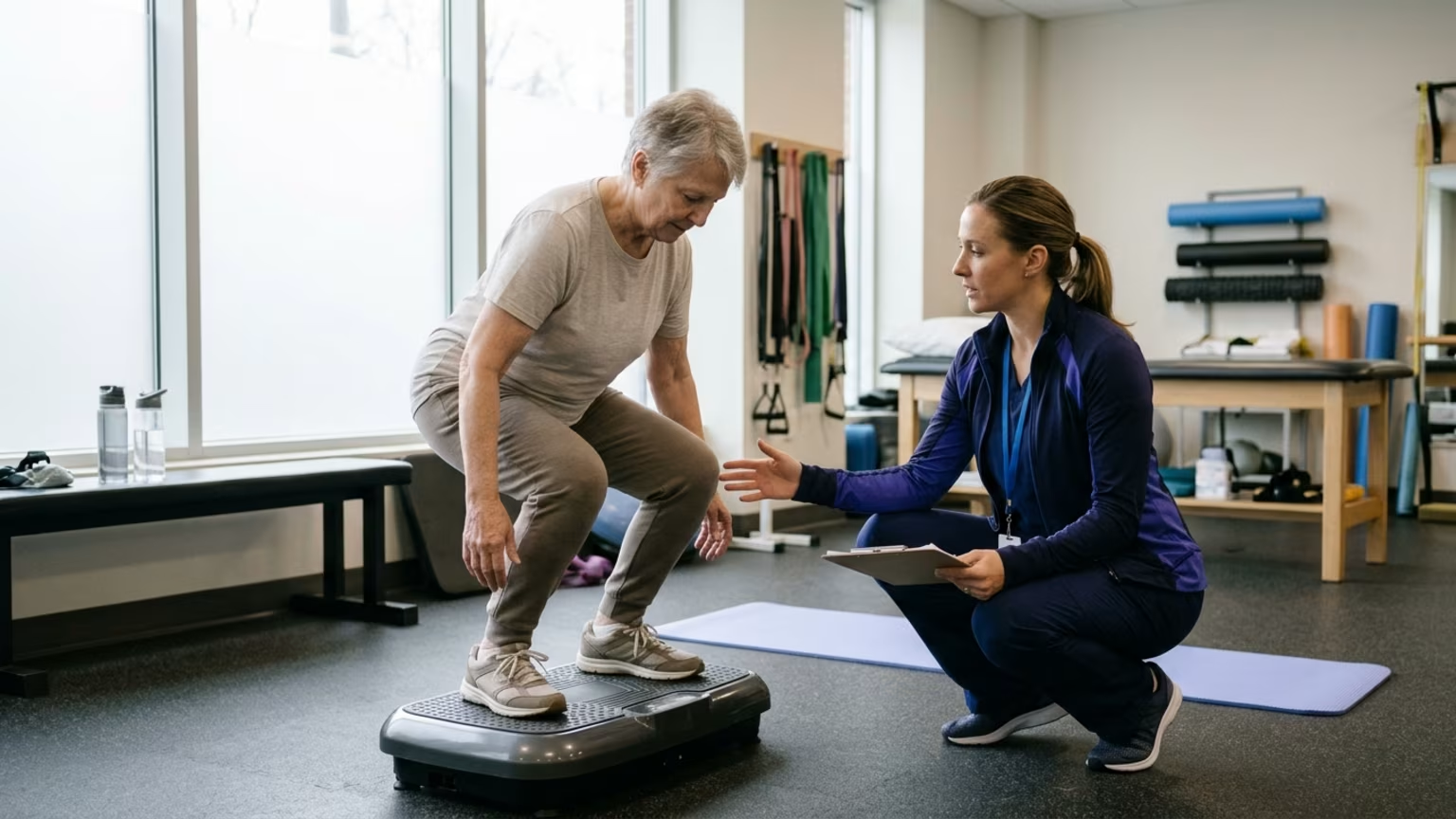

Cleveland Clinic puts vibration-plate strength claims in context, with evidence limits and cautions for adults recovering from injury.





On November 5, 2026, Cleveland Clinic published “Vibration Plates and Their Benefits” with sports medicine specialist Lauren Wichman, MD. The explainer describes platforms that shake rapidly and cause muscles to contract and relax several times a second. It presents vibration as a possible addition to exercise rather than a replacement for conventional strength or cardiovascular training.
For adults rebuilding movement after a physical setback, the distinction matters. A device that creates muscle activity raises a different question from a program intended to rebuild strength. Cleveland Clinic’s article helps separate those ideas while identifying cautions that deserve attention during recovery.
The Cleveland Clinic article follows a similar position described by Harvard Health. In its earlier article, Harvard Health quoted Elizabeth Matzkin, MD. She said a vibration plate might add something to a workout but is “definitely not a substitute” for strength training.
That earlier advice provides useful context for the update. The question was not simply whether a vibrating platform could make muscles respond. It was what place the device should have within an exercise routine.
The difference between an addition and a substitute is practical. An addition sits beside other activity. A substitute takes its place. Those are different claims, even when both are presented as ways to challenge muscles.
Read against that background, Cleveland Clinic’s message is a continuation of cautious expert advice. It gives readers a clearer way to interpret the device without treating its movement as the whole story.
Wichman explains that an unstable, oscillating surface can make an exercise more challenging. Maintaining balance can recruit muscles that might not otherwise be used in the same way.
That explains why a vibration plate can change the experience of an exercise. It does not settle whether the change leads to a lasting strength benefit. Cleveland Clinic says it remains unclear whether vibration plates produce lasting strength effects comparable with traditional strength training.
A contraction describes muscle activity at that moment. A lasting strength gain is a claim about capacity over time. Evidence for the first does not automatically establish the second.
This is the central distinction in the update. Describing how a device works is different from showing what it achieves. A platform can create a challenge without that challenge establishing the same result as conventional training.
For readers interpreting fitness claims, this offers a useful dividing line: the explanation of a mechanism and the evidence for a meaningful outcome belong in separate parts of the conversation. Neither should quietly stand in for the other.
The Cleveland Clinic publication is an expert explainer rather than a new clinical trial or guideline. It does not report results from a single group of people recovering from orthopedic surgery or injury. Some of its general exercise suggestions are directed at people who are generally healthy.
Harvard Health describes possible balance benefits among older adults. That is a population-specific observation about balance, not proof of a benefit after a particular injury or operation. Age alone does not make the finding a rehabilitation recommendation.
Cleveland Clinic also identifies situations in which people should avoid vibration plates or approach them cautiously. These include:
The article warns that vibration may cause dizziness, nausea or vertigo in people with balance problems or neck or back pain. These cautions are especially relevant to an audience managing physical setbacks.
The reviewed material does not provide a recovery-specific protocol or establish when plate use is safe after surgery or injury. Its general exercise examples therefore are not personal clearance to use one during rehabilitation. Decisions about suitability belong with a qualified healthcare professional who understands the person’s condition.
For readers, the immediate implication is about understanding a claim rather than changing an exercise plan. Cleveland Clinic says the U.S. Food and Drug Administration has not approved vibration plates for treating injuries or other conditions. A description of a fitness device should therefore stay separate from a claim that it treats an orthopedic problem.
Several questions can help organize a conversation with a treating clinician. They do not amount to instructions for using a plate.
Muscle activity, balance and lasting strength are different outcomes. A claim about one should not be treated as an answer about all of them.
This distinction fits the broader question of which physical capacities recovery is trying to rebuild. Before judging a device’s value, the intended result needs to be clear. Otherwise, a discussion can shift from muscle contractions to recovery progress without explaining the connection.
If a plate is being considered alongside exercise, its proposed contribution should be specific. Is the discussion about adding a balance challenge or about a claimed strength benefit? Those purposes call for different evidence.
The word “adjunct” can sound technical. Here it simply means an add-on. Calling a device an adjunct does not establish that the extra element is useful for every person or every recovery goal. The purpose still needs to make sense within the wider plan.
The relevant discussion includes the injury or operation and the cautions Cleveland Clinic lists. A general article cannot weigh those details for an individual reader.
That conversation belongs within the broader process of setting rehabilitation goals and reviewing progress. The useful question is not simply whether a plate is available. It is whether its proposed role fits the person’s situation and the goal being discussed.
Together, these questions keep attention on outcomes rather than equipment. They also leave room for a clinician to explain why a device might have a place in one setting but not another. No personal change in treatment follows from the headline alone.
Harvard Health reports that vibration-plate studies have used different frequencies and intensities. Those differences make results difficult to generalize. Cleveland Clinic also says the evidence has not established which settings or duration would deliver the claimed benefits.
This matters when interpreting the phrase “research supports vibration.” The phrase can hide important differences in how vibration was delivered and what researchers measured. Findings from different approaches should not be treated as evidence for one standard method.
Harvard Health also describes the evidence about muscle and bone benefits as uncertain. A report about one outcome should not become a blanket endorsement across strength, balance and bone health. Each claim needs evidence that matches it.
A useful next step for research would be clearer links between a defined approach and a specific outcome in a relevant population. For rehabilitation readers, that means evidence tied to the recovery setting rather than relying only on general exercise findings. This is an evidence need, not a suggested protocol.
The current update is most useful as a way to keep claims in proportion. It distinguishes what the platform does from what readers may hope it will achieve. The platform’s movement is easy to notice. Its place in a recovery story is a more careful question.
Visible muscle activity on a vibration plate can be mistaken for proof of recovery progress, the kind of evidence gap ReboundBody keeps in view. ReboundBody publishes independent explanations of rehabilitation and strength rebuilding for adults facing physical setbacks. Its coverage distinguishes supported findings from uncertain claims to give readers clearer context for conversations with a treating clinician.

Follow ReboundBody for practical articles on injury recovery, rehabilitation, mobility and rebuilding strength. New posts turn research into clear ideas for the road back to activity after injury or surgery.






Read practical guidance on injury recovery, rehabilitation, mobility and rebuilding strength as you work your way back to activity.
Explore Resources