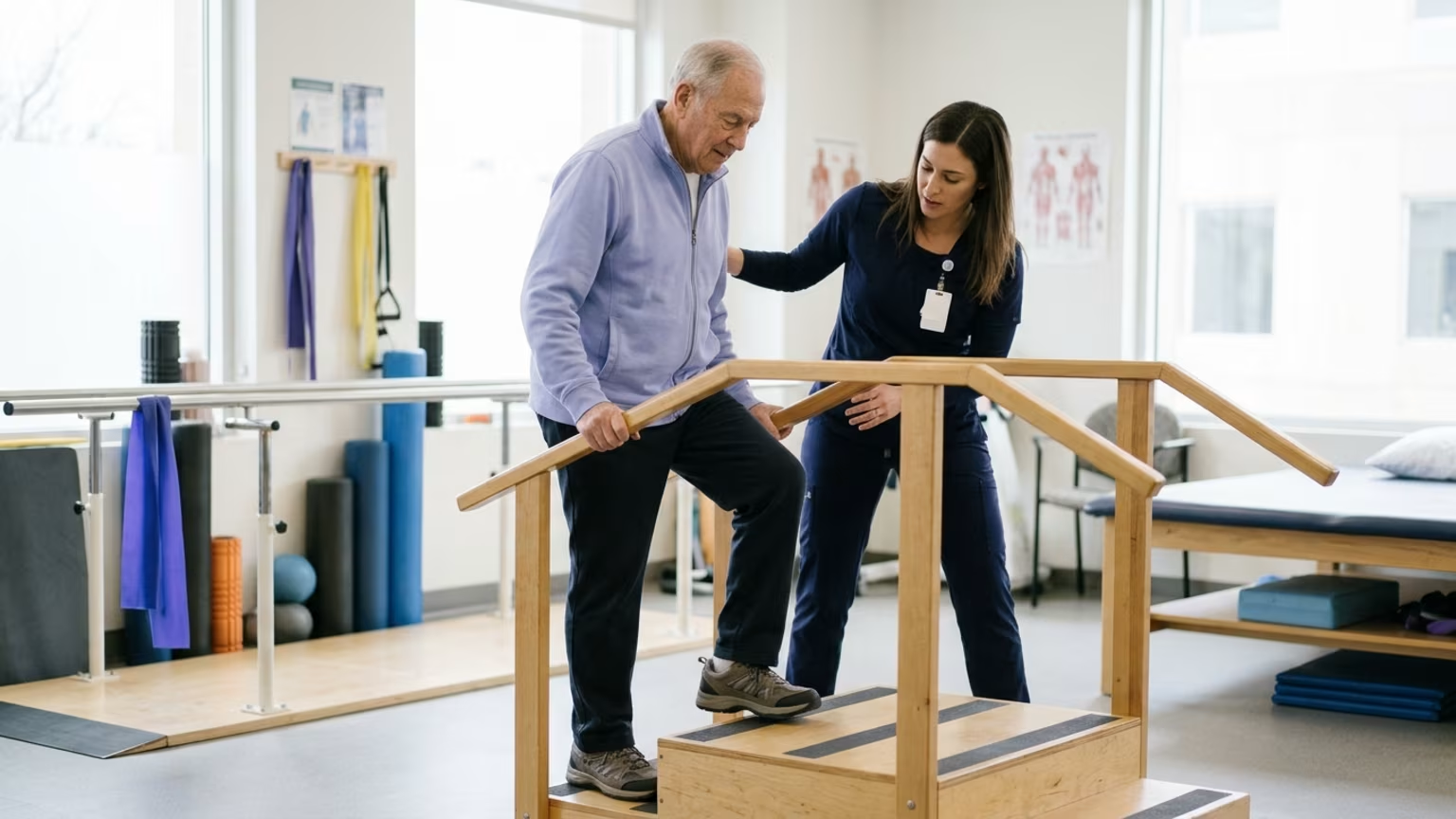

Understand how physical therapy may address mobility, strength, balance and everyday tasks, and why the focus differs across recovery plans.





A 2026 review of knee osteoarthritis management describes rehabilitation options that include strengthening and aerobic activity alongside work on joint motion. Physical therapy may build toward everyday function through mobility, strength and balance while also addressing activity tolerance and practical tasks. The emphasis depends on the condition and the person rather than a universal sequence of phases.
That distinction helps explain the purpose of rehabilitation. The goal may involve more comfortable movement today while also preparing for the demands of walking, stairs or recreation. Understanding what each part is meant to build gives the work a clearer connection to daily life.
The focus varies because people begin rehabilitation with different conditions, abilities and goals. Even when two people share a diagnosis, their treatment priorities need not match.
The knee osteoarthritis review describes exercise choices as adjustable. Its authors identify disease severity and starting function as relevant factors. Symptoms, other health conditions and personal goals also shape those choices.
Postoperative care brings additional considerations. A clinic description of postoperative rehabilitation includes mobility and strengthening alongside balance, walking and functional activities. It describes timing as dependent on the surgery, medical instructions and healing, as well as the person's response.
These factors help explain why a plan may emphasize different aims:
The evidence has an important boundary. The review concerns knee osteoarthritis rather than every orthopedic injury or surgery. The clinic examples describe practice rather than proving that a particular sequence works best. Together, they support discussing possible rehabilitation aims but do not establish a universal schedule or return-to-activity date.
The useful question is therefore not simply, “Which phase am I in?” It is, “What is this part of therapy intended to help me do?”
Mobility may be an early focus when restoring appropriate movement is part of the recovery plan. In protected rehabilitation, that work also needs to respect healing and medical restrictions.
The postoperative clinic description identifies mobility as one possible component of care. The knee osteoarthritis review also includes flexibility and range-of-motion work among its exercise options. These sources place movement work within a broader rehabilitation plan rather than treating it as the whole plan.
Range of motion concerns how far a joint moves. Everyday function asks a broader question about what a person can do with movement. ReboundBody's guide to understanding joint motion in daily life provides more context for that distinction.
A movement goal and a functional goal can be related without being identical. For example, a discussion about joint motion is different from a discussion about managing stairs. Both may belong in rehabilitation, but they describe different parts of the recovery picture.
This is why “more movement” is not always a complete description of the goal. A clearer explanation names both the movement being addressed and the activity it relates to. That gives the patient a reason for the work without turning a measurement into a personal prediction.
For someone unsure about an early emphasis on mobility, a useful discussion is how that work connects to their priorities. The clinician can explain the purpose of the current focus and how medical instructions affect it. That conversation is more specific than comparing progress with a generic phase chart.
Strength matters when rebuilding capacity for movement and daily tasks is part of the person's rehabilitation goals. It need not be treated as a separate stage that starts only after all mobility work has ended.
The knee osteoarthritis review includes progressive strengthening among the available exercise approaches. It also describes balance training and work on movement control. These are possible components selected for the person's needs rather than a single package that everyone must complete.
In this context, strengthening is about rebuilding capacity for movement and practical activity. The word “progressive” describes an approach in which the work changes over time. It does not give the reader a personal rule for increasing exercise.
The connection to daily life deserves a clear explanation. Is the current work related to walking, getting between positions or another activity? Naming the intended purpose makes a broad label such as “strengthening” easier to understand.
ReboundBody's discussion of connecting strength with daily demands offers further context for this distinction. A capacity being trained and an activity someone hopes to resume are related topics, but they are not interchangeable labels.
Balance and movement control are additional aims described in the research. The knee osteoarthritis review includes balance training and gait retraining as options for addressing mobility and control. Gait retraining refers to work on walking.
This helps explain why a rehabilitation plan may contain more than movement and resistance work. A session may also address how a person manages a movement or task. The relevant question is what that component contributes to the person's goals, not whether it appears in the same place in someone else's program.
Physical therapy may address function by working on relevant tasks and the capacities those tasks involve. The tasks depend on what the person needs or wants to do within the medical boundaries of recovery.
A clinic account of orthopedic rehabilitation gives walking and stairs as examples. It also mentions lifting, work tasks and recreation. These examples show how broad rehabilitation goals can become specific to everyday life.
“Improve function” is a broad phrase. “Work toward managing stairs” identifies a particular activity. “Return to recreation” names a different priority that needs its own discussion with the treating team.
Activity tolerance adds another question: how much of a meaningful activity can the person manage? It shifts the discussion from an individual movement toward participation in an activity.
The knee osteoarthritis review includes aerobic activity among its exercise options. That places endurance-related work alongside strength and mobility in the range of possible rehabilitation approaches.
For a reader, the practical distinction is between discussing movement itself and discussing tolerance for activity. A walking goal may concern the walking task, the amount of walking or both. Making that distinction explicit helps the care team and patient discuss the same priority.
The postoperative clinic description includes transfers, walking and stair practice among possible rehabilitation activities. Transfers are movements between positions or surfaces. Those examples connect rehabilitation with ordinary actions rather than only exercise categories.
Task-specific work gives a functional goal a concrete meaning. It identifies the activity being addressed instead of relying on a general phrase such as “getting stronger.” ReboundBody's guide to daily tasks in rehabilitation discusses this everyday focus.
A task goal is also a useful starting point for questions. Someone whose priority is walking may want to understand how the current mobility or strength work relates to that goal. Someone focused on work or recreation may need a different explanation of the intended connection.
The point is not to rank those goals. It is to make the plan's purpose understandable to the person doing the rehabilitation.
A conversation with the treating clinician can connect broad rehabilitation terms with the person's current plan. It can also clarify which goals are being addressed now and which remain part of the longer discussion.
Useful questions include:
These questions ask for an explanation rather than a self-directed exercise progression. They leave treatment choices and activity decisions with the qualified care team.
It is also reasonable to ask for plain language. A term such as “functional training” becomes more useful when the clinician names the activity it concerns. The same applies to a broad goal such as improving mobility or rebuilding strength.
Physical therapy may address movement, strength and balance while also considering activity tolerance and meaningful tasks. These are connected aims rather than boxes that must be checked in order.
For patients, understanding the purpose of the current work is a useful way to make sense of the plan. A clear explanation links what happens in therapy with what matters outside it.
The review's inclusion of aerobic activity and strengthening alongside joint motion brings the opening point into focus. Restoring movement is part of the picture. Everyday function gives that movement a purpose.
Physical therapy priorities are a matter for the patient and treating clinician; ReboundBody adds independent editorial context to help readers understand the concepts being discussed. For adults facing conflicting exercise and treatment claims after an orthopedic setback, its evidence-aware writing explains recovery with realistic limits so they can bring more focused questions to their care team.

Follow ReboundBody for practical articles on injury recovery, rehabilitation, mobility and rebuilding strength. New posts turn research into clear ideas for the road back to activity after injury or surgery.






Read practical guidance on injury recovery, rehabilitation, mobility and rebuilding strength as you work your way back to activity.
Explore Resources