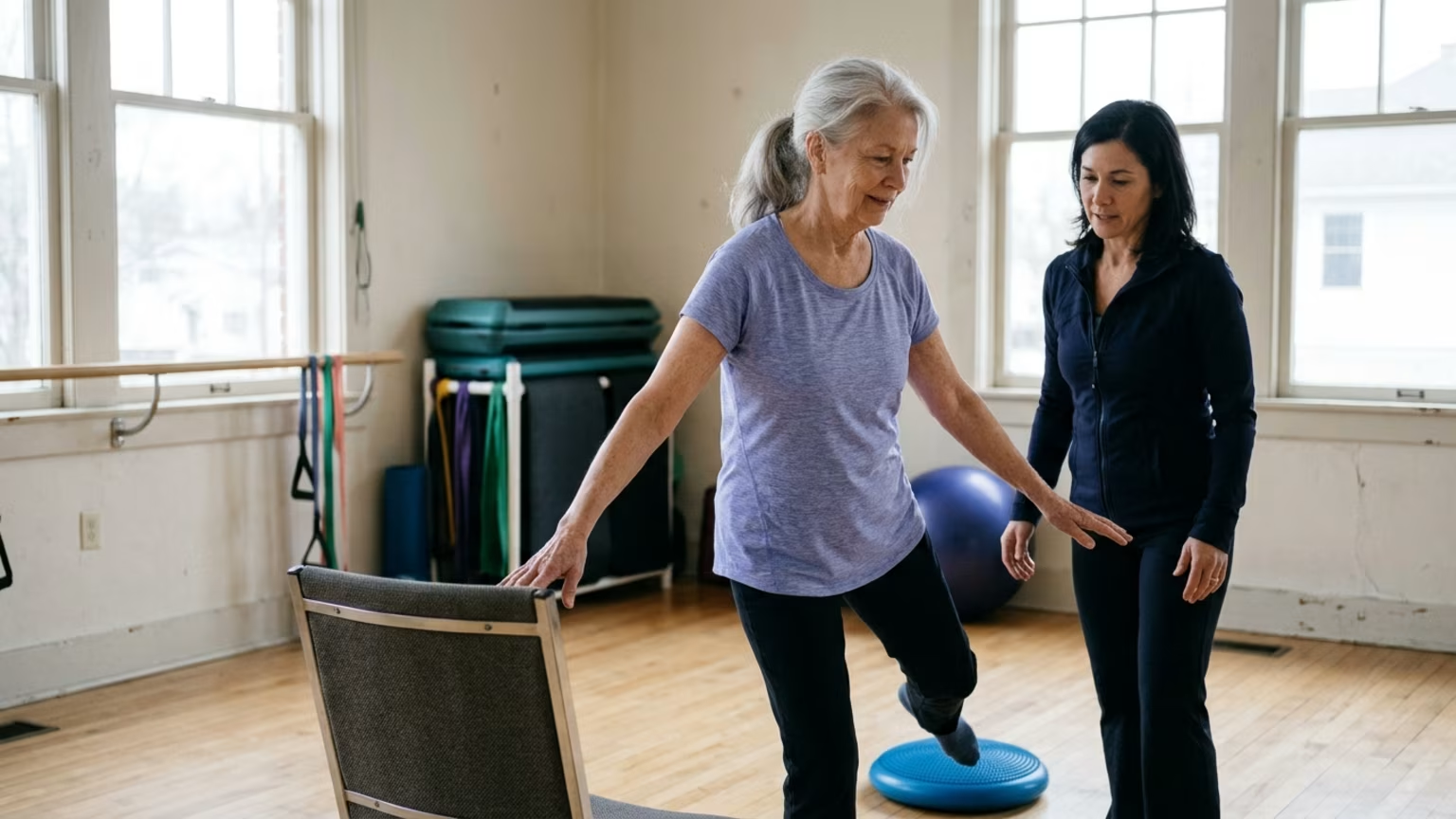

A review found gains on selected balance tests in older adults with chronic conditions. Understand the practical meaning and the questions still open.





On 2026-11-07, Yahoo Health reported on a review that found improvements in selected balance and mobility tests among community-dwelling adults aged 60 and older with chronic conditions. Its coverage interpreted the findings as support for considering balance-specific practice alongside general exercise.
The review dated 2026-10-20 brings a focused question into the healthy-aging discussion: should balance have its own place within an activity plan? The findings give that question more weight. The useful development is evidence about measured outcomes, rather than a new set of exercise instructions.
For adults trying to understand movement research, the important distinction is between the activity being studied and the benefit being claimed. This review offers a reason to keep those two things closely connected.
The evidence behind this update came from exercise studies that assessed balance, mobility and physical performance. The review brought those findings together. That is different from replacing an older clinical guideline with a new recommendation.
Yahoo Health’s account starts with general physical activity as the broader context. It presents balance-specific practice as something to consider alongside that activity. The question is not whether general exercise has a place, but whether balance deserves attention as a distinct goal rather than being assumed to follow automatically from strength work.
That distinction matters when reading exercise advice. A statement about an overall activity plan is not the same as evidence about a particular outcome. The clearest interpretation keeps the goal visible instead of treating all forms of exercise as interchangeable.
For related background, the distinction between day-to-day movement and planned exercise offers another way to think about different roles within an activity plan. Here, the focus is narrower: what the review measured about balance and mobility.
The review reported improvements in selected balance and mobility measures. The studies used tests such as Timed Up and Go and One-Leg Stance, along with other measures of balance and physical performance. These test results are the concrete basis for the update.
That focus is useful because “better movement” can mean many things in an exercise headline. Naming the measures keeps the claim specific. The review adds evidence about performance on those measures rather than establishing that every aspect of healthy aging changed.
The review also examined subgroups involving different exercise approaches. Those results may help shape future research questions. However, the formal comparison between exercise modalities was not statistically significant, so the subgroup findings do not establish that balance-only programs are superior to other exercise.
The practical reading is therefore not a ranking of exercise types. It is a reason to make the intended goal explicit when discussing activity. Yahoo Health’s interpretation is that balance-specific practice merits consideration alongside general exercise, not that strength training should be discarded.
This distinction separates a useful addition to a conversation from a blanket recommendation. “Give balance a place in the discussion” is a narrower conclusion than “replace the current routine with dedicated balance training.” The former fits the coverage; the latter goes beyond it.
The review concerned community-dwelling adults aged 60 and older who had chronic conditions. Musculoskeletal problems were included within that population. This gives the findings a connection to the concerns of some older adults managing ongoing physical difficulties.
The population is important because ReboundBody’s readers include people at different points in recovery. Some are managing recurring problems. Others are rebuilding activity after an injury or operation. Those situations should not be treated as if they were all directly studied here.
This was not a review specifically of people recovering from recent surgery or acute injury. Its applicability to younger adults or a particular post-operative rehabilitation protocol is not established. The presence of musculoskeletal conditions in the review does not turn it into evidence for every orthopedic recovery plan.
For readers outside the studied group, the findings are best used as context for understanding the research. Decisions about personal rehabilitation still belong in a discussion with a qualified healthcare professional who knows the individual situation.
The most useful practical implication is about purpose, not about copying a program. Yahoo Health’s coverage supports considering balance as a distinct part of an overall activity plan. It does not provide a standard routine that every reader should add.
A conversation about the findings can stay clear by separating several questions:
These are questions for understanding an activity plan, not a self-directed prescription. The review does not supply an individualized exercise selection or a progression for a reader’s particular condition. It also does not create a reason to replace an established plan without qualified input.
ReboundBody’s background on balance practice and progression provides related context for the topic. The role of this update is more specific: to explain why balance deserves a clear place in the conversation about goals and evidence.
For someone facing several competing exercise claims, that distinction can make the discussion more manageable. Start with the outcome being discussed. Then consider how closely the research population and the measured result match the question at hand.
One important uncertainty concerns the size and meaning of the measured changes. The review’s authors described the Timed Up and Go result as statistically significant but relatively small. They said its clinical importance was uncertain, while Yahoo Health also cautioned that better test results do not necessarily translate into noticeable changes in everyday life.
The distinction between statistical significance and clinical importance is central to reading this result. The authors reported both, rather than treating a statistically significant finding as the end of the discussion. The appropriate practical response is to ask what the measured change means in the context of a person’s goals, not to assume that the test result settles that question.
Falls are another separate outcome. According to Yahoo Health, the review could not establish whether exercise reduced falls or fear of falling because the underlying studies measured those outcomes too differently to combine. The balance-test findings therefore should not be presented as evidence that this review demonstrated fewer falls.
The broader relationship between balance practice and fall-prevention planning deserves its own attention. Keeping that question separate helps prevent a result about one outcome from quietly becoming a claim about another.
Further research can help clarify which approaches suit particular groups and how measured gains relate to outcomes people value. For now, the clearest reading is to keep the study population, the test result and the practical question together. That gives the findings a useful place without asking them to answer more than they measured.
A small change on a test is still worth understanding. Its place in a person’s life becomes clearer when the measure and its meaning remain in view.
Deciding whether a reported balance gain belongs in a recovery conversation is where ReboundBody’s editorial role begins. For adults navigating orthopedic setbacks in midlife or later life, its articles explain research terms and evidence limits to help readers understand recovery findings and prepare informed questions for their healthcare team.

Follow ReboundBody for practical articles on injury recovery, rehabilitation, mobility and rebuilding strength. New posts turn research into clear ideas for the road back to activity after injury or surgery.






Read practical guidance on injury recovery, rehabilitation, mobility and rebuilding strength as you work your way back to activity.
Explore Resources